

The Fed: Not So Great Expectations
Published February 2, 2016

Head of Investment and Fixed Income Strategy
The first Federal Reserve (Fed) meeting for 2016 is now history, and to no one’s surprise the policy makers did not announce a further rate hike following their quarter-point increase in the Federal Funds Rate in December. The financial markets were scrutinizing the accompanying policy statement for any hints of what future action the voting members might be considering. On that front, the Fed did not tip its hand. Rather, the policy makers seemed to acknowledge recent events, such as “economic growth slowed late last year” and “inflation is expected to remain low in the near term,” while highlighting a continued reduction of slack in the labor market. Perhaps more importantly, investors were anxious to see if the Fed would make any mention of recent events from a global growth and equity market perspective. On that front the policy statement stopped somewhat short of the concern voiced at the September 2015 gathering, but it still stated that the “Committee is closely monitoring global economic and financial developments” and its implications for “the balance of risks to the outlook.”1 How did the fixed income markets perceive the Fed’s language? One of the more interesting gauges to observe lies in the Fed Funds Futures arena. While these instruments do not necessarily have the greatest track record in accurately predicting actual Fed rate moves, they nonetheless offer a good sense of market sentiment. In addition, they can be rather volatile. In order to gauge market sentiment for this year, we looked at the December 2016 contract. There has clearly not only been the aforementioned volatility over the past 12 months, but a shift in expectations for Fed rate hikes since ‘liftoff’ occurred in mid-December. It is readily apparent that the developments the FOMC referred to in its policy statement have also weighed on expectations of where the Federal Funds Rate will finish 2016. This contract also reveals that investors never seem to have bought into the conventional wisdom of four additional rate hikes. However, sentiment did seem to be leaning toward a future 1% threshold. As of this writing, the pricing mechanism is geared more toward only one additional rate hike this calendar year, or a mid-point of roughly 60 basis points (bps) in the ½- to ¾-percent band. Dec 16 Fed Fund Futures
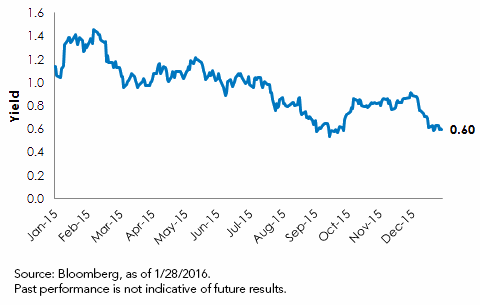
Needless to say, even with the Fed’s recent policy statement in mind, there still seems to be a disconnect between what the market is expecting and what the policy makers are anticipating as the end result. In our estimation, the landscape for U.S. Treasury yields remains one of more range-bound activity and without any significant surge to groundbreaking levels. In fact, with the Bank of Japan’s recent easing move, investors are now presented with two of the world’s largest central banks (including the European Central Bank) having policy rates in the negative territory, a landscape that should continue to support our base case for U.S. rates. As we have witnessed over the last few years, in such an environment fixed income investors can tend to reach for yield by moving too far out on either the maturity or down the credit curve. WisdomTree feels fixed income investors should consider other ways to enhance their yield. One alternate approach to achieve this goal could be the WisdomTree Barclays U.S. Aggregate Bond Enhanced Yield Fund (AGGY), an exchange-traded fund (ETF) that tracks the Barclays U.S. Aggregate Enhanced Yield Index. This strategy looks to enhance yields relative to the Barclays U.S. Aggregate Index by re-weighting its components to enhance income while broadly retaining its risk characteristics. When utilizing this approach, investors have the potential to stay within a core fixed income strategy and avoid the possible negative effects of “reaching for yield.” 1Press Release of the Board of Governors of the Federal Reserve System, 1/27/16.
Important Risks Related to this Article
There are risks associated with investing, including possible loss of principal. Fixed income investments are subject to interest rate risk; their value will normally decline as interest rates rise. Fixed income investments are also subject to credit risk, the risk that the issuer of a bond will fail to pay interest and principal in a timely manner, or that negative perceptions of the issuer’s ability to make such payments will cause the price of that bond to decline. Investing in mortgage- and asset-backed securities involves interest rate, credit, valuation, extension and liquidity risks and the risk that payments on the underlying assets are delayed, prepaid, subordinated or defaulted on. Due to the investment strategy of the Fund, it may make higher capital gain distributions than other ETFs. Please read the Fund’s prospectus for specific details regarding the Fund’s risk profile.
About the contributor

Head of Investment and Fixed Income Strategy
Kevin serves as the Head of Investment and Fixed Income Strategy. In this role, he writes macro and fixed income-related content and works closely with the sales, research and marketing teams. In addition, Kevin conducts client-facing webinars and meetings, providing expertise on WisdomTree’s existing and future bond ETFs. Prior to joining WisdomTree, Kevin spent 30 years at Morgan Stanley, where he was Managing Director and Chief Fixed Income Strategist for Wealth Management. He was responsible for tactical and strategic recommendations and created asset allocation models for fixed income securities. He was a contributor to the Morgan Stanley Wealth Management Global Investment Committee, primary author of Morgan Stanley Wealth Management’s monthly and weekly fixed income publications, and collaborated with the firm’s Research and Consulting Group Divisions to build ETF and fund manager asset allocation models. Kevin has an MBA from Pace University’s Lubin Graduate School of Business, and a B.S. in Finance from Fairfield University.