

The Expensive Active Managers’ Dilemma: Hurdling in the Sand
Published August 14, 2018

Head of Equity Strategy
It’s not easy managing a big-fee mutual fund. Last August, in Active Share: Measuring Stock Picking among Your Strategies, we discussed the interrelationship between the uniqueness of a fund’s holdings and its expense ratio. Unlike “closet indexers,” who hug their benchmarks while claiming to implement great investment ideas, truly active managers1have the courage of their convictions. They have high active share, which measures the proportion of the fund that is different from what is in the benchmark.
Many fund managers, having witnessed years of flows into passive, cap-weighted indexes, realize that the jig is up on charging lucrative fees for mirroring the benchmark, so they are making bolder calls out of business necessity. A problem is that, for many, bold investing still can’t overcome the obstacle of fee structures stuck in a time warp. Even high-tracking-error funds are left sprinting on sand while the competition laces up for solid-surface running.
Our 500
Our answer to the S&P, the WisdomTree U.S. Earnings 500 Index (WTEPS), modifies capitalization weighting by focusing on each company’s proportional piece of society’s total earnings. If corporate America earns $500 billion in aggregate, and XYZ Corp. earns $10 billion of that pie, the company is 2% of our Index. As investors learn that cap weighting is our industry’s accident of history, active fund managers find themselves going head-to-head with modern alpha ETFs like the WisdomTree U.S. Earnings 500 Fund (EPS), which tracks WTEPS.
Sand Runner Screens
Using the Zacks Investment Research fund screener, we find 378 U.S. large-cap blend funds with an expense ratio of 1% or more. Of those, 10 have more than $2 billion under management. Figure 1 shows the difference in holdings, measured by active share, between those funds and EPS, our 500 stock ETF.
The funds have median AUM of $3.3 billion and high active share to EPS of 78%, so only 22% of their exposures are the same as what is inside our ETF. In fact, their active share to the ETF ranges from 67% to 94%, meaning that every single one of them is materially different from EPS.
Figure 1: Active Share & Hurdle Rate, Expensive Mutual Funds
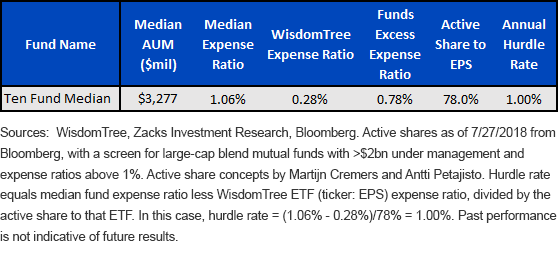
A problem, of course, is that many of these funds are stuck in a prior era’s fee paradigm. With expense ratios 78 basis points (bps) higher than that of EPS, the 78% of holdings that are different from the holdings of EPS need to really shoot the moon. Doing the division, those positions have a “hurdle rate” of 100 bps, the amount they need to outperform just so the fund’s return can equal that of EPS, after fees.
Their 10,000 Friends
These 10 funds are not alone. There are another 368 large-cap core funds that are charging that kind of expense ratio; they just have smaller asset bases. In fact, open the Zacks database to all fund managers across all asset classes—stocks, bonds, commodities, and the rest—and you will find more than 10,000 funds that are charging 1% or more. Some will overcome that hurdle with skill, or luck. But many others are sprinting on beach sand.
For investors that understand these hurdles, a modern alpha ETF like EPS may be the angle for entire U.S. large-cap allocations. The choice is beach sand or a solid surface, and the fee is the decision maker.
1Martijn Cremers, “Active Share and the Three Pillars of Active Management: Skill, Conviction and Opportunity,” 12/18/2016.
Important Risks Related to this Article
There are risks associated with investing, including possible loss of principal. Funds focusing their investments on certain sectors increase their vulnerability to any single economic or regulatory development. This may result in greater share price volatility. Please read the Fund’s prospectus for specific details regarding the Fund’s risk profile.
Categories
About the contributor

Head of Equity Strategy
Jeff Weniger, CFA, has been with WisdomTree since 2017 and serves as the Head of Equities. He shapes the firm’s market outlook through a combination of macroeconomic and fundamental analysis. With more than two decades in investment strategy, Jeff is known for his work on market cycles and valuations. Before joining WisdomTree, Jeff was with BMO Private Bank and BMO Global Asset Management for 11 years. At BMO, he sat on the firm’s Asset Allocation Committee and co-managed ETF model portfolios across the U.S. and Canada. In 2013, at age 32, he became the youngest member of BMO’s Global Investment Forum. When he left BMO to come to WisdomTree, his final role was Director, Senior Strategist in the Office of the CIO in 2017.
Jeff is a frequent television guest on networks such as CNBC, Bloomberg, and Schwab, with regular print appearances in The Wall Street Journal, Barron’s and Reuters. He also appears weekly on the Behind the Markets podcast and is a regular on SiriusXM’s The Business Briefing. On X, Jeff has developed one of the larger followings in financial media. He earned a B.S. in Finance from the University of Florida and an MBA from the University of Notre Dame. He has held the CFA charter since 2006.