

“The BRICs Are Dead; Long Live the TICKs,” Says Financial Times
Published May 17, 2016

Global Head of Research
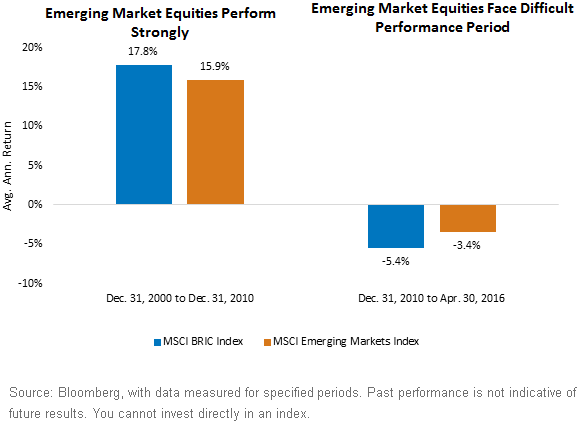
We saw this phenomenal title in an online article from the Financial Times in January.1 The term "BRIC" (Brazil, Russia, India and China), coined by Jim O’Neill during his time at Goldman Sachs, didn’t come about because of these markets’ ongoing underperformance—quite the opposite. As illustrated below, from December 31, 2000, to December 31, 2010—a 10-year period that includes the global financial crisis—the MSCI BRIC Index outperformed the MSCI Emerging Markets Index (which was enjoying mid-double-digit returns for a decade) by almost 2% per year.2 During that period, the currency impact on both the MSCI BRIC Index and the MSCI Emerging Markets Index was negligible—appreciation of approximately 1% per year. But shifting the period to December 31, 2010 − April 29, 2016, provides a completely different picture. The MSCI BRIC Index underperformed the MSCI Emerging Markets Index by 2% per year, and the currency decline on these indexes against the U.S. dollar was roughly the full magnitude of the negative returns (i.e., the stocks did not contribute to the negative performance anywhere near as much as their currencies did, measured against the U.S. dollar).3 A Tale of Two Periods for the BRICs
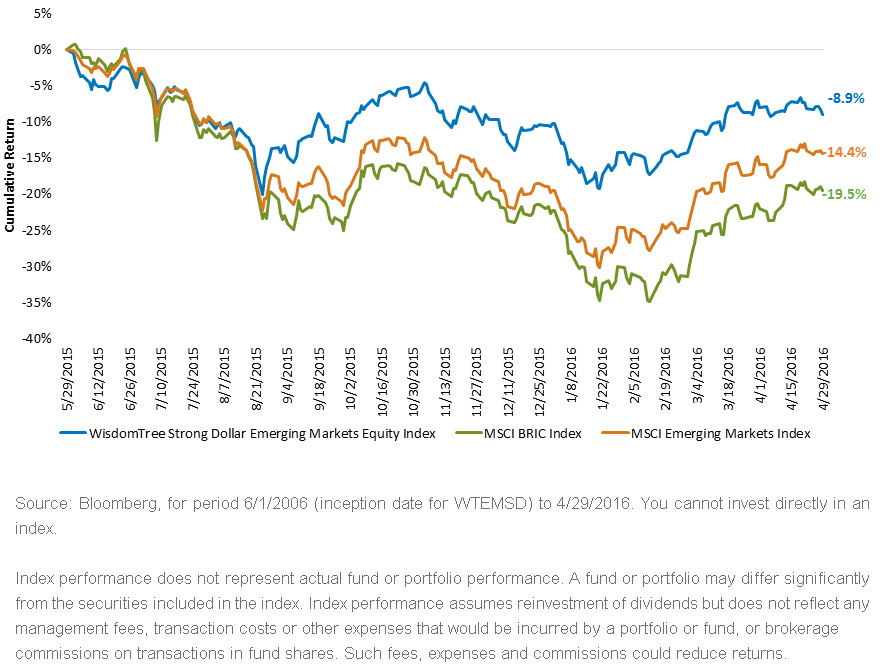
The WisdomTree Strong Dollar Emerging Markets Equity Index (WTEMSD) Finds the TICKs (Taiwan, India, China & [South] Korea), not the BRICs As we describe the process below, our strategy syncs up with the Financial Times’ conclusion: WTEMSD has country exposure focused on the TICKs, not the BRICs, with the following top three most heavily weighted countries4: • Taiwan: 37% • South Korea: 34% • India: 10% China is the one TICKs country not getting significant exposure currently. WTEMSD Sector Exposure The process for inclusion in WTEMSD starts by more restrictive exposure to various sectors. WisdomTree’s approach places emphasis on the following sectors5: • Information Technology: 36% • Consumer Discretionary: 25% • Industrials: 17% • Health Care: 13% • Consumer Staples: 9% By design, WTEMSD avoids the more leveraged sectors (Financials, Telecommunication Services and Utilities)—which are at risk of a stronger U.S. dollar if they have debt denominated in U.S. dollars that is becoming harder to pay back with weakening currencies—as well as commodity sectors (Energy and Materials), which also tend to be most impacted by a rising dollar. Proof in the Performance Since its inception, the WisdomTree Strong Dollar Emerging Markets Equity Index has delivered a performance experience distinctly different from that of either the MSCI BRIC or MSCI Emerging Markets indexes. WisdomTree Strong Dollar Emerging Markets Strategy Performance
1Published on 1/28/16. 2Source: Bloomberg, with data from 12/31/00 to 12/31/10. 3Source: Bloomberg, with data from 12/31/10 to 4/29/16. 4Source: Bloomberg, with data measured as of 4/29/16. 5Source: Bloomberg, with data measured as of 4/29/16.
Important Risks Related to this Article
Investments in emerging, offshore or frontier markets are generally less liquid and less efficient than investments in developed markets and are subject to additional risks, such as risks of adverse governmental regulation and intervention or political developments.
Investments in currency involve additional special risks, such as credit risk and interest rate fluctuations.
Categories
About the contributor

Global Head of Research
Christopher Gannatti began at WisdomTree as a Research Analyst in December 2010, working directly with Jeremy Schwartz, CFA®, Director of Research. In January of 2014, he was promoted to Associate Director of Research where he was responsible to lead different groups of analysts and strategists within the broader Research team at WisdomTree. In February of 2018, Christopher was promoted to Head of Research, Europe, where he was based out of WisdomTree’s London office and was responsible for the full WisdomTree research effort within the European market, as well as supporting the UCITs platform globally. In November 2021, Christopher was promoted to Global Head of Research, now responsible for numerous communications on investment strategy globally, particularly in the thematic equity space. Christopher came to WisdomTree from Lord Abbett, where he worked for four and a half years as a Regional Consultant. He received his MBA in Quantitative Finance, Accounting, and Economics from NYU’s Stern School of Business in 2010, and he received his bachelor’s degree from Colgate University in Economics in 2006. Christopher is a holder of the Chartered Financial Analyst Designation.