

Ten Years Later: Revisiting Case for International Small Caps
Published May 23, 2016

Global Chief Investment Officer
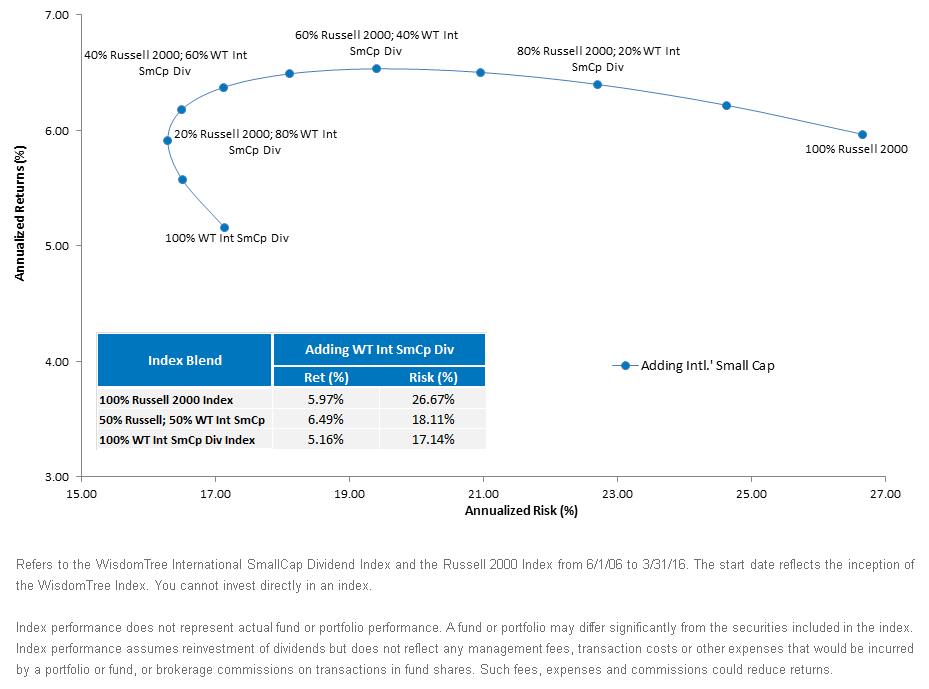
In June 2006, WisdomTree launched the first international small-cap exchange-traded fund (ETF), the WisdomTree International SmallCap Dividend Fund (DLS). WisdomTree was early to recognize that the “size factor” was just as important in allocating to stocks in foreign markets as it was for the United States. Yet prior to the launch of DLS, no other ETFs provided access to the small-cap factor for the developed world (think MSCI EAFE Index) universe. Since the inception of DLS, we believe international small caps have added meaningful value to international portfolio allocations compared to international large caps. The WisdomTree International SmallCap Dividend Index, which DLS is designed to track before fees and expense, for instance, has out performed the MSCI EAFE Index by approximately 300 basis points (bps) per year over this nearly 10-year history (5.16% vs. 1.75%) and 45.42% on a cumulative basis.1 Foreign Markets for Dividends and Value Increasingly, investors are looking toward foreign markets as an opportunity based on a relative valuation basis, and there is definitely a major difference between U.S. small caps and foreign small caps from a historical risk and valuation perspective. U.S. small caps, as exemplified by a market cap-weighted universe like the Russell 2000 index, tend to be characterized by higher volatility than large caps and greater allocations to more speculative growth companies. Currently almost 18% of the Russell 2000 is in unprofitable companies, and 45% in non-dividend-paying companies. This makes the dividend characteristics of the Index a nonfocus, with average dividend yields close to 1.6% and companies typically being net share issuers2 (not conducting net buybacks) to fund their growth. By contrast, the International SmallCap Dividend Index had an average dividend yield close to 4%, a price-to-earnings ratio (P/E) of 16x and a price-to-sales ratio of 0.7x.3 From a risk perspective, international small caps surprisingly typically show lower volatility than U.S. small caps. Adding International Small Cap1 to U.S. Small Cap Allocations (6/1/2006 - 3/31/2016)
How Are You Managing Currency Risk? While international small-cap stocks have traditionally had lower volatility than U.S. stocks, we believe there is an approach to international equities that can help lower volatility: by focusing on just the stock component and not layering currency risk on top. I believe the question today is no longer to hedge or not hedge your foreign currency, but really how are you hedging your foreign currency risk. WisdomTree offers three currency approaches to its international small-cap dividend strategy: • The WisdomTree International SmallCap Dividend Fund (DLS): The original unhedged option launched 10 years ago • The WisdomTree International Hedged SmallCap Dividend Fund (HDLS): The static, fully currency-hedged strategy launched in 2015 • The WisdomTree Dynamic Currency Hedged International SmallCap Equity Fund (DDLS): A dynamic currency-hedged strategy that was launched in January 2016 Many investors look at the decision to hedge currencies as a tactical trade that, in the past, was specific to Japan and Europe, the two regions in which currency hedging most resonated and helped to introduce the concept to investors. However, I view the long-term expected return from taking currency risk to be zero, while it can certainly add to your expected risk profile for broad-based international regions. Having a process to determine when to hedge currency can be a way to further add value. We have seen early interest in the dynamic approach from our broad-based dynamic hedged strategy. In my mind, the logical next piece of the asset allocation pie to apply this to is international small caps. I believe now is a great time to consider these foreign allocations. The U.S. markets look expensive compared to foreign markets, and valuations on these small-cap Indexes appear reasonable. I would suggest investors approach this category for long-term allocations by choosing to either passively or dynamically hedge the currency. WisdomTree has a track record of providing innovative and first-to-market solutions. Such was the case when DLS launched about 10 years ago as the first small-cap-factor ETF for international markets. Now, with the dynamic currency hedge on top of the original equity strategy—with DDLS—investors can apply a currency risk management process that can help add to returns—we think potentially as much as 100 basis points per year over fully hedged or unhedged strategies. Read more research on the dynamic hedging process that drives DDLS.
1Sources: WisdomTree, FactSet as of 3/31/16.
2Sources: WisdomTree, Bloomberg as of 3/31/16.
3WisdomTree, FactSet as of 3/31/16.
Important Risks Related to this Article
There are risks associated with investing, including possible loss of principal. Foreign investing involves special risks, such as risk of loss from currency fluctuation or political or economic uncertainty. Funds focusing their investments on certain sectors and/or smaller companies may be more vulnerable to any single economic or regulatory development. This may result in greater share price volatility.
DDLS invests in derivatives in seeking to obtain a dynamic currency-hedge exposure. Derivative investments can be volatile, and these investments may be less liquid than other securities, and more sensitive to the effects of varied economic conditions.
Derivatives used by the Fund may not perform as intended. A Fund that has exposure to one or more sectors may be more vulnerable to any single economic or regulatory development. This may result in greater share price volatility. The composition of the Index underlying the Fund is heavily dependent on quantitative models and data from one or more third parties, and the Index may not perform as intended. The Fund invests in the securities included in, or representative of, its Index regardless of their investment merit, and the Fund does not attempt to outperform its Index or take defensive positions in declining markets.
Please read each Fund’s prospectus for specific details regarding each Fund’s risk profile.
About the contributor

Global Chief Investment Officer
Jeremy Schwartz has served as Global Chief Investment Officer since November 2021 and leads WisdomTree’s investment strategy team in the construction of WisdomTree’s equity Indexes, quantitative active strategies and multi-asset Model Portfolios. Jeremy joined WisdomTree in May 2005 as a Senior Analyst, adding Deputy Director of Research to his responsibilities in February 2007. He served as Director of Research from October 2008 to October 2018 and as Global Head of Research from November 2018 to November 2021. Before joining WisdomTree, he was a head research assistant for Professor Jeremy Siegel and, in 2022, became his co-author on the sixth edition of the book Stocks for the Long Run. Jeremy is also co-author of the Financial Analysts Journal paper “What Happened to the Original Stocks in the S&P 500?” He received his B.S. in economics from The Wharton School of the University of Pennsylvania and hosts the Behind the Markets podcast. Jeremy is a member of the CFA Society of Philadelphia.