

Siegel on Challenges for the S&P 500 Index Returns: Why 2025 May Be the Year for Selling Options
Published February 7, 2025

Global Head of Research
Key Takeaways
- With the S&P 500 Index expected to deliver modest gains in 2025, option-writing strategies like PUTW may offer attractive income opportunities during periods of heightened market uncertainty.
- The WisdomTree PutWrite Strategy Fund (PUTW) seeks to generate consistent income by selling put options bi-weekly and investing in U.S. Treasury bills, targeting a premium of 2.5%.
- PUTW's approach emphasizes higher income potential through increased equity market sensitivity, making it a compelling choice for investors navigating uncertain market conditions.
If Professor Siegel’s views for 2025 come to pass, we think it could be a more interesting year to consider strategies that sell options, as option premiums could go up during more volatile equity environments.
The Morningstar Derivative Income Category
Morningstar places option-writing funds within the Derivative Income category. As of December 31, 2024, the largest fund by assets within this category was the JPMorgan Equity Premium Income ETF (JEPI), with more than $36 billion.2 This strategy employs a basket of defensively oriented equities and combines this with selling call options against the basket to increase the overall income generation of the fund.
The WisdomTree PutWrite Strategy Fund (PUTW) is different.
- Instead of selling call options, the strategy sells put options. Specifically, PUTW seeks to track the price and yield performance, before fees and expenses, of the Volos US Large Cap Target 2.5% PutWrite Index.
- The index methodology specifies selling options every two weeks, not every month.
- Instead of holding an underlying basket of equities, the strategy holds a basket of short-term, U.S. Treasury securities.
While it is tempting to zero in on the selling of put options versus call options as the primary difference, the tricky thing about the world of options is that, if we assume the same underlying—such as the S&P 500 Index—the concept of put-call parity means that selling at-the-money puts or at-the-money calls could yield a very similar return.
- The call-writing approach contains underlying equities.
- The put-writing approach contains U.S. Treasury bills.
The primary difference between JEPI and PUTW comes down to the fact that JEPI is using a strategy of active stock selection in addition to selling the options, whereas PUTW is focused on an S&P 500 Index exposure, at least from an equity perspective. Below, figure 1 shows the average annual total returns for PUTW and JEPI.
Figure 1: Average Annual Total Returns

Sources: WisdomTree, LSEG, FactSet, specifically data from the Fund Comparison Tool in the PATH suite of tools, as of 12/31/24. NAV denotes total return performance at net asset value. MP denotes market price performance. Past performance is not indicative of future results. Investment return and principal value of an investment will fluctuate so that an investor’s shares, when redeemed, may be worth more or less than their original cost. Current performance may be lower or higher than the performance data quoted. For PUTW’s most recent month-end and standardized performance, click here. Performance of less than one year is not annualized.
A Capacity for Income Generation
An attribute of selling options that many investors appreciate is the income. Even with short-term interest rates currently above 0%, the demand for income-generating investments is always there.
- PUTW uses a strategy that, every two weeks, is seeking to sell an option with a 2.5% premium. A good heuristic with regard to S&P 500 Index options is to look at the VIX Index3 and consider that a monthly at-the-money option on the S&P 500 Index underlying is roughly the VIX Index value/10, expressed as a percentage. If the VIX Index is reading a 25, then 25/10=2.5, which is expressed as 2.5%. The VIX Index is usually below 25, which means that to derive a 2.5% premium requires selling in-the-money options. The income generation is there, but the consequence of selling in-the-money options is that there is a greater sensitivity to movements in the S&P 500 Index.
- JEPI is seeking to sell out-of-the-money S&P 500 Index options. These options may have lower premiums, but also have lower sensitivity to equity market movements.
On the subject of PUTW’s monthly distributions, the Fund’s prospectus says:
The Fund is managed in a way that seeks, under normal circumstances, to provide monthly distributions at a relatively stable level.
It makes sense to test how “relatively stable” these distributions have been over the period for which the current strategy has been in place, which began on October 24, 2022.
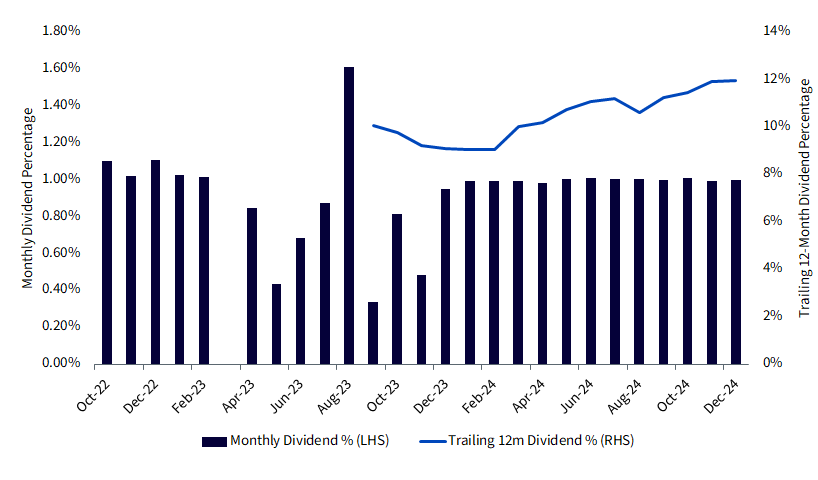
- 2023 did show a more volatile distribution history, particularly from March 2023 to November 2023.
- From December 2023 onwards, the distribution has been much closer to a level of 1%. There is no guarantee that the distribution will always be 1%, but it is a good illustration using data to establish from the actual record how stable it has been.
Figure 2 illustrates PUTW’s historical monthly distributions as a percentage of its net asset value, showcasing its income consistency and periods of distribution volatility since the strategy change in October 2022.
Figure 2: PUTW’s Distributions as a Percentage of NAV
Source: WisdomTree. Prior to 10/24/22, the WisdomTree PutWrite Strategy Fund was named the WisdomTree CBOE S&P 500 PutWrite Strategy Fund, which accounts for the time period shown in figure 2. Past performance is not indicative of future results. Investment return and principal value of an investment will fluctuate so that an investor’s shares, when redeemed, may be worth more or less than their original cost. Current performance may be lower or higher than the performance data quoted. For PUTW’s most recent month-end and standardized performance, click here.
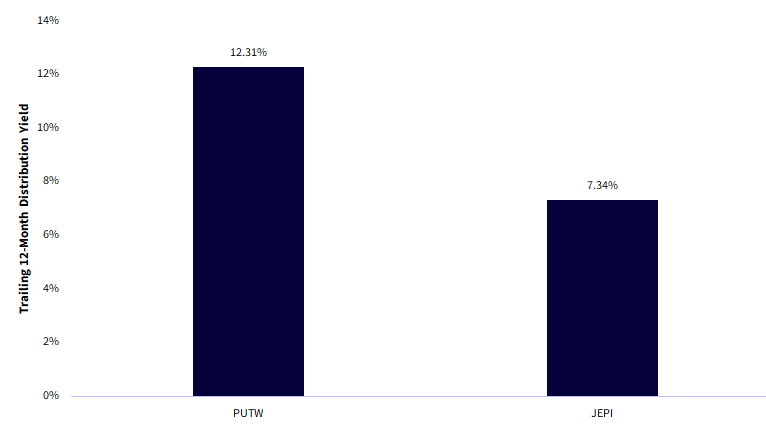
JEPI is notably taking a different approach and it’s important for investors to understand that the dividend yield is merely one characteristic to assess on a given investment. The risk that PUTW employs to generate this income comes with a higher overall exposure to equity market movements—and those movements could very well go in the negative direction, impacting one’s total return. Figure 3 displays the trailing 12-month dividend yields of PUTW, offering insights into its income-generating potential compared to its market price and net asset value.
Figure 3: Trailing 12-Month Fund Dividend Yield
Sources: WisdomTree, LSEG, FactSet, specifically data from the Fund Comparison Tool in the PATH suite of tools, as of 1/10/25. Past performance is not indicative of future results. Investment return and principal value of an investment will fluctuate so that an investor’s shares, when redeemed, may be worth more or less than their original cost. Current performance may be lower or higher than the performance data quoted. For PUTW’s most recent month-end and standardized performance, click here.
Total Returns across the Current Strategy
PUTW’s Current Methodology
If one looks at PUTW’s current methodology, one sees the following:
The WisdomTree PutWrite Strategy Fund seeks to track the price and yield performance, before fees and expenses, of the Volos US Large Cap Target 2.5% PutWrite Index.
But this was not always the case. Prior to October 24, 2022, the strategy was tracking the return of the CBOE S&P 500 PutWrite Strategy Index.
The prior approach was selling the at-the-money option on the S&P 500 Index every month. There was no focus on targeting a specific premium—so as the VIX Index fluctuated, so too did the premium generated. Since the VIX Index value tends toward about 15, the premium collected also tended toward 1.5% on a monthly basis.
The new approach is targeting a premium of 2.5%, and the way to get there is to sell in-the-money options. The plus side of this is greater income potential. The minus side is greater equity market sensitivity.
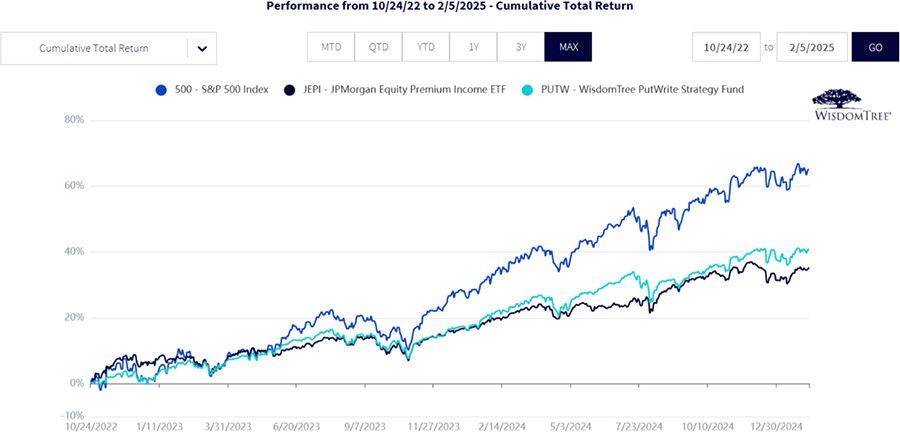
Figure 4 tracks the cumulative total returns of the S&P 500 Index alongside PUTW and JEPI since October 24, 2022, providing a visual comparison of how these strategies have performed in a rising market.
- The general trend of the S&P 500 Index was up, with cumulative total returns in the vicinity of 60%. Neither PUTW nor JEPI kept up, but neither of these strategies is designed to capture the full upside of the S&P 500 Index during a robustly positive market environment.
Figure 4: The Robust, Upward Market Environment from October 24, 2022
Sources: WisdomTree, LSEG, FactSet, specifically data from the Fund Comparison Tool in the PATH suite of tools, for the period 10/24/22–2/5/25. Period selected as the longest available due to the full history of the current strategy employed by PUTW. Past performance is not indicative of future results. Investment return and principal value of an investment will fluctuate so that an investor’s shares, when redeemed, may be worth more or less than their original cost. Current performance may be lower or higher than the performance data quoted. For PUTW’s most recent month-end and standardized performance, click here.
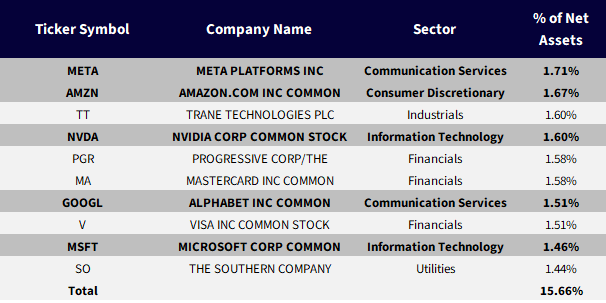
While PUTW is selling options and keeping the proceeds in U.S. Treasury bills, JEPI employs a strategy of underlying stock selection. As of January 10, 2025, we looked at the top 10 holdings in the strategy. We know that these can change at any time, but given Professor Siegel’s comments on CNBC, we found it notable that five out of the seven so-called Magnificent Seven stocks were included.
Figure 5 lists the top 10 equity holdings in JEPI as of January 2025, illustrating its stock selection approach, which includes a number of the Magnificent Seven tech giants.
Figure 5: The Top 10 Equity Positions in JEPI
Source: JP Morgan, with JEPI fund holdings as of 1/10/25. Holdings subject to change.
Conclusion: No Rewards Come without Risk
Option writing strategies can sport very attractive distribution yields, but we caution that looking at yield alone doesn’t tell the full story. Generating greater income can mean taking on a different sort of risk.
- JEPI, on the other hand, selects a basket of roughly 100 stocks and generates an equity market exposure that is different from that of the S&P 500 Index. As with any stock-selection strategy, it can outperform or underperform in different periods.
With equity markets at or near record highs, based on the S&P 500 Index, it may make sense to take a deeper look at strategies that seek to sell volatility. Figure 6 provides a summary of important disclaimers and details about PUTW, including risks associated with its strategy of selling options and holding U.S. Treasury bills.
Figure 6: Important Information
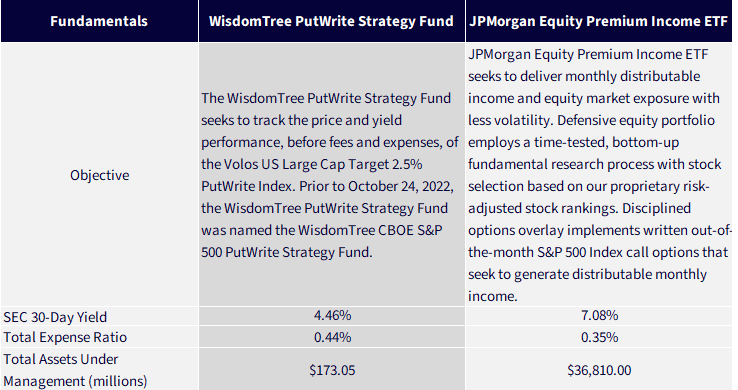
Sources: WisdomTree, LSEG, FactSet specifically data from the Fund Comparison Tool in the PATH suite of tools, as of 12/31/24. Past performance is not indicative of future results. Investment return and principal value of an investment will fluctuate so that an investor’s shares, when redeemed, may be worth more or less than their original cost. Current performance may be lower or higher than the performance data quoted. For standard performance of the Funds mentioned in the table, plesae click their respective tickers: PUTW, JEPI.
1 Source: Professor Siegel spoke on CNBC on 1/10/25.
2 Source: Morningstar Direct, with data as of 12/31/24.
3 The VIX Index refers to the Cboe Volatility Index.
Important Risks Related to this Article
For holdings of funds mentioned in this blog, please click the respective ticker: PUTW, JEPI.
There are risks associated with investing, including the possible loss of principal. The Fund will invest in derivatives, including S&P 500 Index put options (“SPX Puts”). Derivative investments can be volatile, and these investments may be less liquid than securities, and more sensitive to the effects of varied economic conditions. The value of the SPX Puts in which the Fund invests is partly based on the volatility used by market participants to price such options (i.e., implied volatility). The options values are partly based on the volatility used by dealers to price such options, so increases in the implied volatility of such options will cause the value of such options to increase, which will result in a corresponding increase in the liabilities of the Fund and a decrease in the Fund’s NAV. Options may be subject to volatile swings in price influenced by changes in the value of the underlying instrument. The potential return to the Fund is limited to the amount of option premiums it receives; however, the Fund can potentially lose up to the entire strike price of each option it sells. Due to the investment strategy of the Fund, it may make higher capital gain distributions than other ETFs. Please read the Fund’s prospectus for specific details regarding the Fund’s risk profile.
Professor Jeremy Siegel is Senior Economist to WisdomTree, Inc., and WisdomTree Asset Management, Inc. This material contains the current research and opinions of Professor Siegel, which are subject to change and should not be considered or interpreted as a recommendation to participate in any particular trading strategy or deemed to be an offer or sale of any investment product, and it should not be relied on as such. The user of this information assumes the entire risk of any use made of the information provided herein. Unless expressly stated otherwise, the opinions, interpretations or findings expressed herein do not necessarily represent the views of WisdomTree or any of its affiliates.
Categories
About the contributor

Global Head of Research
Christopher Gannatti began at WisdomTree as a Research Analyst in December 2010, working directly with Jeremy Schwartz, CFA®, Director of Research. In January of 2014, he was promoted to Associate Director of Research where he was responsible to lead different groups of analysts and strategists within the broader Research team at WisdomTree. In February of 2018, Christopher was promoted to Head of Research, Europe, where he was based out of WisdomTree’s London office and was responsible for the full WisdomTree research effort within the European market, as well as supporting the UCITs platform globally. In November 2021, Christopher was promoted to Global Head of Research, now responsible for numerous communications on investment strategy globally, particularly in the thematic equity space. Christopher came to WisdomTree from Lord Abbett, where he worked for four and a half years as a Regional Consultant. He received his MBA in Quantitative Finance, Accounting, and Economics from NYU’s Stern School of Business in 2010, and he received his bachelor’s degree from Colgate University in Economics in 2006. Christopher is a holder of the Chartered Financial Analyst Designation.