

Risk vs. Return in International Portfolios
Published January 27, 2015

Chief Investment Officer, Fixed Income and Model Portfolios
After an unexpected move by the Swiss National Bank on January 15 to abandon its peg against the euro and the announcement of quantitative easing by the European Central Bank (ECB) on January 22, investors around the world have been forced to re-evaluate currency risk as part of their asset allocation decisions. For many U.S.-based investors, currency hedging continues to resonate as they seek out new opportunities in foreign markets. Over the past 10 years, foreign currencies declined modestly against the U.S. dollar.1 However, as we have highlighted previously, our analysis shows that we may currently be in the middle stages of a secular appreciation in the U.S. dollar. As a result, investors should continue to consider hedging investments exposed to foreign currency risk. One way investors have historically managed volatility in their portfolios was through allocations to cash. By maintaining a portion of their portfolios in cash, investors would hypothetically be able to deploy capital when markets became undervalued. However, today’s interest rates environment is much different than it once was. From 2004 through 2007, short-term interest rates averaged 3.46%.2 Today, the U.S. 30-year bond only yields 2.40%.3 With yields this low across the yield curve, U.S. cash positions can provide a significant drag on performance. Today, the argument for short-term fixed income is that it reduces exposure to risk assets, albeit with considerably less income potential than in the past. However, volatility across asset classes is trending higher. Due to such low opportunity costs from short-term fixed income, hedging foreign currency risk via a long-dollar strategy provides investors additional flexibility compared to simply allocating to cash. As illustrated in the chart below, investors were able to have a significant impact on portfolio volatility while still capturing a large percentage of returns from their equity positions.
Dialing Down Risk while Maintaining Returns Risk/Return Implications of Dollar Bull Strategies for International Equity Positions, 11/30/04- 11/30/14
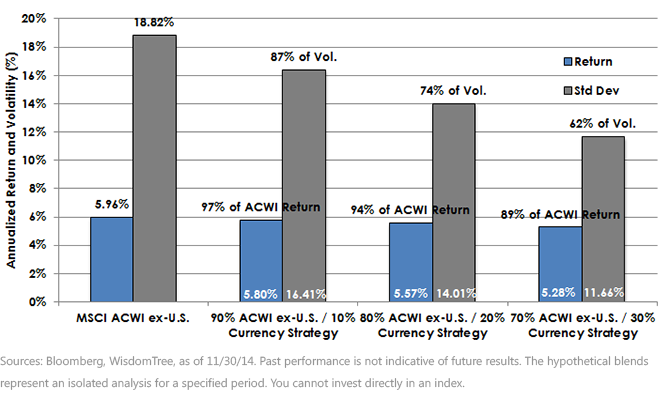
Interestingly, even though the volatility of the dollar bull strategy was significantly higher than cash over this period, it actually reduced overall portfolio risk to a greater degree due to its negative correlation (-0.71) with international equities.4 In our view, the real value of bullish dollar strategies in the current market environment is for investors with long-term international holdings. Given that many of these legacy positions may have large unrealized capital gains, a bullish dollar currency strategy can help reduce volatility from currency markets while maintaining existing exposure. In our analysis over the last 10 years, investors would have been able to capture a large portion of the upside, while significantly reducing volatility. As illustrated in the chart above, a 20% allocation to a currency strategy would have been able to capture 94% of total returns while reducing volatility by 26%. In our view, a blended approach to managing currency risk can help investors navigate increasingly uncertain markets. With volatility of many asset classes rising, deploying currency hedging strategies may represent one way investors can enhance risk- adjusted returns.
1Source: Bloomberg, as of 11/30/14.
2Refers to the three-month U.S. Treasury bill. Source: Bloomberg, 12/31/03–12/31/07. 3Source: Bloomberg, as of 1/15/15.
4Source: Bloomberg, as of 11/30/14.
Important Risks Related to this Article
Investments in currency involve additional special risks, such as credit risk and interest rate fluctuations.
About the contributor

Chief Investment Officer, Fixed Income and Model Portfolios
Rick Harper serves as the Chief Investment Officer, Fixed Income and Model Portfolios at WisdomTree Asset Management, where he oversees the firm’s suite of fixed income and currency exchange-traded funds. He is also a voting member of the WisdomTree Model Portfolio Investment Committee and takes a leading role in the management and oversight of the fixed income model allocations. He plays an active role in risk management and oversight within the firm.
Rick has over 29 years investment experience in strategy and portfolio management positions at prominent investment firms. Prior to joining WisdomTree in 2007, Rick held senior level strategist roles with RBC Dain Rauscher, Bank One Capital Markets, ETF Advisors, and Nuveen Investments. At ETF Advisors, he was the portfolio manager and developer of some of the first fixed income exchange-traded funds. His research has been featured in leading periodicals including the Journal of Portfolio Management and the Journal of Indexes. He graduated from Emory University and earned his MBA at Indiana University.