

Re-thinking Your Small-Cap Allocation? Think Dividends
Published July 20, 2017

Director, Research
There seems to be a consensus forming regarding the investment thesis for developed international exposure: attractive relative valuations compared to the U.S. in tandem with subdued political risks, accommodative monetary policy and cohesive global economic growth that will spur investment and bolster corporate profits. Given all these apparent tailwinds, how should investors think about the best ways to access this market?
Is Your Portfolio Small Enough?
We recently highlighted that U.S. small -caps have by most measures underperformed U.S. large caps in 2017 year-to-date and have underperformed international small caps by an even greater margin. Despite the research and performance history to support a long-term strategic holding in small caps, investors have been exiting in droves from the small-cap trade.
The specter of a considerable drawdown in the segment should the administration’s fiscal stimulus plan disappoint rightly worries investors. But what should be more worrying is that many investors have missed out on diversifying their portfolios to access the small-cap value premiums in global markets.
How Rules-Based Indexing Has Outperformed
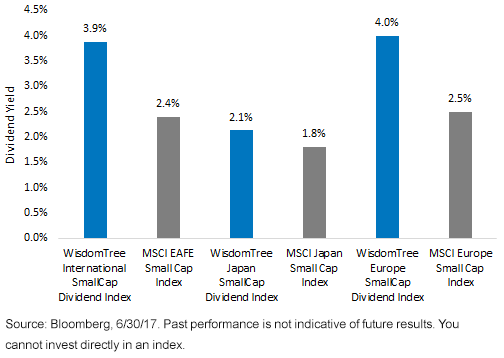
WisdomTree pioneered small-cap international indexes in 2006, and we now have a more than 11-year track record of performance in this category. Among them are the WisdomTree International SmallCap Dividend Index, the WisdomTree Europe SmallCap Dividend Index and the WisdomTree Japan SmallCap Dividend Index. These Indexes use a passive, rules-based dividend-weighted approach in targeting small-cap value in less efficient markets. As a result of dividend weighting, WisdomTree’s Indexes boost dividend yields across these markets, in some cases by almost 150 basis points (bps) above the market cap-weighted benchmark.
Dividend Yields as of 6/30/17
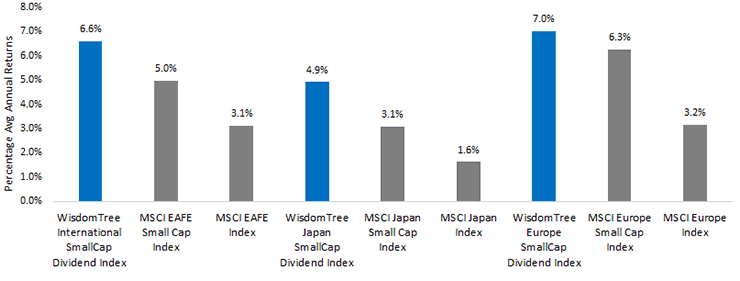
Since their inception, the WisdomTree Indexes have average annual returns above their cap-weighted small-cap benchmarks in the range of 75 to 183 bps, and their large-cap benchmarks by even greater margins of 329 to 384 bps. This is just the most recent 11-year example of the benefits of including small caps with a value tilt in international allocations over just traditional large caps.
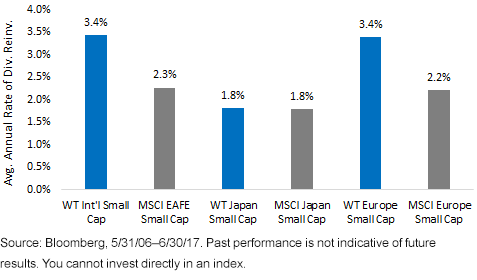
In breaking down the returns since inception of the WisdomTree dividend-weighted Indexes, you can see the significant increase in returns attributable to dividends. The largest difference is the 118bps increase in the average annual rate of dividend reinvestment for the WisdomTree Europe SmallCap Dividend Index versus the MSCI Europe Small Cap Index.
Average Annual Returns and Average Annual Rate of Dividend Reinvestment
Stock prices are vulnerable to the volatility of the markets, particularly with small caps, but dividends typically provide stickier, more reliable returns. Academic research debates the theoretical significance of dividend policy on individual company returns—our research and live history of outperformance shows both the value of dividends and of dividend payers in contributing to excess returns in a rules-based indexing approach, particularly in less efficient markets such as these.
International Small Caps: Relative Value and More
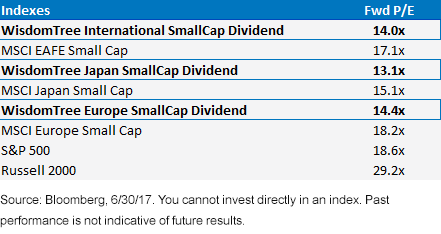
WisdomTree’s dividend-weighted methodology provides access to the small-cap value factor in a way that has resulted in not only increasing dividend yields but also tilting to more favorable price-to-earnings ratios (P/E).
In the table below, you can see how in each case the WisdomTree Index is less expensive than its market cap-weighted benchmark on a P/E basis, with the European index having the greatest discount of 21%. And when you consider the relative value between the U.S. and international indexes, the Russell 2000 Index is more than twice as expensive as the highest P/E WisdomTree Index.
Exposure to international dividend-weighted small caps can provide relatively inexpensive access to the small-cap premiums during a stage of economic growth, but investors should also keep in mind some other long-term benefits:
- Portfolio Diversification: The low correlation of returns between international small-cap indexes and U.S. equity markets can enhance portfolio diversification, particularly with Japan. The correlation of returns between the WisdomTree Japan SmallCap Dividend Index, the S&P 500, and the Russell 2000 are .51 and .45 respectively.
- Blunt the Risks of Currencies and Global Trade: Small caps generate a greater share of their income domestically than do large caps, and they’re less susceptible to trends in global trade or the reverberations on trade from currencies.
- Higher Dividend Yields Globally than Can Be Found in the U.S.: Developed international markets typically pay higher dividends than the U.S., an important consideration for income-seeking investors. The dividend yield on the Russell 2000 and S&P 500 is 1.43% and 1.97%, respectively, compared to 2.40% for the MSCI EAFE Small Cap Index and 3.15% for the MSCI EAFE Index.1
1Bloomberg, 6/30/17.
Important Risks Related to this Article
Foreign investing involves special risks, such as risk of loss from currency fluctuation or political or economic uncertainty.
Dividends are not guaranteed, and a company currently paying dividends may cease paying dividends at any time.
Investments focusing on certain sectors and/or smaller companies increase their vulnerability to any single economic or regulatory development.
Categories
About the contributor

Director, Research
Matt Wagner joined WisdomTree in May 2017 as an Analyst on the Research team. He currently serves as a Director, where he supports the creation, maintenance, and reconstitution of WisdomTree’s indexes and actively managed ETFs. Matt began his career at Morgan Stanley, working as an analyst in Treasury Capital Markets from 2015 to 2017, focusing on unsecured funding planning, execution, and risk management. He graduated magna cum laude from Boston College in 2015 with a B.A. in International Studies, concentrating in Economics. In 2020, he earned a Certificate in Advanced Valuation from NYU Stern. He is also a Chartered Financial Analyst (CFA) charterholder.