

Rebalancing EM Small Caps during Volatile Markets
Published November 5, 2018

Quantitative Research Analyst
As global trade disputes between the two largest economies continue to escalate, volatility has once again become a fact of global markets, as seen in the VIX spiking above 251. Perhaps due to their sensitivity to trade (and concentration in China), emerging market (EM) equities have sold off considerably during this period, falling by 10.7%2 over the last month alone. Despite the turmoil, we believe this bout of volatility can create long-term opportunities. At WisdomTree, a key element of our Index methodology is our focus on yearly rebalancing based on fundamentals. To illustrate this process, we focus on small-cap dividend payers in EM.
Longer Trend Intact—Rebalancing to Stronger Fundamentals with Less Volatility
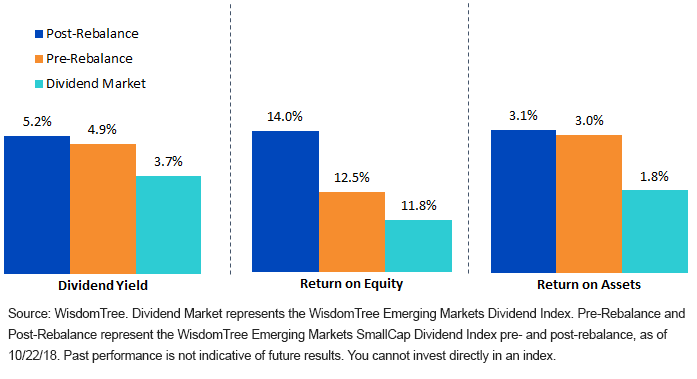
With EM selling off, we believe this may be an opportunity for EM investors to take a step back and reassess their portfolios. Coincidently, the timing of WisdomTree’s dividend rebalances is allowing us to do the same, giving us the opportunity to review and refresh the Index weights and potentially take advantage of favorable entry points. Every year, per Index rules, WisdomTree can turn over the portfolio to reallocate Funds to potentially cheaper and undervalued constituents. This year, the WisdomTree Emerging Markets SmallCap Dividend Index rebalance increased the Index’s overall dividend yield and improved the quality of its overall basket. After rebalancing, the WisdomTree Emerging Markets SmallCap Dividend Index now offers a dividend yield of 5.2%, and has meaningfully enhanced quality metrics for return on equity and return on assets.
Rebalancing to Higher Quality and Dividend Constituents
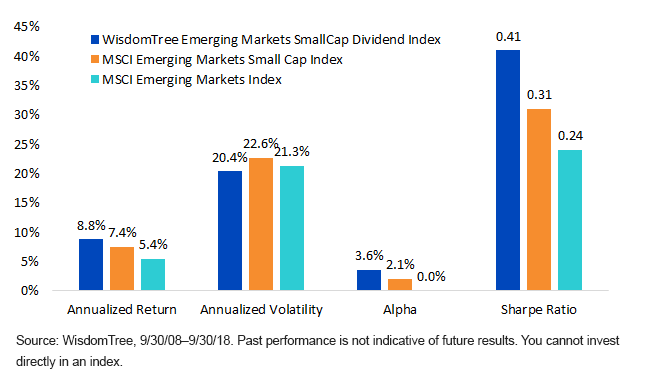
Historically, weighting EM small caps by their cash dividends and annually rebalancing back to that measure has resulted in higher returns and lower volatility. To some, it might be surprising that EM small caps have exhibited lower volatility than their large-cap counterparts, but over the last trailing five-year, ten-year and common inception periods, that has been the case. Highlighting the standardized ten-year period in figure 2, you can see the return advantage has been over 300 basis points (bps) a year in performance. For investors with a longer-term view, recent underperformance in the market can represent a buying opportunity.
10-Year Summary Statistics
Longer Trend Intact—Consumer Growth Is Still the Story
The use of dividend payers to construct the WisdomTree Emerging Markets SmallCap Index has yielded a portfolio that gives investors the ability to tap into local growth with a less volatile, higher income approach. EM small-cap growth is a good way to play local economic development. Despite recent setbacks, the EM growth story remains intact. Rising populations and income levels have created a burgeoning consumer class. People in many EM countries are also moving toward urbanized regions as their countries’ economies develop and they seek to move up the value chain. One of the lasting benefits for emerging countries is their ability to adopt technology at an incredible pace. The number of internet users in EM has grown to 1.8 billion since 2007 and is forecast to increase even more over the next decade.3 These are all positives for the growth story of EM local markets.
Large-cap names now appear much more tied to global growth than to local growth in emerging markets. By comparison, top-line growth numbers for small caps tend to be more closely tied to local economic growth factors. Specifically, small-cap dividend payers are concentrated in the information technology, consumer discretionary, and industrial sectors. These companies may be more locally focused, and many of them are bigger players in the smaller industries they are a part of.
China A-Shares Inclusion
With the inclusion of China A-shares in this year’s rebalance, we are increasing exposure to one of the largest consumer sectors in the world. WisdomTree’s Index added 100 Chinese domestic-listed small-cap companies, capping the exposure at roughly 5%, although total China exposure is around 22.4%.
In short, near-term volatility may be an opportunity for investors to reassess their EM exposure. By focusing on small-cap dividend payers, investors may also be able to reduce volatility relative to the large-cap multinationals currently being impacted by fears in global trade. In our view, the most recent rebalance continues to emphasize these trends.
1Source: CBOE SPX Volatility Index (VIX), 10/30/18.
2Source: MSCI Emerging Market Index month-to-date returns, 10/30/18.
3Source: BCG, 10/22/18.
Categories
About the contributor
