

Putting Some Income in Fixed Income
Published July 27, 2016

Head of Investment and Fixed Income Strategy
We’re now past the one-month post-Brexit vote mark, and the dust does appear to be settling in the fixed income markets. The initial knee-jerk responses in both the interest- and credit-sensitive arenas have given way to more of a focus of what market conditions may be like during the second half of this year and into 2017. Indeed, as of this writing, the U.S. Treasury (UST) 10-Year yield has risen roughly 30 basis points (bps) from its intraday post-Brexit low, while corporate bond spreads have more than reversed their initial widening and have returned to summer 2015 levels. Notwithstanding these recent moves, given ongoing uncertainties and continued concerns surrounding economic growth both here and abroad, investors will more than likely continue to face a low-rate environment. Certainly, the usual suspects such as slow growth, low inflation and safe-haven demand should continue to play a role, but in our opinion, a key factor both past, present and for the future will likely be the incredibly low-rate backdrop abroad. This factor doesn’t look like it’s going to change anytime soon, either, as the European Central Bank (ECB), the Bank of Japan (BOJ) and now the Bank of England (BOE) all seem to be focusing on policies that, at a minimum, should keep rates where they currently are. There is little doubt that favorable rate differentials have already helped push UST 10-Year yields to new lows and should serve as a future cap on domestic rates, at a minimum. Credit Quality Sectors 6/30/06–6/30/16
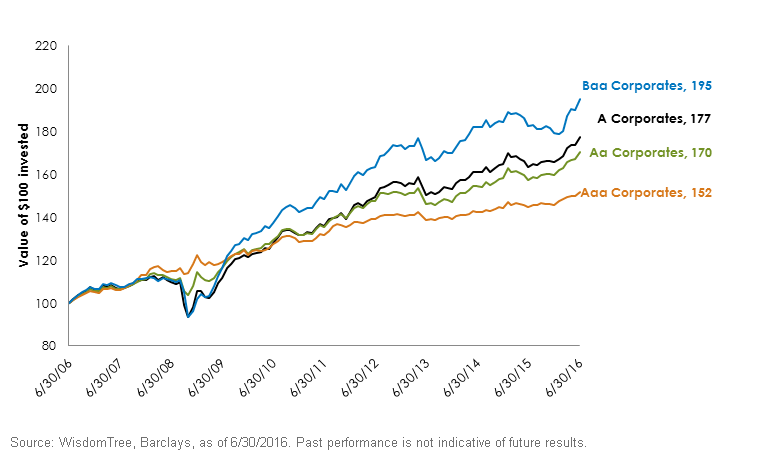
Aaa Corporates, Aa Corporates, A Corporates, and Baa Corporates proxied by each credit ratings sub-index of the Barclays US Corporate Investment Grade Index. Against this backdrop, income-based solutions should continue to be the goal for bond investors. However, it is important to consider how yield enhancement may be achieved, and the potential risks that could be involved. Oftentimes, the pursuit of additional income involves placing bets too far out in duration (interest rate risk) and/or going too far down the credit ratings curve (credit risk). Given an investor’s parameters, high-yield corporates and emerging market debt could be viewed as solutions for income, but for core fixed income portfolios these types of investments may be viewed as adding too much incremental risk. In our opinion, a more disciplined approach, which does not involve “reaching for yield,” would be to focus on the relative value differentials that exist in the investment-grade universe. In other words, reallocating positions among the interest- and credit-sensitive arenas. In our interest rate scenarios, we feel an over-weight to Treasuries is not only suboptimal but also susceptible to any potential unexpected rise in rates. The sector of fixed income that we feel could offer the best relative value is investment-grade (IG) corporates. Not only could this sector provide a visible yield advantage to Treasuries, it can also offer some risk mitigation from rising rates if the economy improves. In fact, the average yield for an IG corporate is almost double the yield of a UST 10-Year note, something that has happened only twice before. Within the IG corporate sector, we focus on the Baa area. This rating exhibited lower correlations to Treasuries while also offering strong absolute returns relative to other credit quality sectors. Conclusion The WisdomTree Barclays U.S. Aggregate Bond Enhanced Yield Fund (AGGY) is suited as both an income solution and the core fixed income aspect of an investor’s portfolio. Its risk characteristics are well placed for a variety of interest rate landscapes and/or event risks that can come about.
Important Risks Related to this Article
There are risks associated with investing, including possible loss of principal. Fixed income investments are subject to interest rate risk; their value will normally decline as interest rates rise. Fixed income investments are also subject to credit risk, the risk that the issuer of a bond will fail to pay interest and principal in a timely manner or that negative perceptions of the issuer’s ability to make such payments will cause the price of that bond to decline. Investing in mortgage- and asset-backed securities involves interest rate, credit, valuation, extension and liquidity risks and the risk that payments on the underlying assets are delayed, prepaid, subordinated or defaulted on. Due to the investment strategy of the Fund, it may make higher capital gain distributions than other ETFs. Please read the Fund’s prospectus for specific details regarding the Fund’s risk profile.
Credit ratings apply to the underlying holdings of the Fund, and not to the Fund itself. S&P and Moody’s study the financial condition of an entity to ascertain its creditworthiness. The credit ratings reflect the rating agency’s opinion of the holdings financial condition and histories.
About the contributor

Head of Investment and Fixed Income Strategy
Kevin serves as the Head of Investment and Fixed Income Strategy. In this role, he writes macro and fixed income-related content and works closely with the sales, research and marketing teams. In addition, Kevin conducts client-facing webinars and meetings, providing expertise on WisdomTree’s existing and future bond ETFs. Prior to joining WisdomTree, Kevin spent 30 years at Morgan Stanley, where he was Managing Director and Chief Fixed Income Strategist for Wealth Management. He was responsible for tactical and strategic recommendations and created asset allocation models for fixed income securities. He was a contributor to the Morgan Stanley Wealth Management Global Investment Committee, primary author of Morgan Stanley Wealth Management’s monthly and weekly fixed income publications, and collaborated with the firm’s Research and Consulting Group Divisions to build ETF and fund manager asset allocation models. Kevin has an MBA from Pace University’s Lubin Graduate School of Business, and a B.S. in Finance from Fairfield University.