


Preparing for a Steeper Yield Curve in Our Model Portfolios
Published September 26, 2024

Andrew Okrongly, CFA
Director, Model Portfolios
Key Takeaways
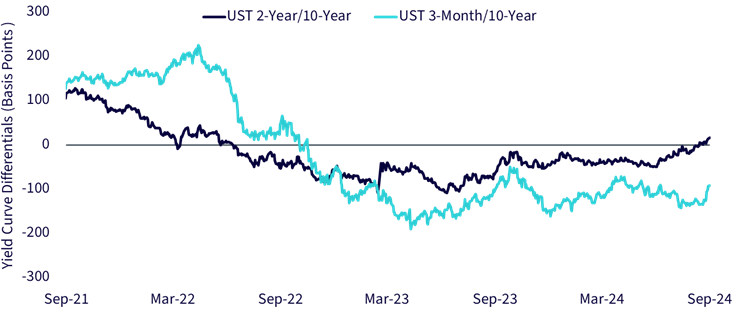
- In the days leading up to the September FOMC meeting, the U.S. Treasury UST 2-Year/10-Year yield curve un-inverted, reaching positive territory for the first time since June 2022
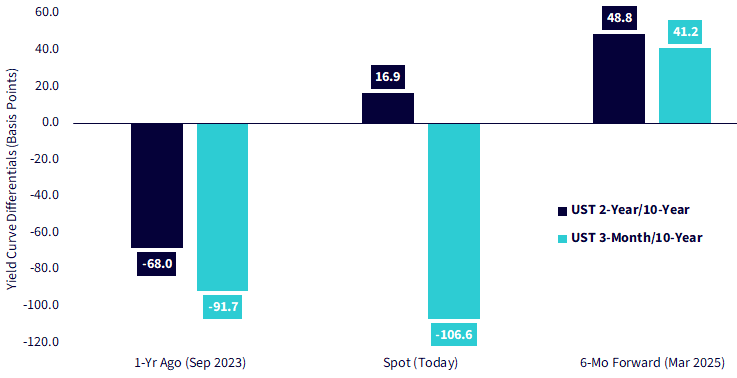
- While the UST 3-Month/10-Year curve remains in inverted territory, both measures of yield curve steepness are forecast to be positive six months from now
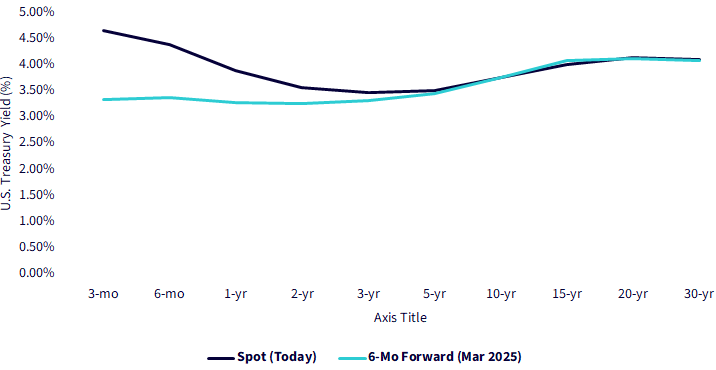
- Forward curves are pricing in a normalizing yield curve with longer-term interest rates at levels much higher than what investors experienced throughout the prior decade
- In this context, we have moved to neutral duration within our model portfolios, and recommend investors consider barbell strategies to help lock in higher yields into the future
This article is relevant to financial professionals who are considering offering model portfolios to their clients. If you are an individual investor interested in WisdomTree ETF Model Portfolios, please inquire with your financial professional. Not all financial professionals have access to these Model Portfolios.
As highlighted in Kevin Flanagan’s recent blog, the Federal Reserve officially initiated a new rate-cutting cycle with a 50-basis-point reduction at the September FOMC meeting, bringing the Fed Funds target range to 4.75%–5.00%.
In the lead-up to this decision, the U.S. Treasury 2-Year/10-Year yield curve un-inverted, entering positive territory for the first time since July 2022.
Figure 1: U.S. Treasury Yield Curves Steepening, with UST 2-Year/10-Year Differential Now in Positive Territory
Sources: WisdomTree, FactSet, as of 9/23/24. Past performance is not indicative of future returns.
Meanwhile, another closely watched yield curve, the UST 3-Month/10-Year yield differential, remains in inverted/negative territory. However, the market is pricing in over five additional 25 basis point Fed rate cuts by March 2025, likely pushing both yield curves into positive territory.
Figure 2: U.S. Treasury Yield Curve Differentials: Then, Now, and What’s Ahead
Sources: WisdomTree, FactSet, as of 9/23/24. Past performance is not indicative of future returns.
Beyond these specific maturity points, the market is pricing in a yield curve that is much more positively sloped in general six months from today.
Figure 3: U.S. Treasury Yield Curves: Spot (Today) vs. 6-Months Forward Curve
Sources: WisdomTree, FactSet, as of 9/23/24. Past performance is not indicative of future returns.
Embedded in these forward curves is the collective view among market participants that the Fed’s dovish outlook will persist and the U.S. economy will remain resilient. Should either one of these come into question, these future expectations could likely shift.
How should investors position their portfolios in this dynamic interest rate environment?
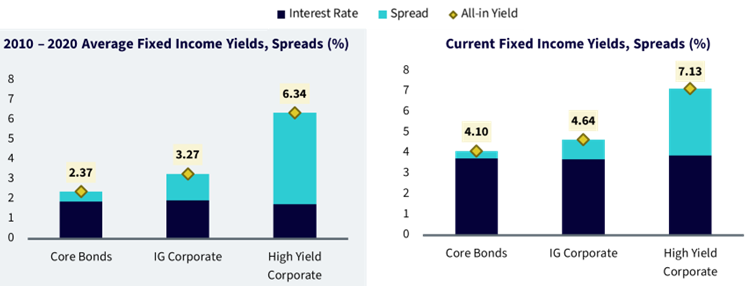
While short-term interest rates are likely headed lower, we remain in a New Rate Regime, and overall bond yields are starting from much higher levels than were observed throughout the prior decade.
Figure 4: U.S. Treasury Yield Curves: Spot (Today) vs. 6-Months Forward Curve
Source: WisdomTree, Bloomberg; as of September 30, 2024. Core bonds based on Bloomberg U.S. Aggregate Bond Index. IG Corporate based
on Bloomberg U.S. Corporate Bond Index. High Yield Corporate based on Bloomberg U.S. High Yield Corporate Bond Index. Past performance
is not indicative of future results. You cannot invest directly in an index.
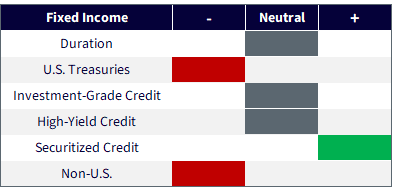
To help manage reinvestment risk and lock in higher yields, we’ve shifted to a neutral duration stance in our model portfolios, recommending that investors explore barbell strategies. This approach enables investors to balance short-term/floating rate strategies with longer term bonds. The result is a portfolio that maintains exposure to the ultra-short end (which we still view as attractive) while limiting any overall interest rate sensitivity mismatch with broader fixed income performance benchmarks.
From a sector standpoint, the resilient economic landscape provides a supportive backdrop for US credit, but spreads have largely priced this in. We remain constructive on quality-screened investment grade and high yield corporate bonds but see better valuation prospects in securitized assets and agency mortgage-backed securities.
Figure 5: Current Fixed Income Strategic Positioning and Outlook
Source: WisdomTree, as of September 30, 2024.
Financial advisors can learn more about the WisdomTree CIO Managed lineup of fixed income and multi-asset Model Portfolios by visiting our Portfolio Solutions offerings.
Important Risks Related to this Article
For financial advisors: WisdomTree Model Portfolio information is designed to be used by financial advisors solely as an educational resource, along with other potential resources advisors may consider, in providing services to their end clients. WisdomTree’s Model Portfolios and related content are for information only and are not intended to provide, and should not be relied on for, tax, legal, accounting, investment or financial planning advice by WisdomTree, nor should any WisdomTree Model Portfolio information be considered or relied upon as investment advice or as a recommendation from WisdomTree, including regarding the use or suitability of any WisdomTree Model Portfolio, any particular security or any particular strategy.
For retail investors: WisdomTree’s Model Portfolios are not intended to constitute investment advice or investment recommendations from WisdomTree. Your investment advisor may or may not implement WisdomTree’s Model Portfolios in your account. The performance of your account may differ from the performance shown for a variety of reasons, including but not limited to: your investment advisor, and not WisdomTree, is responsible for implementing trades in the accounts; differences in market conditions; client-imposed investment restrictions; the timing of client investments and withdrawals; fees payable; and/or other factors. WisdomTree is not responsible for determining the suitability or appropriateness of a strategy based on WisdomTree’s Model Portfolios. WisdomTree does not have investment discretion and does not place trade orders for your account. This material has been created by WisdomTree, and the information included herein has not been verified by your investment advisor and may differ from information provided by your investment advisor. WisdomTree does not undertake to provide impartial investment advice or give advice in a fiduciary capacity. Further, WisdomTree receives revenue in the form of advisory fees for our exchange-traded Funds and management fees for our collective investment trusts.

About the contributor

Andrew Okrongly, CFA
Director, Model Portfolios
Andrew Okrongly joined WisdomTree in 2022 as a Director on the Model Portfolios Team. He is responsible for the design and ongoing management of model portfolios and custom solutions for portfolio managers and advisors. Andrew is also a member of the Model Portfolio Investment Committee. Prior to joining WisdomTree, Andrew was a Director on the Outsourced Chief Investment Officer (OCIO) team at Commonfund, where he was responsible for macro-economic analysis and advising institutional clients on strategic and tactical asset allocation. Andrew began his career at BlackRock where he held a variety of fixed income and multi-asset investment roles. Andrew received a BBA degree from the University of Michigan and is a holder of the Chartered Financial Analyst designation.