


Model Portfolios Are Mainstream. Now Advisors Want Personalization.
Published June 23, 2026

Ryan Krystopowicz, CFA
Head of RIA Portfolio Solutions Distribution & Specialists
Key Takeaways
- Model portfolios have become core infrastructure for advisory practices—with 72% of advisors now using either models alone or alongside SMAs/direct indexing—but the next frontier is delivering greater personalization and tax-aware outcomes without sacrificing scale.
- Advisors increasingly view tax optimization, customization and client-specific implementation as the biggest gaps in traditional models, creating demand for solutions that combine institutional portfolio management with household-level personalization.
- The firms best positioned to differentiate may be those that pair model portfolios with tax-aware SMAs, direct indexing and advanced implementation technology, allowing advisors to act as “Financial M.D.s” while delivering a more customized client experience.
Model portfolios have helped many advisors solve for scale. The next challenge is more nuanced: how do advisors keep that scale while delivering more personalization, tax awareness and differentiated value to clients?
That was the central theme that stood out to me during a recent webcast hosted by RIA Channel with WisdomTree and Quorus. The polling results from advisors were especially telling. They did not suggest that advisors are rejecting models. Quite the opposite. They suggested that the model portfolio conversation has entered its next phase.
When asked how they currently implement portfolios, roughly 37% of advisors said they primarily use model portfolios, while another 35% said they use a mix of models and SMA strategies or direct indexing.1
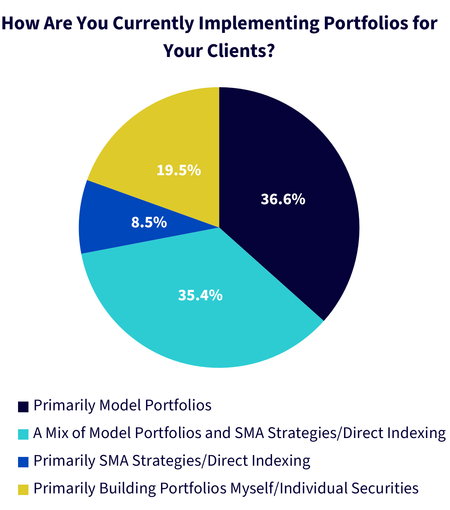
To me, that means models are no longer a niche implementation tool. They are becoming core infrastructure for modern advisory practices.
But infrastructure alone is not enough.
When advisors were asked where model portfolios fall short, the top response was limited tax awareness and after-tax optimization at 38%. Other common responses included the inability to tailor portfolios to specific client needs and difficulty differentiating the advisor’s value proposition, both around 31%.2
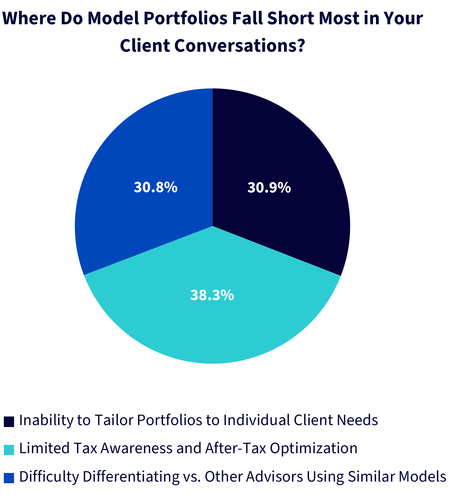
That gets to the heart of the issue. Advisors like the efficiency, consistency and institutional oversight that models can provide. But they also know clients do not have standardized financial lives. Clients have legacy holdings, embedded gains, concentrated positions, tax sensitivities, income needs, personal preferences and different expectations around communication.
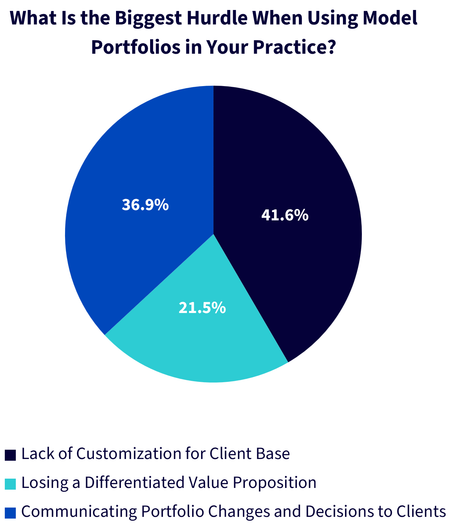
The hurdle question reinforced this. 42% of advisors cited lack of customization as a key obstacle to broader model adoption. Another 37% pointed to the challenge of communicating portfolio changes and decisions to clients. 22% cited concern about losing a differentiated value proposition.3
This is where I think the “Financial M.D.” concept becomes useful — and it is a framework I have written about before.
A good doctor does not personally invent every test, build every tool or manufacture every medicine. Patients do not expect that. What they expect is a trusted professional who understands their situation, leverages the right specialists and resources, makes a thoughtful diagnosis and communicates the plan clearly.
Financial advisors are increasingly playing a similar role.
In WisdomTree’s model portfolio research, 9 out of 10 investors welcome their advisor to use third-party model portfolios.4 The same research found that 7 out of 10 investors believed model portfolio use would be an upgrade, and 7 out of 10 believed it could improve portfolio performance.
That is powerful because many advisors still worry that using third-party models may weaken their value proposition. The data suggests clients often see it differently. They view model portfolios as a form of leveraged expertise: their advisor combining personal knowledge of the client with the investment research, resources and portfolio management capabilities of an institutional asset manager.
And that is the essence of becoming the client’s Financial M.D. The advisor remains the trusted relationship, the diagnostician and the communicator — while leveraging specialists, technology and institutional resources to help support a more personalized portfolio experience.
But the RIA Channel polling shows that leveraged expertise now needs an added layer: personalization at scale.
That is where SMAs, direct indexing and tax-aware implementation come into the conversation. These tools can help advisors extend the model portfolio value proposition beyond “outsourced asset allocation” toward more customized, tax-sensitive client outcomes.
The challenge is that personalization can create complexity.
A model portfolio may look scalable on paper. In practice, taxable accounts, cash flows, restrictions, transitions and rebalancing can create meaningful operational drag. Advisors do not just need a model; they need an implementation engine that helps make the model work across real client accounts.
That is why the Quorus discussion was so relevant to the webcast and can serve as the “missing link.”
Quorus is designed to support custom, tax-aware portfolio management across model portfolios, SMAs and unified managed accounts. Its capabilities include daily, lot-level management, tax-loss harvesting, tax-aware transitions, trading, reconciliation and after-tax reporting.
The investor demand is there as well. The Quorus materials cited Cerulli research showing that 78% of affluent investors believe it is important that their accounts are customized to their specific situation, while 69% believe it is important that their provider helps reduce their tax bill.5
That lines up almost perfectly with what advisors told us in the polling.
Advisors want the scale of models. Clients want personalization and tax awareness. The missing link is the operational infrastructure to deliver both without forcing advisors to become full-time traders, tax-lot analysts and portfolio operations specialists.
To me, this is the future of model adoption: models plus personalization, institutional portfolio management plus advisor differentiation, and technology that helps advisors spend more time acting as their clients’ Financial M.D.
The advisors who get this right may be the ones who combine the best of both worlds: scalable portfolio implementation and a client experience that still feels personal, tax-aware and deeply connected to each household’s goals.
WisdomTree Portfolio Solutions Informational Sessions
Join WisdomTree experts for concise, 15-minute sessions on how institutional insights and personalized strategies can be applied to build, customize, and manage portfolios — supporting more consistent and meaningful client outcomes.
Register here.
1 RIA Channel, “Scaling Personalization: Tax-Aware SMA Strategies and No-Fee Model Trading,” WisdomTree Webcast Series, hosted by WisdomTree, April 7, 2026. Available on demand at RIA Channel.
2 Ibid.
3 Ibid.
4 WisdomTree’s Models Research Initiative. Interviews conducted 10/16/19–7/21/20. WisdomTree’s Models Research Initiative maintained a +/- 2.3% margin of error among consumer investors across generations and a +/- 6.2% error rate among financial advisors. A mixed methodology was applied that included a robust base of more than 2,000 constituents in the models’ value chain, as well as dozens of in-depth interviews that were conducted on the topic.
5 Cerulli Affluent Investor Tracker. 2025
Important Risks Related to this Article
There are risks involved with investing, including possible loss of principal. Using an asset allocation strategy does not ensure a profit or protect against loss.
Neither WisdomTree, Inc., nor its affiliates, provide tax advice. All references to tax matters or information provided in this material are for illustrative purposes only and should not be considered tax advice and cannot be used for the purpose of avoiding tax penalties. Investors seeking tax advice should consult an independent tax advisor.
The information provided regarding WisdomTree Investment Strategies for SMAs is designed to be used by financial advisors solely as an educational resource, along with other potential resources advisors may consider, in providing services to their end clients. WisdomTree’s Investment Strategies for separately managed accounts (“SMAs”) information and related content are for information only and are not intended to provide, and should not be relied on, for tax, legal, accounting, investment or financial planning advice by WisdomTree, nor should any WisdomTree Investment Strategy information be considered or relied upon as investment advice or as a recommendation from WisdomTree, including regarding the use or suitability of any WisdomTree Investment Strategies for SMAs, any particular security or any particular strategy.
WisdomTree and Quorus Relationship: WisdomTree, Inc., the parent company of WisdomTree Asset Management, Inc. (“WTAM”), holds a minority equity stake in Quorus Inc. (“Quorus”), and WTAM has commercial arrangements with Quorus under which WTAM Model Portfolios are offered through the Quorus platform, as well as, WTAM Investment Strategies, which may be implemented in separately managed accounts (“SMAs”). For the Investment Strategies used in SMAs, WTAM receives a revenue sharing payment equal to a specified portion of the portfolio management fee collected by Quorus from advisors or end clients and based on the aggregate value of the account. WTAM does not provide investment advice in connection with such SMA implementations. Accordingly, WTAM and its affiliates have a financial interest in the success of Quorus and may benefit economically from the relationship. The author of this post is a WTAM employee and serves on Quorus’s board of directors. This material is for informational purposes only, does not constitute investment advice or a recommendation to buy or sell any security.
This material has been prepared by WisdomTree Asset Management.
About the contributor

Ryan Krystopowicz, CFA
Head of RIA Portfolio Solutions Distribution & Specialists
Ryan drives the commercialization of model portfolio solutions and supports advisor growth strategies. He plays a central role in WisdomTree’s Model Portfolio Research Study, advancing insights on model adoption, advisor behavior and prospecting opportunities. Ryan's passion for third-party model portfolios and investment outsourcing was cultivated during his tenure at a Registered Investment Advisor, where he held roles across research and operations. He also brings WisdomTree’s research on advisor online presence to life through high-impact programming that turns key findings into practical guidance for improving digital credibility and prospect engagement. Ryan is a CFA charterholder and a graduate of Loyola University of Maryland.