

Looking Past the Narrative on Japan into Fundamentals
Published September 21, 2018

Global Chief Investment Officer
One of the markets caught up in global trade fears that continues to perplex investors is Japan. The Japanese markets are trading near their lowest valuation levels in the last 30 years, supported by increased profitability, better returns on capital and improving profit margins. A recent article in The Wall Street Journal by Mike Bird summarizes sentiment and the environment nicely:
“Something strange is going on with corporate Japan: Profits have soared. . . . Yet foreign investors, by and large, aren’t that interested. . . . After decades of stagnation, profitability has soared under Prime Minister Shinzo Abe’s economic revival program, dubbed Abenomics. Profit margins at nonfinancial firms hit a record 7.7% in the second quarter. This ratio, which compares earnings before interest payments and taxes with sales, rarely topped 4% until a few years ago.”1
While Japan tends to trade with its currency and global macro sentiment, this market behavior masks some strong underlying trends in corporate governance and profitability.
One element of Abenomics involved the creation of new stock indexes that encouraged a focus on return on equity (ROE). Companies have responded, increasing both dividends and buybacks and better managing the cash on the “bloated balance sheets” (which are often cited as a reason to stay away from corporate Japan).
Below, I review some of the key fundamental attributes of the WisdomTree Japan Dividend Index (which also serves as the underlying for the WisdomTree Japan Hedged Equity Index) to show how globally oriented Japanese companies are trading on valuation and a multiple basis.
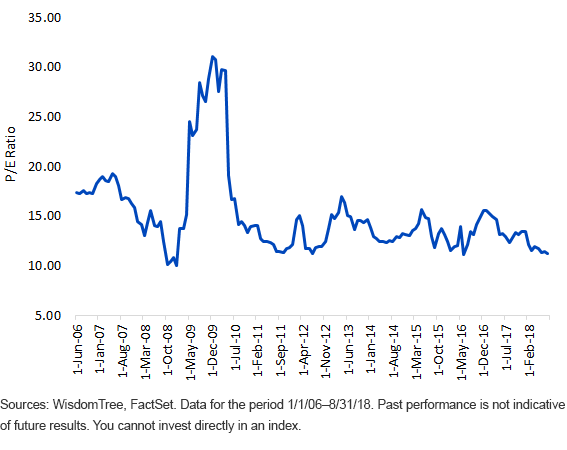
The median price/earnings (P/E) ratio over the last 12 years was 13.9x, and the latest P/E ratio was 11.8x, a 20% discount to the median. These valuation levels are similar to the depression during the financial crisis 10 years earlier, before earnings collapsed.
The P/E ratio has only been lower in these 12 years less than 4% of the time—meaning that Japan is in the 96% range for inexpensiveness on P/E ratio valuation in the last 12 years.
WisdomTree Japan Dividend Index–P/E Ratio Excluding Negative Earnings
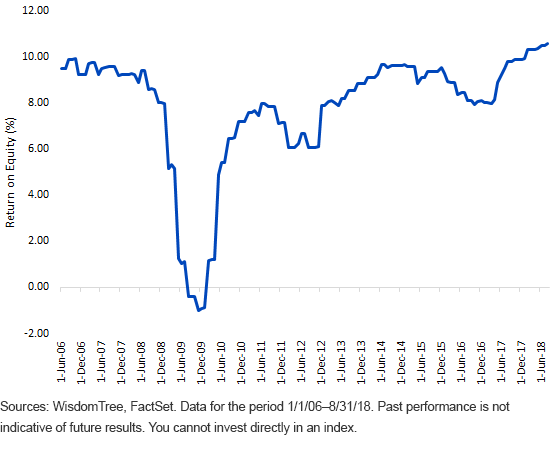
These low valuations come despite the broad improvement in one of WisdomTree’s preferred “quality” metrics: ROE. In the 12 years we have been calculating it for the WisdomTree Japan Dividend Index, there had never been a ROE figure greater than 10%—in 2006, when we launched the Index, it was close to those levels, but it dropped sharply during the financial crisis and has been building back slowly ever since.
Showing the relative profitability figures and better management of corporate balance sheets, we saw this figure go past 10% in 2018. We also see room for further improvement given the broad increase in shareholder returns and still-high cash levels on balance sheets that are starting to get paid out. ROE figures for a similar U.S. index are closer to 15%—and as Japan tries to attract more global capital, being good stewards of capital should keep pushing ROEs higher.
WisdomTree Japan Dividend Index–Return on Equity
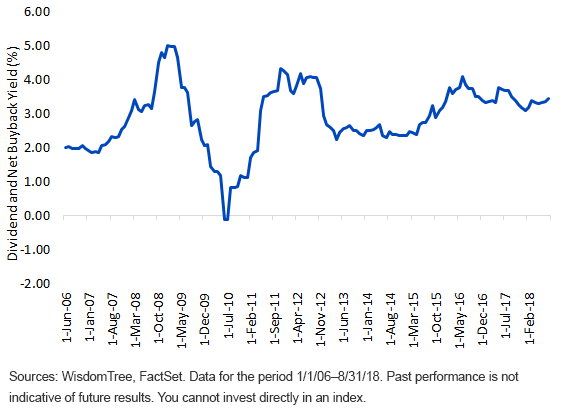
The dividend yield on our Index is 2.7%, and the net buyback yield was 0.7% at the end of August, giving a total dividend and net buyback yield of 3.4%. The median of this ratio over the last 12 years has been 2.9%. In general, the broad increase in this ratio ever since the end of 2012 shows that corporate Japan has been driven by rising dividends and buybacks and not just rising prices—that was also reflected in the declining P/E ratios presented earlier.
WisdomTree Japan Dividend Index–Dividend and Net Buyback Yield
In early 2018, Japan traded down largely with global sentiment on trade fears and uncertainty associated with U.S. policy—not for some decrease in its fundamental measures of value. While many believe Japan will always be a “value trap,” we see good evidence that corporate payouts are favoring more shareholder-friendly actions and see quality metrics and margins improving.
On September 17, Josh Demasi tweeted something that I think summarizes the situation quite well:
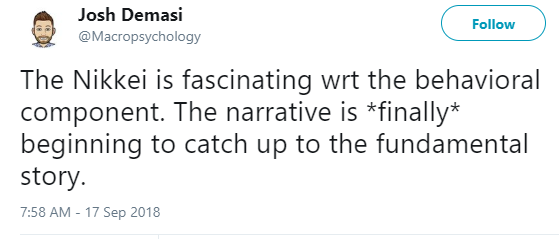
For most of this year, the narrative was that Japan is going to be hurt by trade wars and perhaps a peaking in global growth and slowdown in China. Improved trade dynamics between Japan and China might be one outcome of the U.S-China spat that many are not factoring into their models. We like Japan as an underowned value opportunity.
1Mike Bird, “Profits Jump at Japanese Companies, but Foreign Investors Don’t Bite,” The Wall Street Journal, 9/9/18.
Important Risks Related to this Article
Investments focused in Japan increase the impact of events and developments associated with the region, which can adversely affect performance.
About the contributor

Global Chief Investment Officer
Jeremy Schwartz has served as Global Chief Investment Officer since November 2021 and leads WisdomTree’s investment strategy team in the construction of WisdomTree’s equity Indexes, quantitative active strategies and multi-asset Model Portfolios. Jeremy joined WisdomTree in May 2005 as a Senior Analyst, adding Deputy Director of Research to his responsibilities in February 2007. He served as Director of Research from October 2008 to October 2018 and as Global Head of Research from November 2018 to November 2021. Before joining WisdomTree, he was a head research assistant for Professor Jeremy Siegel and, in 2022, became his co-author on the sixth edition of the book Stocks for the Long Run. Jeremy is also co-author of the Financial Analysts Journal paper “What Happened to the Original Stocks in the S&P 500?” He received his B.S. in economics from The Wharton School of the University of Pennsylvania and hosts the Behind the Markets podcast. Jeremy is a member of the CFA Society of Philadelphia.