

Leading Economic Indicators Suggest It’s Time for the Fed to Hike
Published September 14, 2015

Chief Investment Officer, Fixed Income and Model Portfolios
With the underlying improvement in the August employment report, domestic economic strength continues to move the Federal Reserve (Fed) toward liftoff. Leading economic indicators would suggest it is about time: the trend has been above zero for 68 consecutive months. This is the longest period of Fed inactivity on rates amid economic recovery since 1971. While the expansion has been noteworthy for its lack of robustness, it is still a very long time to remain in positive territory without a monetary policy adjustment. The Leading Economic Indicators Index is a composite of 10 economic and market indicators, whose levels and changes tend to foreshadow changes in the overall economy. Building permits, average weekly hours, new orders and the spread between 10-Year Treasuries and the Federal Funds Rate are just a few of the indicators incorporated into the index. It is published every month by The Conference Board. The trend in leading economic indicators (year over year) has been relatively useful in validating thoughts on the economy and monetary policy. For example, the Fed punctuated both the 1994–1995 and 1999–2000 tightening cycles by hiking rates when the trend in leading economic indicators was decelerating rapidly. Both periods presented tremendous opportunities for bond managers to lengthen duration. Recent Period of Strength Is Longest by Far With the trend exceeding 4% since mid-2013, I was curious about how this recent period of strength compared to other periods. As illustrated in the graph and table below, there have been seven periods since 1971 in which the trend in leading economic indicators has remained positive for an extended period of time. The previous six periods have averaged 54 months in length, with average Fed rate movements of +2.33%. Interestingly, the time until the first rate hike in these periods has ranged from 1 month to 36 months, with the average being a little over 15 months. Trend in Leading Economic Indicators vs. Fed Funds Target
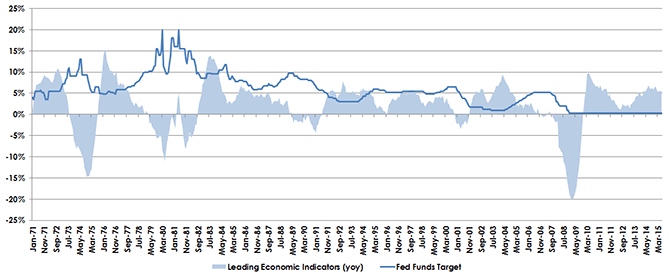
Monetary Policy Changes in Regimes of Positive Trends in Leading Economic Indicators, January 1971- July 2015
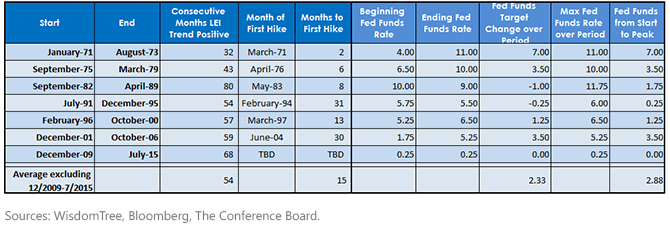
This recent streak, which started at the end of 2009, is now 68 months old, and still the Fed remains inactive—37 months longer than the second-longest period. The extraordinary monetary policy triggered by the financial crisis has in many ways overwhelmed economic fundamentals and altered incentives for participants in the capital markets. But followers of economic cycles continue to keep nuggets of information like this in their back pockets and wonder whether the Fed’s inactivity in recent years could come back to haunt us when cyclical forces return. With the markets still relatively complacent about the upcoming Fed meeting, we could see rates adjust higher and additional volatility in the equity and commodity markets. The August employment reports could give the Federal Reserve the domestic cover to hike rates despite lingering global concerns. The trend in leading economic indicators would argue it’s about time.
Categories
About the contributor

Chief Investment Officer, Fixed Income and Model Portfolios
Rick Harper serves as the Chief Investment Officer, Fixed Income and Model Portfolios at WisdomTree Asset Management, where he oversees the firm’s suite of fixed income and currency exchange-traded funds. He is also a voting member of the WisdomTree Model Portfolio Investment Committee and takes a leading role in the management and oversight of the fixed income model allocations. He plays an active role in risk management and oversight within the firm.
Rick has over 29 years investment experience in strategy and portfolio management positions at prominent investment firms. Prior to joining WisdomTree in 2007, Rick held senior level strategist roles with RBC Dain Rauscher, Bank One Capital Markets, ETF Advisors, and Nuveen Investments. At ETF Advisors, he was the portfolio manager and developer of some of the first fixed income exchange-traded funds. His research has been featured in leading periodicals including the Journal of Portfolio Management and the Journal of Indexes. He graduated from Emory University and earned his MBA at Indiana University.