
WSPC
Space Economy Fund

Published September 18, 2026

Global Head of Research
On August 22, 2026, SpaceX posted on X: "Falcon 9 lifts off from California and delivers 27 Starlink satellites to orbit, completing our 100th Falcon launch of the year.”1 That is SpaceX's own count, in SpaceX's own words, not a journalist's tally. It's worth being precise about what the number does and doesn't capture. It is specifically the 100th Falcon launch (Falcon 9 and Falcon Heavy combined), not necessarily every orbital mission the company has flown this year under every possible counting convention. Media trackers using slightly different methodologies had already flagged the 100-launch mark four days earlier, on August 18–19, following a separate Starlink mission from Vandenberg.2 The two counts differ by a handful of missions and a few days, a small but useful illustration of how even a ‘simple’ statistic requires a stated methodology.
What doesn't change under either count is the shape of the trend. SpaceX's own milestone announcement is, by itself, unremarkable. We’re talking about a routine polar-orbit Starlink delivery, a booster landing, a few dozen satellites folded into an already-enormous constellation. What makes it worth writing down is the number attached to it, and how ordinary that number has become. This is still rocket science at the end of the day.
The public narrative around SpaceX runs almost entirely through spectacle, including such events as Starship test flights, orbital refueling demonstrations, and the occasional explosion. But the number that should be shaping how we think about the investable space economy isn't any single dramatic mission. It's the cadence, and it’s possible that the cadence has quietly crossed a threshold from "achievement" to "infrastructure."
The WisdomTree Space Economy Fund (WSPC)3 is designed with sensitivity to the broader ecosystem of companies comprising the space economy. If larger numbers of launches are becoming normalized, we see this as an incredible indicator of what could happen in the coming years.
Set the 100-launch milestone against the company's own history and the shape of the trend becomes the real headline.
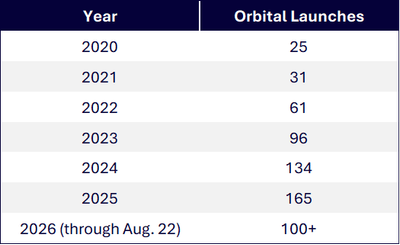
Source: Space.com (2025); SpaceX [@SpaceX] (2026). Note: Figures for 2020–2025 reflect orbital launches (Falcon 9 and Falcon Heavy combined) as reported in Space.com (2025); non-orbital Starship test flights are excluded. The 2026 figure reflects SpaceX’s own count of Falcon launches (Falcon 9 and Falcon Heavy combined) as of August 22, 2026, and will continue to rise through year-end. Other trackers report slightly different annual totals (typically within 1–3 launches) depending on whether launch failures, non-orbital tests, or in-progress missions are included; readers should treat single-digit variation across sources as a function of counting convention rather than factual disagreement.
SpaceX first crossed 100 launches in a single year in 2024, and it did not reach that mark until well into the fall. In 2026, it reached the same number roughly two months sooner. A company that flew 25 times in all of 2020 is now on a pace of roughly three launches per week. It’s amazing that most discussions of SpaceX focus on Starship or AI data center infrastructure well before they mention three launches per week.
There is a useful analytical distinction buried in that comparison.
When a research team at Spaceflight Now or Space.com describes triple-weekly launches as no longer "registering as news," they are describing the exact moment an activity stops being an event and becomes plumbing. Society has become used to trains leaving the station or flights departing the gate. Now, Falcon 9s go to orbit.
Getting to three launches a week is an operations accomplishment, and the mechanics behind it are the "nuts and bolts" that rarely make it into general coverage.
The clearest illustration is booster reuse. SpaceX has been steadily compressing the turnaround time between flights of the same first-stage booster.
In March 2025, booster B1088 completed two separate missions, NASA's SPHEREx/PUNCH launch and the NROL-57 mission for the National Reconnaissance Office, just nine days apart, breaking a previous record of roughly two weeks.4 That mission also happened to be Falcon 9's 450th launch overall. By January 2026, SpaceX had also compressed pad-level turnaround, which is the gap between two different missions launching from the same physical pad, to 45 hours at Cape Canaveral's Space Launch Complex 40, breaking the previous record by nearly six hours.5
Pad turnaround time and booster reuse cadence are the two variables that most directly determine how many missions a fixed set of physical assets, specifically, a handful of pads and a finite booster fleet, can support in a year. When those numbers compress, the ceiling on annual launch capacity rises without SpaceX needing to build a single new pad. That is the mechanical explanation for how the company went from 25 launches in 2020 to 165 in 2025 without a proportional increase in launch infrastructure.
A second, quieter signal that launch has become infrastructure: the federal government has started taxing it like infrastructure. A provision of the One Big Beautiful Bill Act, signed into law on July 4, 2025, directs the FAA to begin charging user fees on every licensed launch and reentry starting in 2026, with the fee calculated by payload weight. For 2026, that works out to $0.25 per pound of payload, capped at $30,000 per mission.6
The FAA's own framing of the fee is telling, in that it exists to fund the Office of Commercial Space Transportation's work integrating launches and reentries into the national airspace system, the same logic behind airline ticket taxes that fund air traffic control. The agency licensed 199 launches and seven reentries in 2025 alone, and its licensing office has requested a 43% budget increase for 2027 to keep pace with a launch-demand surge of more than 50% since 2023. Regulators do not build fee schedules and staff up licensing offices around activities they consider novelty demonstrations. They do it for things they expect to keep happening, indefinitely, at scale, which is precisely the definition of infrastructure.
None of this cadence would matter if there weren't sustained demand pulling it forward, and the demand driver is mundane by design, Starlink. The majority of 2026's hundred-plus launches have been dedicated Starlink missions, continuing a pattern from 2024 and 2025. The constellation crossed 11,000 satellites in low Earth orbit in August 2026.7
None of this cadence would matter if there weren't sustained demand pulling it forward, and the demand driver is mundane by design, Starlink. The majority of 2026's hundred-plus launches have been dedicated Starlink missions. In its S-1 filing, SpaceX disclosed that Starlink's monthly average revenue per user fell from $91 in 2024 to $66 in the first quarter of 2026, and stated plainly that it expects the figure to keep declining as the subscriber base shifts further outside North America and toward lower-priced plans. That is SpaceX's own stated strategy, not an analyst's inference.8
Prioritize subscriber volume over per-user revenue.
In other words, the launch cadence is being subsidized by a volume strategy on the consumer side, not a premium one, which is a meaningfully different demand story than "the world needs more satellites," and the kind of detail a headline about a 100th launch doesn't carry.
The investable implication is a shift in emphasis, not a new idea. If launch is infrastructure rather than spectacle, then the interesting exposure increasingly sits one layer away from the rocket itself. It may include such things as:
A launch provider that can put a payload into orbit three times a week, on a predictable schedule, at a predictable cost, is not selling a moonshot. It is selling a supply chain input, closer in kind to freight capacity than to a technology breakthrough.
That reframing is the point of pulling together the year-by-year numbers rather than reacting to any single mission. The progression is clear: 25 launches in 2020, 165 in 2025 and 100 by mid-August 2026. The trajectory itself is the story, and it is a story about industrial capability compounding quietly in the background: infrastructure, not spectacle.
1 Source: SpaceX [@SpaceX]. (2026, August 22). Falcon 9 lifts off from California and delivers 27 Starlink satellites to orbit, completing our 100th Falcon launch of the... [Tweet]. X.
2 Sources: Space.com. (2026, August 19). SpaceX launches its 100th mission of the year, sends Starlink satellites to orbit; Spaceflight Now. (2026, August 21). SpaceX launches 100th orbital mission of 2026.
3 As of August 21, 2026, SpaceX represented a 13.42% weight in WSPC. Holdings subject to change.
4 Sources: BGR. (2026, March 14). How quickly can SpaceX's Falcon 9 rocket be ready to relaunch?; UPI. (2025, March 21). SpaceX sets rocket re-use record Friday with a nine-day turnaround.
5 Sources: Spaceflight Now. (2026, January 14). SpaceX breaks pad turnaround record at Cape Canaveral with midday Starlink launch; Technobezz. (2026, February 13). SpaceX sets new launch pad turnaround record with 45-hour gap.
6 Source: Space Launch and Reentry Licensing and Permitting User Fees, 91 Fed. Reg. 21,591 (Apr. 22, 2026)
7 Source: Space.com. (2026, August 19). SpaceX launches its 100th mission of the year, sends Starlink satellites to orbit.
8 Source: Space Exploration Technologies Corp. (2026). Form S-1 registration statement. U.S. Securities and Exchange Commission.
There are risks associated with investing, including possible loss of principal. The Fund invests primarily in equity securities that provide exposure to global companies involved in activities that form the space economy (“Space Economy Companies”), which are subject to significant technological complexity, high capital requirements, extended development cycles, and uncertainty regarding the commercial adoption of space-based products and services. These companies face intense competition, rapid technological change, and evolving domestic and international regulatory requirements, which may adversely affect their operations and financial performance. The Fund’s exposure to certain sectors may increase its vulnerability to any single economic or regulatory development related to such sector. As this Fund can have a high concentration in some issuers, the Fund can be adversely impacted by changes affecting those issuers.
The Fund concentrates its investments in the Capital Goods and Technology Hardware & Equipment groups of industries and expects to have significant exposure to the Industrials, Information Technology, and Communication Services sectors, making it more susceptible to developments affecting those industries and sectors.
Investments in non-U.S. securities involve political, regulatory, and economic risks that may not be present in U.S. securities. For example, foreign securities may be subject to risk of loss due to foreign currency fluctuations, political or economic instability, or geographic events that adversely impact issuers of foreign securities. Investments in securities and instruments traded in developing or emerging markets, or that provide exposure to such securities or markets, can involve additional risks relating to political, economic, or regulatory conditions not associated with investments in U.S. securities and instruments or investments in more developed international markets.
While the Fund is actively managed, the Fund's investment process is heavily dependent on quantitative models, including artificial intelligence-based models, and the models may not perform as intended.
Please read the Fund's prospectus for specific details regarding the Fund's risk profile.
Space Economy Fund


Global Head of Research
Christopher Gannatti began at WisdomTree as a Research Analyst in December 2010, working directly with Jeremy Schwartz, CFA®, Director of Research. In January of 2014, he was promoted to Associate Director of Research where he was responsible to lead different groups of analysts and strategists within the broader Research team at WisdomTree. In February of 2018, Christopher was promoted to Head of Research, Europe, where he was based out of WisdomTree’s London office and was responsible for the full WisdomTree research effort within the European market, as well as supporting the UCITs platform globally. In November 2021, Christopher was promoted to Global Head of Research, now responsible for numerous communications on investment strategy globally, particularly in the thematic equity space. Christopher came to WisdomTree from Lord Abbett, where he worked for four and a half years as a Regional Consultant. He received his MBA in Quantitative Finance, Accounting, and Economics from NYU’s Stern School of Business in 2010, and he received his bachelor’s degree from Colgate University in Economics in 2006. Christopher is a holder of the Chartered Financial Analyst Designation.