

Japan Is Inexpensive—Where to Look for Performance
Published July 7, 2016

Senior Advisor
Yes, this is a very good time to re-engage with Japan, in our view. The Brexit capitulation trade forced TOPIX down to almost 30% below its August 2015 peak,1 which in turn makes Japanese equities the most attractively valued equity market in the world. More importantly, Japan is not a “value trap.” In coming weeks, both micro and macro forces that should trigger a positive inflection point for Japanese large-cap performance will begin to align, in our view: On the micro side, dividend growth and share buyback momentum is likely to be maintained at the upcoming earnings season, despite negative earnings growth. On the macro side, a coordinated demand boost by the Ministry of Finance (MoF) and the Bank of Japan (BOJ) is on its way, with the BOJ poised to finance an ¥8 trillion to ¥10 trillion extra budget that includes “helicopter money” cash transfers to Japan’s working poor. In short, attractive valuations + concrete triggers = time to re-engage in Japanese large caps. Deep Value It Is… In our view, this is true both from an absolute and relative perspective: MSCI Japan trades on a 1.1x price-to-book (P/B) ratio, which is in the bottom 10% range against its long-term history and well below the 2.0x for the MSCI World Index. Japan’s trailing price-to-earnings (P/E) ratio now stands at 14.2x. This is at the very bottom 2% against its history and well below the 20.2x for MSCI World. These are just the highlights. We see below in the more detailed global valuation matrix that by whichever metrics you choose, Japan is clearly winning the global valuation beauty contest. Global Valuation Matrix: Japan Is Looking More and More Attractive Overview of MSCI Equity Market Valuations by Region: MSCI Market Capitalization-Weighted Benchmarks
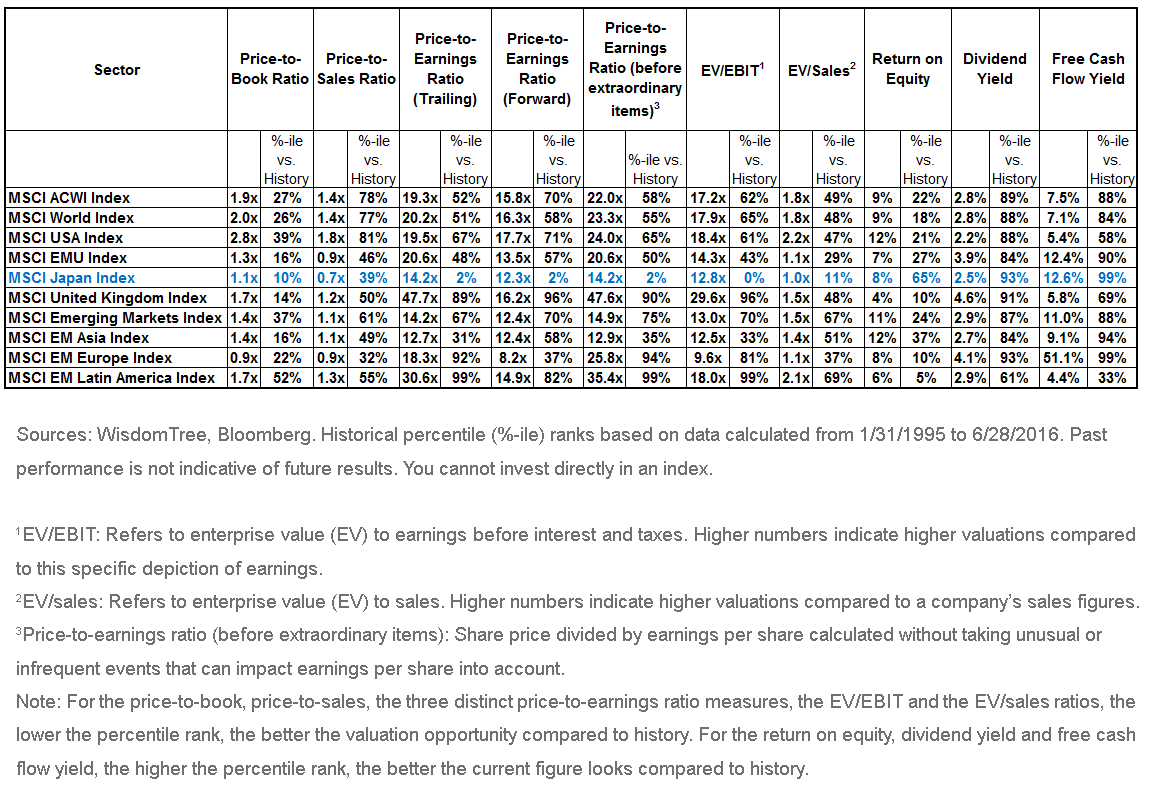
…But Is Japan a “Value Trap”? While valuations are very attractive, performance ratios appear less so: Japan’s return on equity (ROE) stands at 8%, which is not just below the 9% of the MSCI World but also at the 68% percentile mark—high by historical standards measured against its own history. Ditto for the dividend yield, 2.5% currency, which is in the 93rd percentile compared to its history. This is where our key pillar of the Japan bull thesis comes in: Corporate governance has fundamentally changed, and capital stewardship is now a principal focus for corporate managers. Equity returns and dividends are on a structural up-trend, in our view. The economic dynamic here is Japan’s declining savings rate, forcing higher rates of return, with the newly introduced Stewardship Code2 and Governance Code3 helping to engender management behavior. The fact that Japan boasts a 12.6% free cash flow yield—MSCI World is 7.1%—suggests there is ample room for a structural rise in shareholder returns. Trigger One: “Show Me the Money” at Upcoming Earnings Season Here, the upcoming earnings results season should prove key to convincing investors that capital stewardship is really changing for the better: The April–June period is expected to be a second consecutive quarter of earnings declines. We will want to see confirmation that dividends will be maintained or even increased and share buybacks continue. The upcoming results season will be all about “show me the money” (from a shareholder perspective). If, as we suspect, dividend growth and share buyback momentum can be maintained, this should be the first concrete trigger to help overcome Japanese value trap fears (the April–June earnings results season will peak in early August). Trigger Two: Coordinated Monetary & Fiscal Stimulus A second positive performance trigger is poised to come from, yes, “Abenomics.” Specifically, a pro-growth boost to aggregate demand is on its way, likely to be delivered by end-August/early September, in our view. Prime Minister Shinzo Abe has already instructed technocrats to prepare a supplementary fiscal boost. Here, an added ¥4 trillion to ¥5 trillion of public infrastructure investment for the reconstruction of the Kumamoto earthquake devastation is bound to be the mainstay. Added elements are expected to bring fiscal support for regional enterprises as well as a new round of cash transfers to the working poor. How exactly helicopter money will be administered is heavily debated, but the helicopter money question appears to have moved from “should” to “how?” In our view, a one-off gift from the treasury to the working poor has become likely. Most importantly, Team Abe is very focused on coordinating added fiscal spending with the Bank of Japan. Specifically, there is great awareness of the diminishing returns from monetary policy. The focus is on linking the central bank balance sheet more directly to aggregate demand. In practical terms, this means that the financing of the coming fiscal boost is poised to come from the BOJ. In our view, the BOJ will increase its quantitative easing by basically the same amount that the MoF will need to fund the extra budget. We expect a deficit-bond-funded extra budget of ¥8 trillion to ¥10 trillion and a boost in the BOJ’s balance sheet growth target from the current ¥80 trillion to between ¥88 trillion and ¥90 trillion. For Japanese large-cap equities, we are approaching a positive turning point, in our view. Valuations are now very attractive, and concrete performance triggers are likely from both micro and macro dynamics unfolding. The time has come to re-engage in Japanese large caps, in our view. 1Source: Bloomberg, with data measured from 8/10/15 to 6/28/16. 2Stewardship Code: “Principles for Responsible Institutional Investors, Japan’s Stewardship Code: To Promote Sustainable Growth of Companies through Investment and Dialogue,” Financial Services Agency, 2/26/14. 3Governance Code: “Japan’s Corporate Governance Code: Seeking Sustainable Corporate Growth and Increased Corporate Value over the Mid- to Long-Term,” JPX: Tokyo Stock Exchange, 6/1/15.
Important Risks Related to this Article
Investments focused in Japan increase the impact of events and developments associated with the region, which can adversely affect performance.
About the contributor
