

Japan GDP – Steady as She Goes, and Still Priced at a Discount
Published May 22, 2017

Senior Advisor
Last week’s gross domestic product (GDP) report confirms that Japan’s economy has turned into a bastion of stability, with both the rate and the balance of growth showing steady improvement: GDP grew at an annualized 2.2% in the January–March quarter. This beat expectations of 1.7% and, more importantly, confirms the fifth consecutive quarter of growth, a feat of positive sequential expansion not achieved in over a decade. Better still: all components of private demand—consumption, capex, housing and exports—contributed positively while the public demand contribution was nil.
From a policy maker perspective, it does not get much better than this: Japan’s economy is entering a more balanced growth phase, with the rate of growth above potential but not so fast as to warrant changes in monetary policy. The Bank of Japan’s “zero-rate anchor” policy is here to stay for at least another 12–15 months, in our view.1 At the same time, prime minister Shinzo Abe’s budget leaves a “war chest” for an added fiscal stimulus boost.
From an investor perspective, the key question is whether Japan’s newfound growth and policy stability deserves to be rewarded with higher multiples, both in absolute terms and compared to other markets. Theoretically, the combination of accelerating and well-balanced growth with continued monetary policy expansion should allow for price multiple expansion, i.e., a drop in the risk premium.
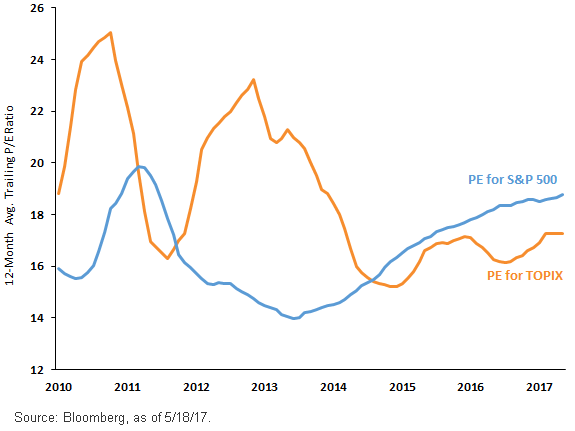
Specifically, Japanese equities have been trading at a discount vis-à-vis U.S. equities, with the price-to earnings (P/E) ratio of the TOPIX (16.2x) trading below the S&P 500 ratio (21.0x). This relative “Japan discount” has been in place since mid-2014, forced by both the steadfast rise in the “U.S. premium” and the drop in Japan’s intrinsic valuation levels.
If we are right and Japanese growth has entered a new, more balanced and self-sustaining up-cycle and, at the same time, Japanese monetary policy will stay the expansionary course and anchor the risk-free bond yield at zero, Japanese multiples should have room to expand. Despite the short-term jitters from policy uncertainty in the U.S., the structural bull-case for Japan remains intact. A “Japan premium” is well deserved, in our view.
Unless otherwise noted, data source is Bloomberg, as of 5/18/2017.
1Refers to a policy of the Bank of Japan targeting a yield of zero on the benchmark 10-Year Japanese Government Bond as part of a low-interest rate stimulus program.
Important Risks Related to this Article
Investments focused in Japan increase the impact of events and developments associated with the region, which can adversely affect performance.
Categories
About the contributor
