

Investing for Better Risk Adjusted Returns
Published August 16, 2016

Chief Investment Strategist
In the asset management industry, assets often follow performance. Funds that beat their benchmarks and the vast majority of their peers tend to have an edge in attracting investor interest and new inflows into their strategies. But investors, and the financial professionals who serve them, also need to be mindful of what risks are taken to generate stellar performance if and when it occurs. For example, sometimes active managers will use leverage. Sometimes active managers will drift from their defined investment style. Others, including index-based strategies, will concentrate holdings in a narrow list of names or a narrow group of sectors. This can result in a fund having a much higher level of volatility than that of the market, which raises the question, after one adjusts for that extra level of risk, was any additional return achieved?
When evaluating investment strategies, investors also need to be mindful of how much risk an investment manager takes. For many investors, the best measure of this risk is the annualized volatility embedded in the strategy that will impact its risk-adjusted return. This is typically done by measuring the standard deviation of the fund’s returns, and then measuring returns based upon the risk that was taken. The Sharpe ratio, named after Nobel Prize winner William Sharpe, is one such way to measure return per unit of risk.
Recently, we highlighted how several of WisdomTree’s U.S. dividend-weighted exchange-traded funds (ETFs) beat at least 95% of their peer group over the past five years. What makes that performance especially compelling is that those higher returns were generated while WisdomTree’s ETFs exhibited lower volatility than their cap-weighted peers. Usually, higher returns are associated with higher risk. But when one dividend-weights the market, we often see higher returns generated with less risk, as measured by both beta and the standard deviation of returns. For standardized returns of WisdomTree ETFs click here.
Risk-Adjusted Returns, WisdomTree U.S. Dividend-Weighted Indexes and ETFs, 2011–2016
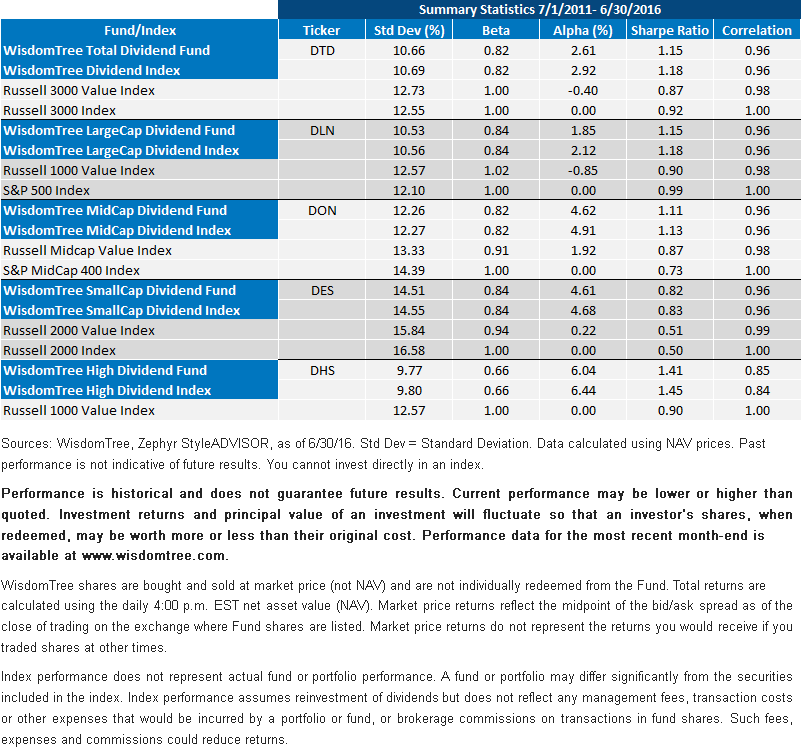
For definitions of terms and indexes in the chart visit our glossary.
- The table above quantifies how, over the last five years, each of WisdomTree’s U.S. dividend indexes and the ETFs that track them generated higher risk-adjusted returns, based on the Sharpe ratio, than were generated by their comparable cap-weighted benchmark.
- In every case, the beta for both the WisdomTree Index and its corresponding ETF over the past five years was lower than its market benchmark, ranging from .66 to .84.
- In every case over the last five years, all five dividend-weighted indexes and the WisdomTree ETFs that track them exhibited lower standard deviation compared to their benchmark peers, ranging from 1.5 to 2.8 percentage points less annualized volatility.
Stocks, as an asset class, are typically more volatile than bonds. So reducing the volatility of one’s equity exposure can help investors remain invested in equities for the long term. One strategy that may potentially reduce volatility is to select stocks that have lower beta, lower annualized volatility or lower correlations relative to the broader market. Another way is to tilt the portfolio toward the lower correlating sectors of the market, which often have been the more defensive sectors of the market—utilities, telecom, consumer staples and health care. Using more mature, dividend-paying companies—and then weighting them by the dividends they pay—is another way one can typically tilt indexes and ETFs that track them toward the more defensive, lower correlating sectors of the market. Certainly, that has been true over the past five years. Combining less correlated sectors or asset classes in a diversified portfolio may help to reduce overall volatility.
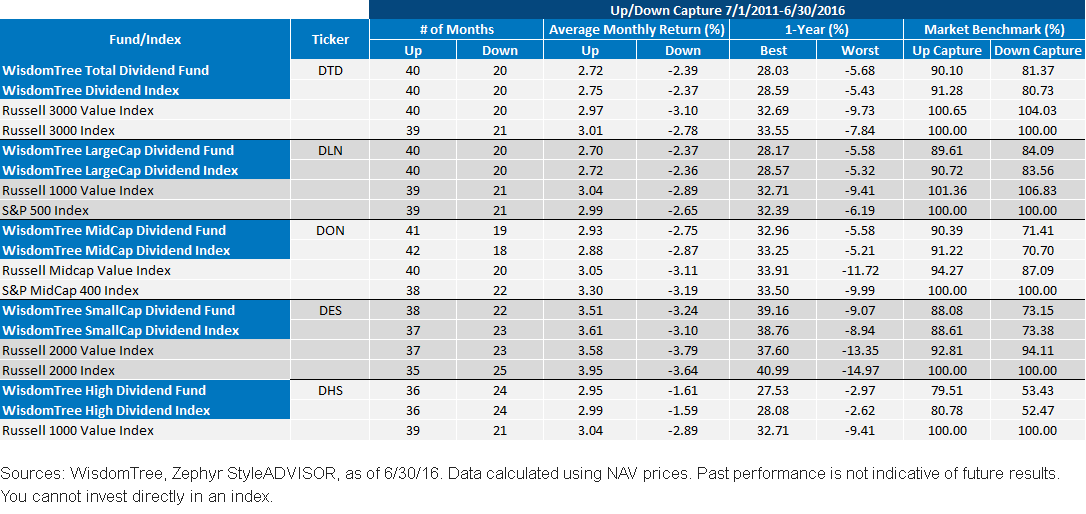
Another way to view the reduction in volatility that occurred with WisdomTree’s dividend-weighted ETFs is to see how they performed in months when their cap-weighted benchmark indexes generated positive returns and in months when those returns were negative. In the table below, over the last five years, we see in the size segments of the markets that the WisdomTree ETFs have consistently captured between 88% and 91% of their benchmark’s upside, while typically capturing between 71% and 84% of the downside. In the case of the WisdomTree High Dividend Fund (DHS), the Fund was able to capture 79.5% of the upside of the Russell 1000 Value Index, while helping to protect investors in down markets, capturing just 53.4% of the Russell 1000 Value Index’s downside, from 2011 through 2016.
Conclusion
WisdomTree’s dividend-weighted ETFs have outperformed the vast majority of passive and active managers managers in their peer group over the past five years. But they have also done so over that period with lower beta, lower volatility, and therefore higher risk-adjusted returns than their comparable cap-weighted indexes. In the U.S., WisdomTree has shown that risk and return are not necessarily joined at the hip. Put another way, it can be possible to generate higher returns than capitalization-weighted indexes while also lowering volatility. Over the last five years, WisdomTree proved it in every major size segment of the U.S. market.
Important Risks Related to this Article
There are risks associated with investing, including possible loss of principal. Funds focusing their investments on certain sectors and/or smaller companies increase their vulnerability to any single economic or regulatory development. This may result in greater share price volatility. Please read the Fund’s prospectus for specific details regarding the Fund’s risk profile.
Dividends are not guaranteed, and a company currently paying dividends may cease paying dividends at any time.
Diversification does not eliminate the risk of experiencing investment losses.
About the contributor
