

Introducing the WisdomTree U.S. Quality Growth Fund (QGRW)
Published December 15, 2022

Director, Research
How do you identify growth stocks?
A few common measures include trailing sales and earnings growth, future sales and earnings growth estimates, and relative valuations like price-to-earnings, price-to-sales and price-to-book ratios.
Because earnings-based measures of growth may be undefined for loss-making growth companies, growth strategies may ignore profitability considerations in favor of metrics like price-to-sales and price-to-book as proxies for growth.
At times, growth investors become enamored with more narrow, non-earnings growth measures like “eye-balls” during the internet craze of the early 2000s or “subscriber-growth” in recent years as it relates to streaming platforms and social media companies.
This can lead to an approach to growth that over-weights allocations to highly speculative, or junky, growth names.
Alternatively, some investors have been considering focusing on quality stocks—companies with higher profitability—to implicitly tilt toward profitable growth stocks. But ignoring explicit growth signals can lead to excluding some of the fastest-growing companies, diluting the intended growth exposure.
The WisdomTree U.S. Quality Growth Index aims to identify stocks that have both quality and growth characteristics to avoid having to sacrifice on either factor.
Why Quality?
Investors are familiar with the standard value, blend and growth styles. So why blend quality with growth?
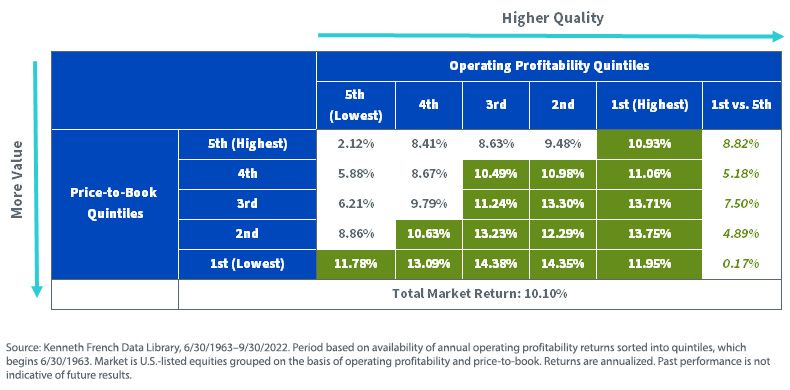
Higher operating profitability (higher quality) has outpaced lower quality over time. And that outperformance has been most pronounced in the higher growth (lower value) segments of the market.
In the below table, the highest profitability quintile (1st quintile) outperformed the broad market controlling for valuation (price-to-book). When looking at the 5th quintile on price-to-book (the lowest value/highest growth quintile), there was a spread of 8.82% annualized between the highest profitability quintile and the lowest profitability quintile.
These historical returns suggest investing in growth stocks is a losing game over the long run. We believe investors should instead invest in high quality growth stocks.
Price-to-Book and Profitability Quintiles
The WisdomTree U.S. Quality Growth Index
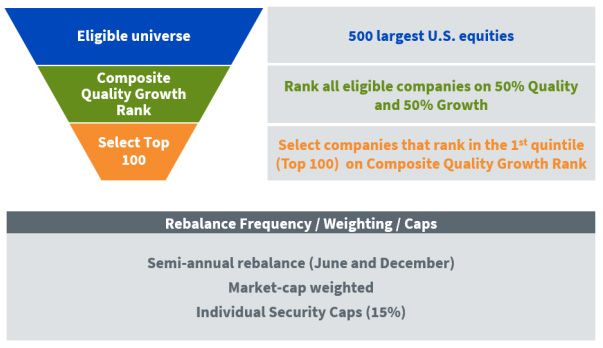
The WisdomTree U.S. Quality Growth Index is a market capitalization-weighted index that consists of companies with quality and growth characteristics. The top 500 U.S. companies by market cap are ranked on a composite score of two fundamental factors: growth and quality, which are equally weighted.
The Index is composed of the 100 U.S. companies (1st quintile) with the highest composite scores.
Growth Factor: The growth factor is determined by a company's ranking based on a 50% weight in its median analyst earnings growth forecast, a 25% weight in its trailing five-year EBITDA (earnings before interest, taxes, depreciation and amortization) growth and a 25% weight in its trailing five-year sales growth.
Quality Factor: The quality factor is determined by a company's ranking based on a 50% weight to its trailing three-year average return on equity and its trailing three-year average return on assets.
Investment Process
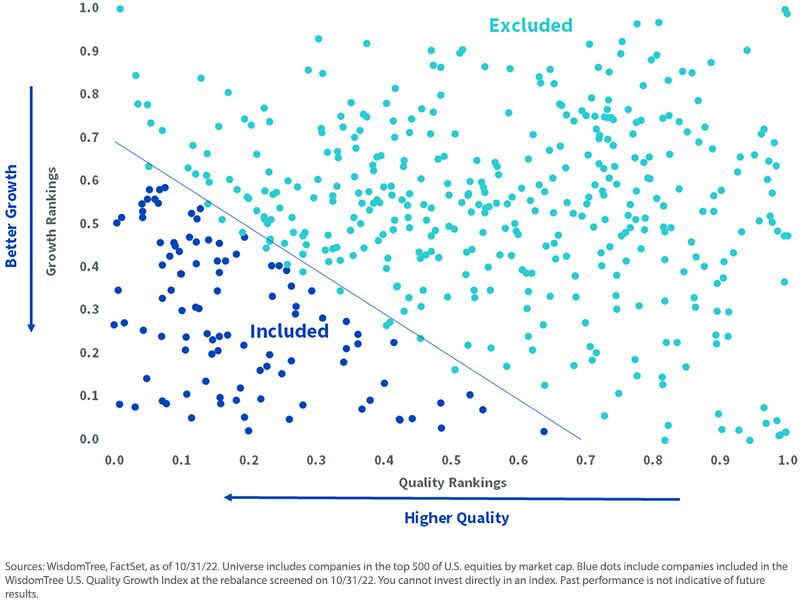
In the below chart we show how the initial 500-stock starting universe ranks on our growth and quality scores. The process of blending independent quality and growth scores results in excluding the bottom 30% (ranks 0.7 through 1.0) on each factor.
Blending Quality and Growth: Rankings for the Quality Growth Universe
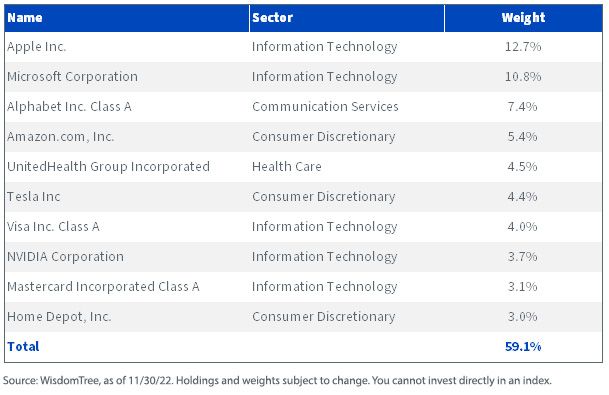
The Index is intended to be a high-conviction, relatively concentrated growth portfolio aimed at having over-weight allocations in the largest quality growth companies. As a result, the Index has a high percentage of its weight (59%) in the top 10 holdings.
Index Top Holdings
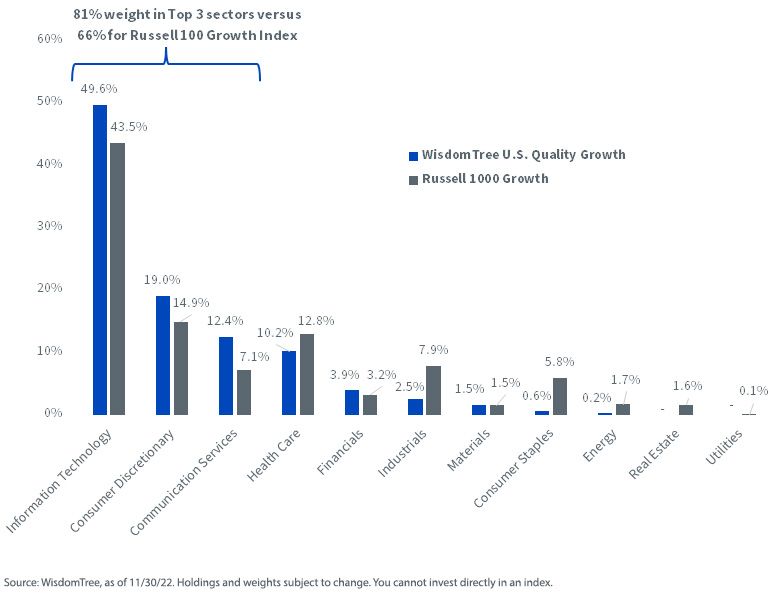
The top three Index sector weights (Information Technology, Consumer Discretionary and Communication Services) combine to 81%, an increase of 15% from the Russell 1000 Growth Index.
Index Sector Weights
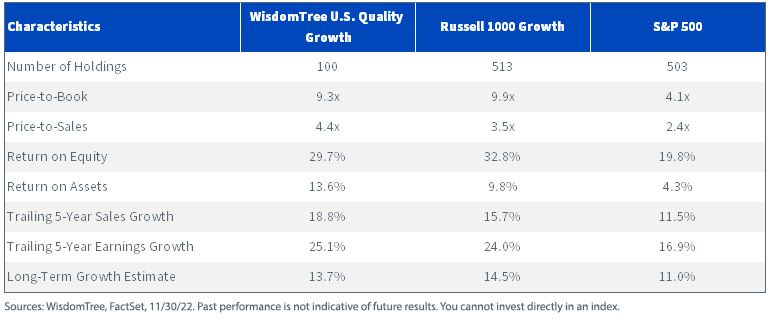
As expected, relative to the S&P 500, both the WisdomTree U.S. Quality Growth and the Russell 1000 Growth have premium profitability and growth characteristics.
Index Characteristics
Introducing the WisdomTree U.S. Quality Growth Fund (QGRW)
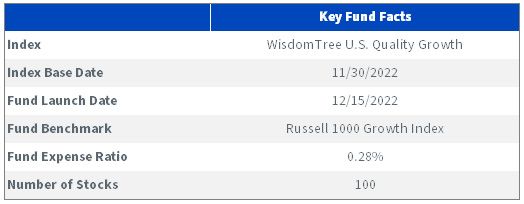
The WisdomTree U.S. Quality Growth Fund (Ticker: QGRW) seeks to track the price and yield performance, before fees and expenses, of the WisdomTree U.S. Quality Growth Index.
Why QGRW?
- Gain core exposure to U.S. large- to mid-cap companies that display strong quality and growth characteristics
- Use as a U.S. growth investing solution that combines quality and growth factors
- Use to satisfy demand for clients seeking high-conviction growth allocations that emphasize profitability
Important Risks Related to this Article
There are risks associated with investing, including possible loss of principal. Growth stocks, as a group, may be out of favor with the market and underperform value stocks or the overall equity market. Growth stocks are generally more sensitive to market movements than other types of stocks. The Fund is non-diversified, as a result, changes in the market value of a single security could cause greater fluctuations in the value of Fund shares than would occur in a diversified fund. The Fund invests in the securities included in, or representative of, its Index regardless of their investment merit. The Fund does not attempt to outperform its Index or take defensive positions in declining markets and the Index may not perform as intended. Please read the Fund’s prospectus for specific details regarding the Fund’s risk profile.
Categories
About the contributor

Director, Research
Matt Wagner joined WisdomTree in May 2017 as an Analyst on the Research team. He currently serves as a Director, where he supports the creation, maintenance, and reconstitution of WisdomTree’s indexes and actively managed ETFs. Matt began his career at Morgan Stanley, working as an analyst in Treasury Capital Markets from 2015 to 2017, focusing on unsecured funding planning, execution, and risk management. He graduated magna cum laude from Boston College in 2015 with a B.A. in International Studies, concentrating in Economics. In 2020, he earned a Certificate in Advanced Valuation from NYU Stern. He is also a Chartered Financial Analyst (CFA) charterholder.