

“Inflate-Gate”? Don’t Tell That to the Bond Market
Published February 10, 2021

Head of Investment and Fixed Income Strategy
If you’ve been keeping up with my 2021 blog posts, you’ll know by now that my focus has been on the “reflation trade.“ Certainly, not all market participants are convinced yet that inflation might make a comeback, but don’t tell that to the bond market.
As I go to press, the U.S. Treasury (UST) 10-Year yield continues to reside at the upper end of the trading range that has been established thus far in the new year, i.e., around the 1.15%–1.20% threshold. While the 2021 trend has been unmistakably to the upside, the UST 10-Year has experienced a brief hiatus from time to time. That is to be expected— from a nearer-term perspective, interest trends can resemble a sawtooth-type pattern. Looking ahead, I continue to see the overarching pattern as a rising one.
10-Year Breakeven Inflation Rate
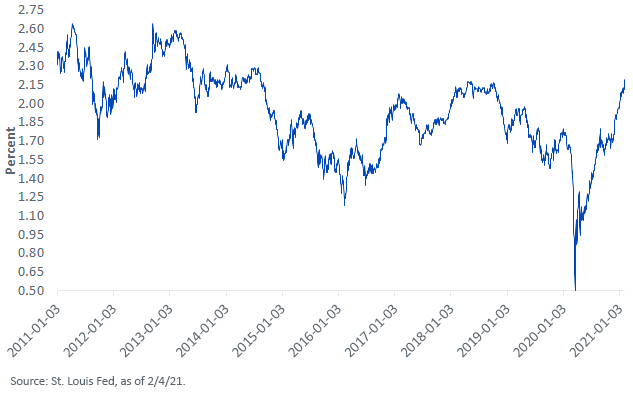
Why is that, you say? Well, take a look at this graph, which measures the 10-year breakeven spread, or what is better known as inflation expectations. Just last week, this gauge rose to 2.19%, the highest level since 2014! Sure, it was easy to see a move from the low of 0.50% in March 2020, the height of the market’s pandemic dislocations, to the 1.75% vicinity, in response to the twin stimulus responses from the Federal Reserve (Fed) and the U.S. government. It is the residual upside that has been witnessed since December to its current level that has caught my attention. If you look closely at the breakeven graph, it is apparent that movement above the 2.30% threshold has been a somewhat rare development over the last 10 years. At its current reading, the breakeven rate is only about 10 basis points (bps) away from that milestone.
Conclusion
In my multi-decade experience in fixed income, I’ve learned the market is a lot smarter than I am. So, when a development like this occurs, I don’t discount what the market is trying to tell me, namely, the chance of higher inflation in the months/years ahead has now increased in a visible fashion.
Against that backdrop, in my opinion, investors should consider positioning their fixed income portfolios for what tends to occur when inflation is beginning to show signs of rearing its head…higher interest rates.
Categories
About the contributor

Head of Investment and Fixed Income Strategy
Kevin serves as the Head of Investment and Fixed Income Strategy. In this role, he writes macro and fixed income-related content and works closely with the sales, research and marketing teams. In addition, Kevin conducts client-facing webinars and meetings, providing expertise on WisdomTree’s existing and future bond ETFs. Prior to joining WisdomTree, Kevin spent 30 years at Morgan Stanley, where he was Managing Director and Chief Fixed Income Strategist for Wealth Management. He was responsible for tactical and strategic recommendations and created asset allocation models for fixed income securities. He was a contributor to the Morgan Stanley Wealth Management Global Investment Committee, primary author of Morgan Stanley Wealth Management’s monthly and weekly fixed income publications, and collaborated with the firm’s Research and Consulting Group Divisions to build ETF and fund manager asset allocation models. Kevin has an MBA from Pace University’s Lubin Graduate School of Business, and a B.S. in Finance from Fairfield University.