

Importance of Refreshing the Quality Factor
Published January 12, 2018

Global Head of Research
We tend to write a lot about the annual rebalance of the WisdomTree U.S. Earnings Indexes because—simply put—this is the single most important difference that they bring to any U.S. equity discussion. The success of the nearly 11-year live track record can be traced back to this process, repeated each year based on data screened on the last trading day of November.
Modern Alpha Generation Must Have a Foundation within Risk Premiums
Even as academics continue to research and debate the presence (or lack thereof) of different risk premiums, consensus has seemed to accept the presence of five primary factors upon which excess returns over and above what could be explained by taking excess risk have tended to be based:
- Value
- Quality
- Size
- Momentum
- Low volatility
As the terminology has shifted from fundamentally weighted to smart beta to now modern alpha, the building blocks—these factors—have remained constant. We wrote recently (“11 Consecutive Years of Lowering P/E Ratios … and Counting!”) about how one can think of our U.S. Earnings Index rebalance “refreshing” exposure to the value factor. Now, we turn our focus to quality.
Profitability within Small Caps and Mid-Caps Has Been Associated with Stronger Returns
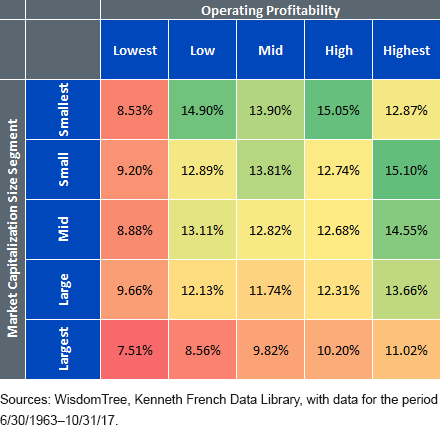
As we search for the darkest shades of green—the strongest returns—we tend to see them on the small- to mid-cap end of the size spectrum and on the higher end of the operating profitability spectrum. We see the darkest shades of red (lowest returns) clustered along the lowest operating profitability quintile. Simple, long-run data, therefore, suggests that the first hurdle to clear could very well be avoiding those firms with the lowest operating profitability, while the second could be emphasizing stronger profitability within the mid-cap and small-cap size segment.
Market Capitalization-Weighted Indexes Won’t Avoid Unprofitable Firms
Simply utilizing a broad-based, market capitalization-weighted benchmark of mid-caps or small caps will not actually avoid exposure to unprofitable firms. We never cease to be surprised by 1) the amount of exposure to unprofitable firms present, particularly in certain small-cap benchmarks, and 2) the variation in exposure to unprofitable firms across different index providers.
Importantly, exposure to unprofitable firms—particularly those with negative trailing 12-month earnings per share—is a fairly insignificant matter on the large-cap end of the size spectrum, which is why we don’t discuss it here.
Exposure to Unprofitable Companies in Mid-Cap and Small-Cap Benchmarks
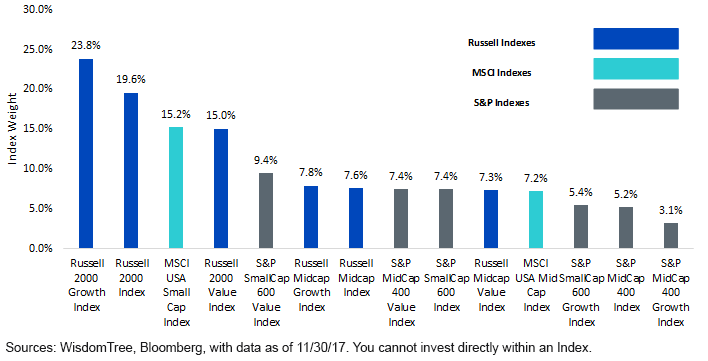
- Russell 2000 Index Variants: Three of the top four exposures to unprofitable firms were the Russell 2000 Index, Russell 2000 Value Index and Russell 2000 Growth Index. This methodology, true, is the broadest-based of the indexes shown, but we’d encourage people to remember that a consequence of being the broadest-based is including firms with strong, average and weak fundamentals.
- The S&P Index Difference: The S&P indexes shown are not as broad as the Russell indexes, and one reason for this is that every constituent must prove positive generally accepted accounting principles (GAAP) net income over four quarters prior to initial inclusion.1 This biases the S&P indexes to tend toward less exposure to unprofitable firms than the Russell indexes.
Eliminating Unprofitable Firm Exposure on an Annual Basis
WisdomTree’s U.S. Earnings Indexes require firms to prove, annually, that they need to generate cumulative profits on an annual basis. Over 11 years, we’ve seen this have the largest impact in the mid-cap and small-cap size segments because of what we showed earlier—without any screening at all, the mid-cap and small-cap markets in the U.S. have significant components that are unprofitable and of a more speculative nature.
An interesting way that this tilt toward higher quality tends to show up is in a quartile distribution of Index weight based on the return on equity (ROE) of underlying constituents.
What a “Quality Tilt” Looks Like in Mid- & Small-Cap Equity Indexes
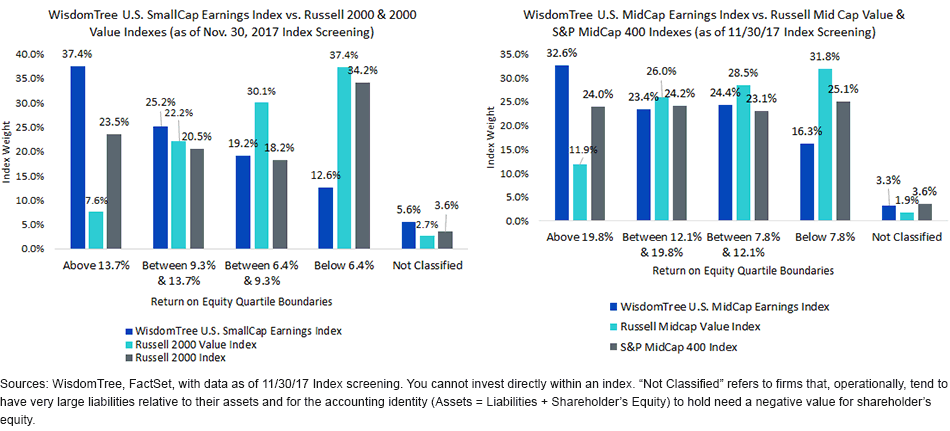
- Traditional value indexes (the Russell 2000 Value and Russell Midcap Value) actually showcased the opposite—more weight in constituents with lower ROE. We mentioned earlier that, even though the WisdomTree U.S. Earnings approach doesn’t access the value premiums in precisely the same fashion as these indexes, the annual rebalance has lowered the price-to-earnings (P/E) ratio on both the WisdomTree U.S. MidCap and U.S. SmallCap Earnings Indexes over all 11 live rebalances.
If one is looking to the “value” style and one approach tilts greater exposure to firms with higher return on equity than another, this is certainly an interesting distinction.
In the Face of Changing Corporate Tax Rates, Prefer Profits to Losses
To conclude, we recognize that over the past year, not a day seemed to go by without mention of Congress and the potential changes to U.S. tax policy, both at the individual and corporate levels. We’ve written about how smaller and midsized firms are better positioned to benefit, as they export less and have less opportunity to leave profits overseas, thereby avoiding U.S. taxes. Both the WisdomTree U.S. SmallCap and MidCap Earnings Indexes have effective tax rates around 30% to 32% on an aggregate basis,2 making the reduction in the statutory rate from 35% to 21% particularly attractive.”
1Source: “S&P U.S. Indices Methodology,” S&P Dow Jones Indices, August 2017.
2Sources: WisdomTree, FactSet.
Categories
About the contributor

Global Head of Research
Christopher Gannatti began at WisdomTree as a Research Analyst in December 2010, working directly with Jeremy Schwartz, CFA®, Director of Research. In January of 2014, he was promoted to Associate Director of Research where he was responsible to lead different groups of analysts and strategists within the broader Research team at WisdomTree. In February of 2018, Christopher was promoted to Head of Research, Europe, where he was based out of WisdomTree’s London office and was responsible for the full WisdomTree research effort within the European market, as well as supporting the UCITs platform globally. In November 2021, Christopher was promoted to Global Head of Research, now responsible for numerous communications on investment strategy globally, particularly in the thematic equity space. Christopher came to WisdomTree from Lord Abbett, where he worked for four and a half years as a Regional Consultant. He received his MBA in Quantitative Finance, Accounting, and Economics from NYU’s Stern School of Business in 2010, and he received his bachelor’s degree from Colgate University in Economics in 2006. Christopher is a holder of the Chartered Financial Analyst Designation.