

If the Bear Lurks, High P/E Stocks Are the Dreaded "Phone Ringers"
Published February 13, 2020

Head of Equity Strategy
A Value investing article recently went quasi-viral.
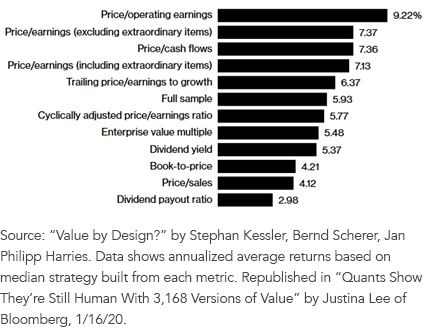
Titled “Quants Show They’re Still Human With 3,168 Versions of Value,” it pointed to the price-to-earnings (P/E) ratio as the best performing value factor (figure 1).
Figure 1: Annualized Returns, Assorted Value Factors, Feb. 1988–Feb. 2017
For definitions of terms in the chart, please visit our glossary.
But even the best performing value factor was no contest for a market that has avoided value stocks like the Bubonic plague. Figure 2 is my favorite chart right now.
Figure 2: 10-Year Rolling Annualized Outperformance, Low P/E vs. High P/E Stocks
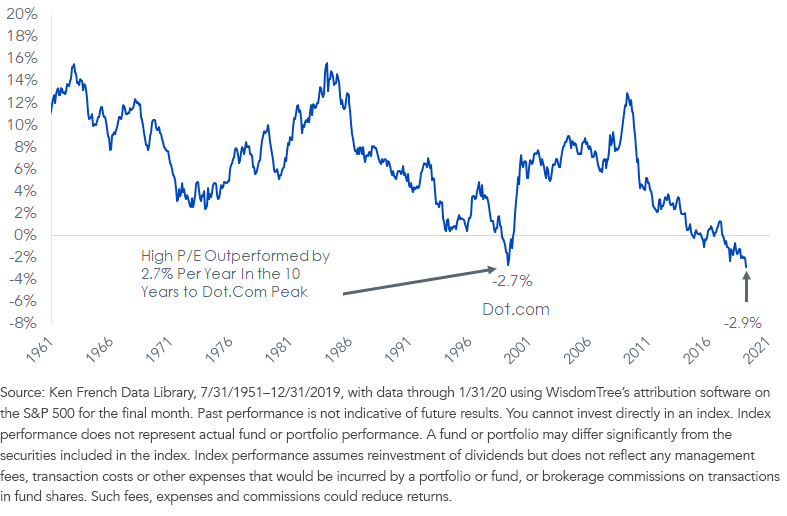
Face it: The amount by which high P/E stocks have outperformed low P/E stocks in the last 10 years exceeds the amount observed at the apex of the dot-com bubble.
I mean, seriously. Are our memories this bad? The dot.com bubble wasn’t even that long ago.
This is remarkable. The 10 years after that blowup—the period ending February 2010—witnessed the quintile of stocks with the lowest P/E beating the quintile with the highest P/E by nearly 13% per year.
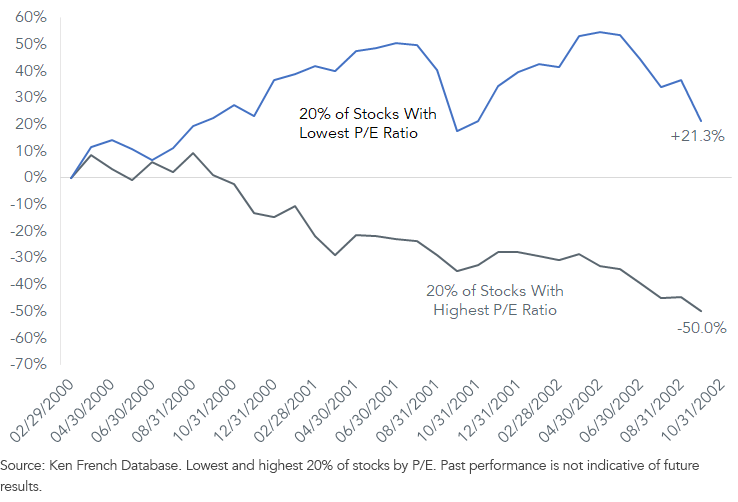
That's because not everything fell in that bear markets (figure 3).
Figure 3: Cumulative Return, 2/29/00–9/30/02
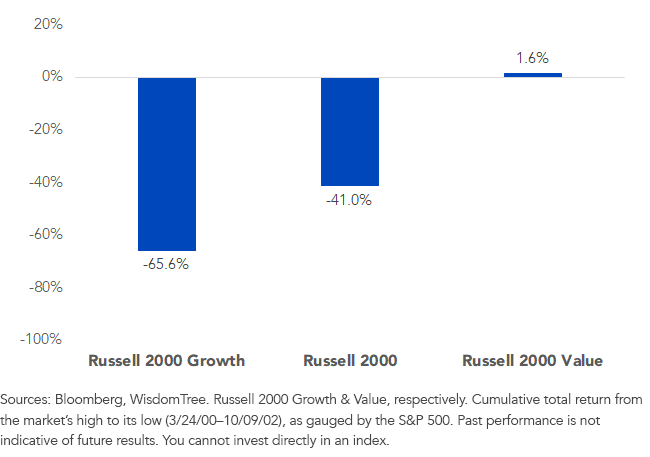
Here’s another interesting fact from the 2000–2002 crash: In the small-cap sector, the Russell 2000 Growth Index lost two-thirds of its value in that bear market, yet the Russell 2000 Value Index of cheaper stocks went up (figure 4).
Figure 4: Cumulative Return, 2000–2002 Bear Market
The double whammy for money managers is when you get:
- A bear market in your largest holding (U.S. large caps), and
- Your stuff goes down harder than the market
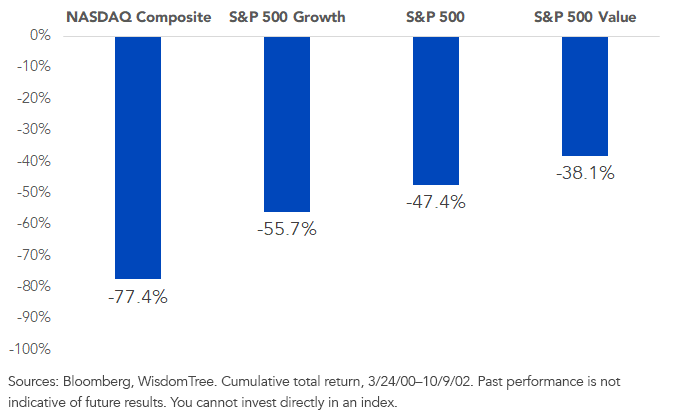
Because the crash was so deep, figure 5 is the dreaded “phone ringing off the hook” chart.
Your whole day is spent trying to convince clients not to dump you for some “smarter” money manager.
The nastiest “phone ringers?” Look at the left side of figure 5.
Figure 5: Cumulative Return, 2000–2002 Bear Market
Last year we slashed the fee to 8 basis points (bps) on the WisdomTree U.S. LargeCap Fund (EPS), our P/E-focused ETF that seeks to track the price and yield performance before fees and expenses of the WisdomTree U.S. LargeCap Index. It’s “beta-lite,” so we put it right there with the expense ratios of the three biggest ETFs that seek to track the S&P 500.
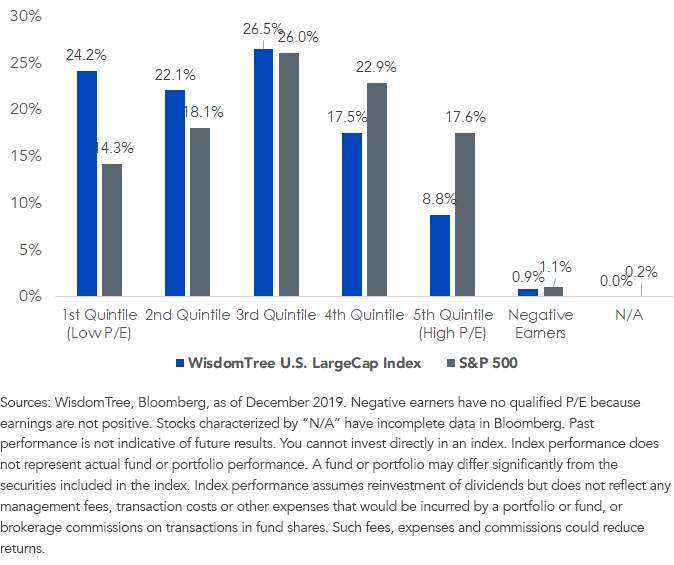
If the gray groups on the right in figure 6 get hurt in the next bear market, our stocks at 8 bps are a way to avoid many of them. It’s about cutting down on the dreaded phone ringers.
Figure 6: Underlying Index P/E Composition
Important Risks Related to this Article
There are risks associated with investing, including possible loss of principal. Funds focusing their investments on certain sectors increase their vulnerability to any single economic or regulatory development. This may result in greater share price volatility. Please read the Fund’s prospectus for specific details regarding the Fund’s risk profile.
Categories
About the contributor

Head of Equity Strategy
Jeff Weniger, CFA, has been with WisdomTree since 2017 and serves as the Head of Equities. He shapes the firm’s market outlook through a combination of macroeconomic and fundamental analysis. With more than two decades in investment strategy, Jeff is known for his work on market cycles and valuations. Before joining WisdomTree, Jeff was with BMO Private Bank and BMO Global Asset Management for 11 years. At BMO, he sat on the firm’s Asset Allocation Committee and co-managed ETF model portfolios across the U.S. and Canada. In 2013, at age 32, he became the youngest member of BMO’s Global Investment Forum. When he left BMO to come to WisdomTree, his final role was Director, Senior Strategist in the Office of the CIO in 2017.
Jeff is a frequent television guest on networks such as CNBC, Bloomberg, and Schwab, with regular print appearances in The Wall Street Journal, Barron’s and Reuters. He also appears weekly on the Behind the Markets podcast and is a regular on SiriusXM’s The Business Briefing. On X, Jeff has developed one of the larger followings in financial media. He earned a B.S. in Finance from the University of Florida and an MBA from the University of Notre Dame. He has held the CFA charter since 2006.