

How You Could Have Avoided Last Year’s Correction
Published January 14, 2019

Associate Director, Asset Allocation and Modern Alpha
Last year finally broke the nine-year bull run in equity markets.
That length has been matched only twice since the 1950s. And most of this bull run was accompanied by extraordinarily low volatility for equities. In 2017, the Chicago Board Options Exchange’s (Cboe’s) VIX Index—a measure of the market’s expectation for forward volatility—traded at close to 10, which is about half of its long-term average of 20.
And then the end of 2018 happened.
I previously have written about indicators WisdomTree tracks that saw the writing on the wall.
Below, I cover what measures could have been taken to help avoid the downturn in equity markets that we saw in the fourth quarter of 2018.
Strategies That Worked
The WisdomTree CBOE S&P 500 PutWrite Strategy Fund (PUTW) and the WisdomTree CBOE Russell 2000 PutWrite Strategy Fund (RPUT) track the Cboe S&P 500 PutWrite Index (PUT) and the Cboe Russell 2000 PutWrite Index (PUTR), respectively.
The underlying indexes of the two strategies have an established track record of handling stress and potentially reducing significant risk in your portfolio.
Let’s see how they performed last year.
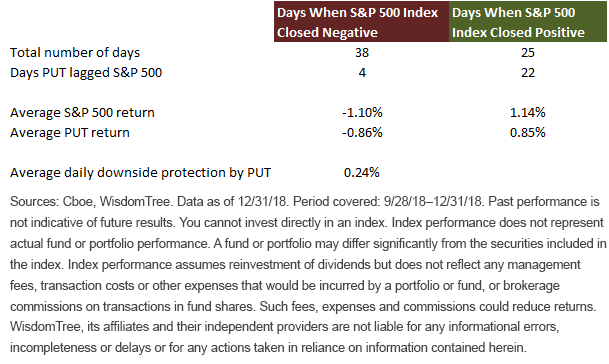
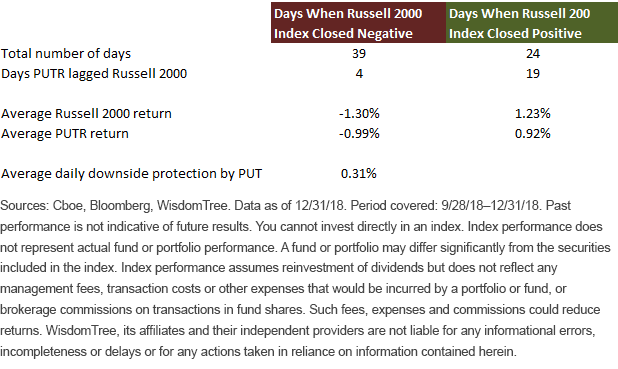
Out of a total 63 trading days in the fourth quarter of 2018, the S&P 500 Index had 38 negative trading days, while the Russell 2000 Index had 39. A true test of any volatility-reducing strategy lies in its relative performance on negative days. The table below compares PUT and PUTR performance relative to their benchmarks.
My quick takeaways:
- PUT outperformed the S&P 500 on 34 of 38 negative days.
- On average, it delivered a downside protection of ~24 basis points (bps) on each of those down days.
- Similarly, PUTR outperformed the Russell 2000 on 35 of 39 negative days, and it did so with an average downside protection of ~31 bps per day.
A Deeper Look
Let’s take this a step further and examine how the two strategies performed after they sold their first option for the quarter. As a refresher, both strategies are designed to collect premiums by selling an at-the-money European-style put option with monthly maturity. Monthly options typically expire on the third Friday of every month, and therefore the first time both of these strategies rolled into a new position was January 19.
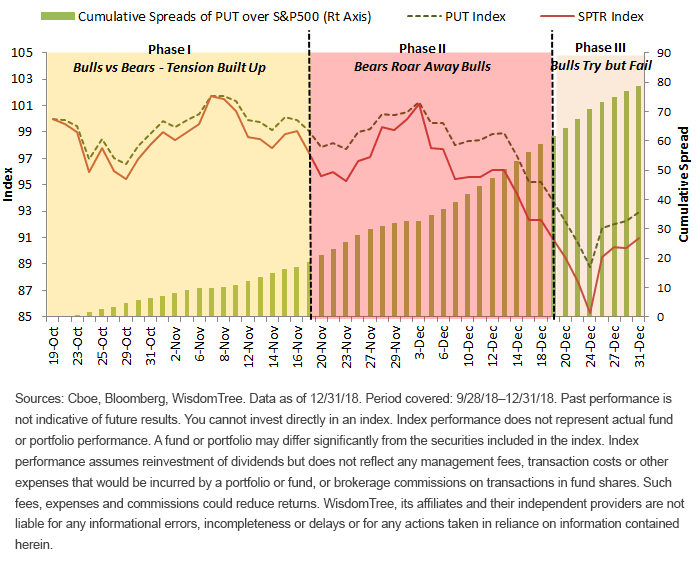
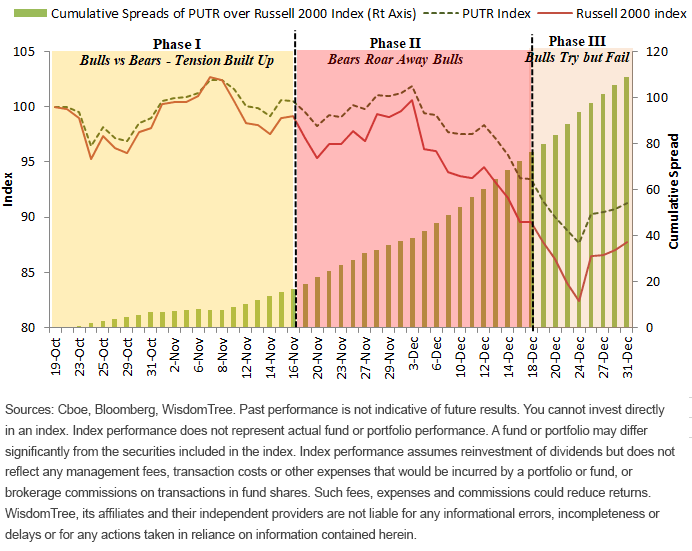
The chart below shows the three phases of the market’s boom and bust for the fourth quarter of 2018 (top for PUT and bottom for PUTR).
- Phase 1 (mid-October through mid-November): On October 19, both strategies roll their first option of the quarter.
- Phase 2 (mid-November through mid-December): On November 16, both strategies roll their second option of the quarter.
- Phase 3 (mid-December through the end of 2018): On December 21, both strategies roll their third option of the quarter.
Performance of PUT vs. S&P 500 Index During Q4 2018
Performance of PUTR vs. Russell 2000 Index During Q4 2018
In both instances, the following is evident:
- In Phase 1, as markets became volatile, both strategies gradually started to build outperformance over their respective benchmarks.
- In Phase 2, by rolling into the second option of quarter when the VIX had spiked (owing to the correction in October 2018), both strategies collected richer premiums, which helped their total return build over their benchmarks. This spread helped sustain and add to their outperformance as their benchmarks continued to fall.
- Finally, in Phase 3, as both strategies sold their third option for the quarter, the buildup of previous outperformances and elevated volatility ensured that both strategies outperformed even when there was a mild rally in equities toward year’s end.
Conclusion
There is a popular saying: “When the going gets tough, the tough gets going.” I think similarly true colors of any risk-reduction strategy are not revealed on days when markets are hunky-dory; rather, they are visible on volatile and stressful days.
By relatively holding up in both the first and fourth quarters of 2018, both WisdomTree’s PUTW and RPUT have established track records as possible investment solutions for an investor’s portfolio during tough times.
Important Risks Related to this Article
There are risks associated with investing, including possible loss of principal. These Funds will invest in derivatives, including Russell 2000 Index put options (“RUT Puts”) and S&P 500 Index put options (“SPX Puts”). Derivative investments can be volatile, and these investments may be less liquid than securities, and more sensitive to the effects of varied economic conditions. The value of the RUT Puts and the SPX Puts in which the Fund invests is partly based on the volatility used by market participants to price such options (i.e., implied volatility). The options values are partly based on the volatility used by dealers to price such options, so increases in the implied volatility of such options will cause the value of such options to increase, which will result in a corresponding increase in the liabilities of the Fund and a decrease in the Fund’s NAV. Options may be subject to volatile swings in price, influenced by changes in the value of the underlying instrument. The potential return to the Fund is limited to the amount of option premiums it receives; however, the Fund can potentially lose up to the entire strike price of each option it sells. Due to the investment strategy of the Fund, it may make higher capital gain distributions than other ETFs. Please read each Fund’s prospectus for specific details regarding the Fund’s risk profile.
Categories
About the contributor
