

How to Manage Valuation Risk in India’s Equities
Published October 16, 2015

Director, Research
WisdomTree believes that weighting by market capitalization, which does not weight, consider or rebalance back to any measure of economic importance of the underlying constituents, may not be the best approach to indexing. Instead, we believe a disciplined strategy of anchoring allocations back to a measure of relative value, based on fundamentals such as dividends or earnings, can add value over time. We also believe that this fundamental process may prove to be most important in less efficient markets, such as small caps or emerging markets. In India we focus on earnings, and the WisdomTree India Earnings Index (WTIND) seeks to provide broad exposure to the profitable core market of India’s equities while maintaining sensitivity to valuation. To help achieve this, WisdomTree weights companies in the Index by the profits they generate, rather than their market cap, and rebalances back to profitability on an annual basis. WisdomTree’s India Earnings Index rebalance process typically is driven by the following: • Earnings Growth: Companies that grow their profits see their weight increased. • Relative Performance:
• Underperformers typically see their weight increased.• Outperformers often see their weight decreased. This process tends to shift weight to firms with lower price-to-earnings (P/E) ratios, as illustrated in the chart below. It compares the distribution of stocks by their P/E ratios in WTIND to that of the MSCI India Index, a widely followed market cap-weighted index that also measures the performance of India’s equities. P/E Ratio and Weight Distribution WTIND’s P/E ratio is approximately 12.5x—reflecting the 2015 Index screening—i.e., over 38% lower than the 20.3x P/E ratio of the MSCI India Index. The chart below provides a look at how the weight is distributed, to give a sense for why WTIND has a lower P/E ratio. P/E Quartile Distribution
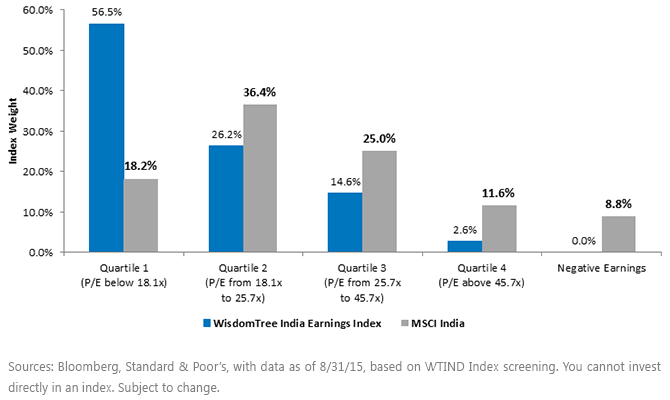
• More Weight to Lower-Priced Stocks: WTIND had more than 50% of its weight in the lowest-priced quartile, which is significantly more than the MSCI India Index. There is a natural tendency of earnings-weighted approaches to reduce weight to stocks whose prices have appreciated at a faster rate than their earnings, and concurrently to increase weight to stocks that have fallen in price despite exhibiting positive earnings growth. • Less Weight to Higher-Priced Stocks: On the other hand, WisdomTree’s approach has less than 3% of its weight going to the highest-priced quartile. The MSCI India Index had more than 20% of its weight in the most expensive quartile and stocks with negative earnings. • Negative Earnings and Speculative Stocks: Although profitability may fluctuate throughout the year, at each annual rebalance WisdomTree requires companies to be profitable before inclusion. This requirement keeps the weight to firms that we believe tend to be more speculative and of lower quality at zero. The MSCI India Index does not share this requirement.
Important Risks Related to this Article
Investments in emerging, offshore or frontier markets are generally less liquid and less efficient than investments in developed markets and are subject to additional risks, such as risks of adverse governmental regulation and intervention or political developments.
Investments focused in India increase the impact of events and developments associated with the region, which can adversely affect performance.
Categories
About the contributor
