

How Does the Strong Dollar Affect Exporters?
Published February 19, 2015

Director, Research
Recently, Nicholas C. Fanandakis, CFO of E.I. du Pont de Nemours1 made a comment on the operating environment his company faces—which we think reflects what many CFOs across America are feeling: “The global currency markets have recently experienced significant volatility and a meaningful strengthening of the dollar against a broad basket of currencies that we operate in. This has created a significant headwind for DuPont’s expected outlook for 2015.”2 While U.S. exporters are taking a hit from the strong dollar, international exporters (in the eurozone and Japan in particular) are on the other side of this trade—and benefiting. The Impact of Currency on Exporters—U.S., Europe, Japan The analysis below shows how the performance of U.S. exporters3 compares to exporters from Japan and Europe. The analysis is clear: U.S. exporters are significantly lagging Japanese and eurozone exporters over each of the periods analyzed over the last year—a period marked by significant dollar strength. Exporter Performance Comparison
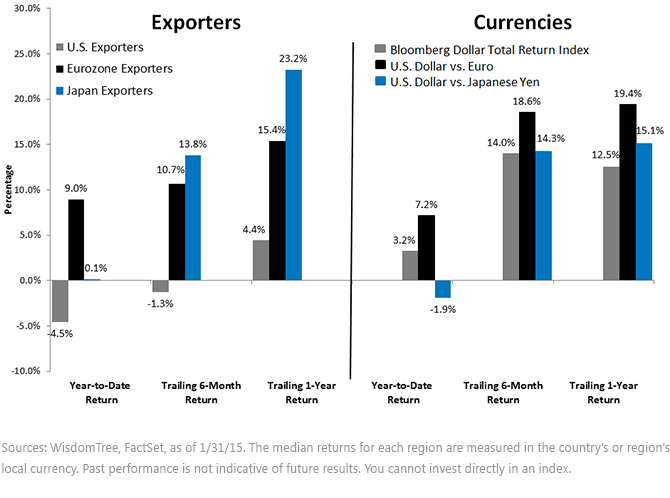
• Japan Benefited the Most over the Full Year – Since the start of “Abenomics,” the yen has weakened more than 29% against the U.S. dollar, which has helped drive profits for many Japanese exporters.4 Toyota Motors5, Japan’s largest exporter, recently announced a continuation of this trend by reporting, “Operating income increased by 258.8 billion yen. Major factors contributing to the increase included currency fluctuations of 215.0 billion yen and cost reduction efforts of 200.0 billion yen.”6 • Europe in Focus Recently – The European Central Bank (ECB) recently announced plans to expand its balance sheet by €60 billion a month, beginning in March and lasting until at least 2016.7 The anticipation and ultimate follow-through of this action has weakened the euro against the dollar and driven the equity market up. We believe this expansionary policy by the ECB will continue to be supportive for the local equity markets, and the euro will continue to weaken against the dollar. As shown with the Japan example, currency weakness can be very positive for export companies. • U.S. Exporters Lagged over All Periods – Over each of the periods above, U.S. exporters lagged their eurozone and Japanese competitors. When you consider the warnings many companies have issued regarding currency headwinds and that the dollar strengthened by more than 19% against the euro and 15% against the yen over the past year, this performance differential seems logical. We believe the U.S. dollar will continue to strengthen against the euro and the yen, making international exporters an attractive investment allocation. But it’s important to remember that this is true only if the equity return potential of these international companies is not eroded by currency depreciation. We see this environment as an ideal scenario for a currency-hedged approach—equity upside potential with no built-in currency bet. Read about the strengthening U.S. dollar’s negative impact on the performance of U.S. exporters here. 1E.I. du Pont de Nemours had a .43% weight in the WisdomTree Dividend Index, a .51% weight in the WisdomTree LargeCap Dividend Index and a .85% weight in the WisdomTree Equity Income Index as of 1/31/15. 2DuPont, FQ4 2014 Earnings Call Transcripts, 1/27/15. 3For this analysis, “exporters” refers to dividend-paying companies incorporated in each region or country with a market cap greater than $1 billion and revenue of 40% or more coming from outside their respective region or country of incorporation. 4Sources: WisdomTree, Bloomberg, 11/30/12–1/31/15. 5Toyota Motors had a 1.23% weight in the WisdomTree DEFA Index and a 5.82% weight in the WisdomTree Japan Dividend Index, as of 1/31/15. 6Source: Toyota, FY2015 3Q Financial Results, as of 2/4/15. 7Source: European Central Bank, “ECB announces expanded asset purchase program,” 1/22/15.
Important Risks Related to this Article
Foreign investing involves special risks, such as risk of loss from currency fluctuation or political or economic uncertainty. Investments in currency involve additional special risks, such as credit risk and interest rate fluctuations. Diversification does not eliminate the risk of experiencing investment losses.
Categories
About the contributor
