

How (and Where) to Stay Bullish on IG Credit
Published September 6, 2018

U.S. Head of Research
Investors are nervous. In a recent JPMorgan survey,1 the bank highlighted that investment-grade (IG) credit would likely face several headwinds through the end of the year due to increased supply, less-favorable fundamentals and noise from the midterm elections. In our view, a straightforward way to combat these challenges is by taking a fundamental approach and increasing positions in the short end of the yield curve. Below, we highlight these headwinds and then illustrate why we believe the WisdomTree Fundamental U.S. Short-Term Corporate Bond Fund (SFIG) can be a powerful tool in navigating tricky markets.
Supply
In an earlier blog post, we highlighted the impact that increases in supply can have on corporate bond spreads. In classic Econ 101, if supply increases, then prices must decrease. In the bond market, lower prices are synonymous with higher yields. When supply increases and demand stays the same, borrowers may be forced to pay up to issue new debt. As this happens, the broader market tends to underperform.
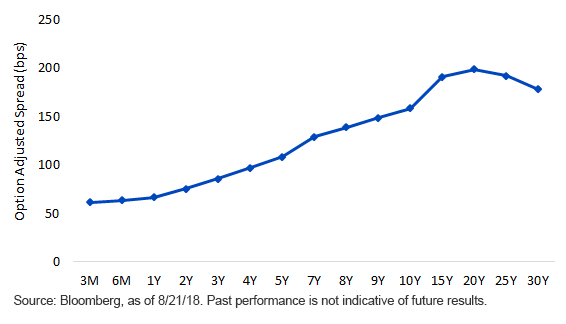
In their report, JPMorgan expects an additional $340 billion in borrowing through the end of the year with nearly $100 billion being raised to finance M&A activity. With the majority of benchmark IG issuance occurring in the 10- and 30-year sector, it’s likely that credit spreads will need to widen to absorb this new supply. However, at the short end of the curve, spreads tend to be much more driven by economic fundamentals. For this reason, we believe that investors concerned about the relationship between credit spreads and issuance should bias their portfolio to the shorter end. As we show in the chart below, longer maturity issues tend to average about 50 basis points (bps) of additional spread compared with shorter-maturity fixed income. This is driven by a few factors, most notably that the longer the tenor, the more compensation an investor will demand because of uncertainty. For an IG issuer, it’s extremely unlikely that their business will experience a shock that would threaten their ability to pay you back in the short run. Over 10 or even 30 years, the fundamentals of their business evolve along with the business cycle. For this reason, the credit curve tends to be upward sloping.
BBB Credit Spreads by Tenor
Fundamentals
During the later innings of a credit cycle, market capitalization weighting fixed income can be problematic. Our rationale is simple: just because a company needs to borrow money doesn’t mean that you should lend it to them. In JPMorgan’s note, it highlighted that current angst in the market is focused on the amount of leverage on corporate balance sheets, the challenging comps that may be around the corner once the short-term impacts of tax reform roll off and how rising rates will impact borrowing costs. Put another way, the market is concerned about leverage, profitability and long-run solvency. Fortunately for investors, these are exactly the same factors that WisdomTree identified when creating our fundamentally weighted fixed income indexes. While a market cap-weighted approach owns every bond regardless of its fundamentals, in WisdomTree’s approach,2 we seek to eliminate the bottom 20% of issuers based on leverage, return on invested capital (a measure of profitability) and free cash flow over debt service (a measure of debt sustainability).
Politics
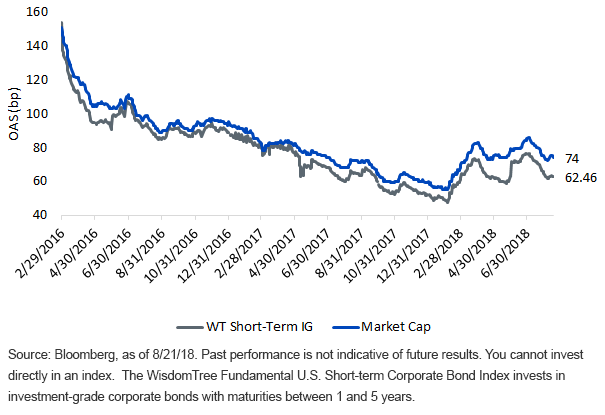
We can’t purport to have an edge when it comes to where the political winds will blow this November, but as we’ve seen in recent history, uncertainty generally begets volatility. In fixed income, two of the biggest sources of volatility are interest rate risk and credit risk. By shifting allocations from longer maturity IG to short-maturity IG, investors are limiting their exposure to rising rates. Additionally, by focusing on fundamentals versus a market cap-weighted approach, we seek to avoid the potential volatility associated with credit ratings downgrades. While a higher-quality approach often comes at a sacrifice in yield, the current spread (OAS) give up in our approach is currently only 12 bps.3 In our view, slightly lower income potential is a small price to pay given where we are in the current cycle.
WT Fundamentals OAS vs. Market Caps
What about Total Returns?
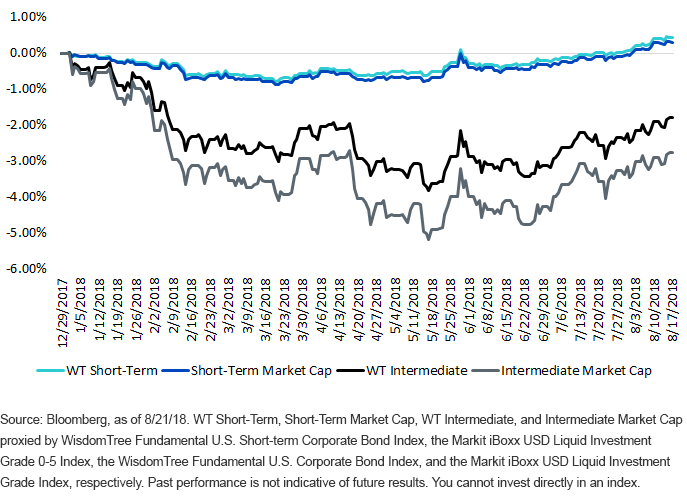
At the end of the day, investors care about generating returns from their investments. In the current environment, we believe our short-term, fundamental approach can help investors navigate an increasingly aging credit cycle. While this approach has lagged market cap over the last two years, we’re starting to see an interesting divergence across the performance in all of our fundamental strategies. In the case of short-term IG, while outperformance (and returns) have been modest, we believe our approach can continue to add value given the concerns in the market through the end of the year. On net, we believe interest rate risk may be a negative contributor to performance. Year-to-date, this has been the primary determinant between generating positive returns versus losing money.
WT IG Fixed Income vs. Market Cap
Conclusion
At this point, we believe a more cautious approach could be warranted. By focusing on fundamentals and the short end of the yield curve, investors may be able to continue to generate reasonable returns relative to market cap-weighted approaches via the WisdomTree Fundamental U.S. Short-Term Corporate Bond Fund (SFIG).
1Sheila Xie et al., “JPMorgan Credit Market Outlook & Strategy,” JPMorgan, 4/17/18.
2Proxied by the WisdomTree Fundamental U.S. Corporate Bond Index (WT Intermediate) and WisdomTree Fundamental U.S. Short-term Corporate Bond Index (WT Short-Term IG).
3Comparing the WisdomTree Fundamental U.S. Short-term Corporate Bond Index and the Markit iBoxx USD Liquid Investment Grade 0-5 Index (Market Cap).
Important Risks Related to this Article
There are risks associated with investing, including possible loss of principal. Fixed income investments are subject to interest rate risk; their value will normally decline as interest rates rise. Fixed income investments are also subject to credit risk, the risk that the issuer of a bond will fail to pay interest and principal in a timely manner or that negative perceptions of the issuer’s ability to make such payments will cause the price of that bond to decline. While the Fund attempts to limit credit and counterparty exposure, the value of an investment in the Fund may change quickly and without warning in response to issuer or counterparty defaults and changes in the credit ratings of the Fund’s portfolio investments. Please read the Fund’s prospectus for specific details regarding the Fund’s risk profile.
Categories
About the contributor

U.S. Head of Research
Bradley Krom joined WisdomTree as a member of the research team in December 2010. He is involved in creating and communicating WisdomTree’s thoughts on global markets, as well as analyzing existing and new fund strategies. Prior to joining WisdomTree, Bradley served as a senior trader on a proprietary trading desk at TransMarket Group. Bradley is a graduate of the Wharton School, University of Pennsylvania.