

High-Yield Quality Control
Published January 23, 2019

Head of Investment and Fixed Income Strategy

Quantitative Strategist
One of the more noteworthy stories in the U.S. fixed income arena as 2018 came to a close was the visible reversal in fortune for the high-yield (HY) corporate bond market. Not coincidentally, this underperformance came at the same time the U.S. stock market was experiencing its own bout of selling pressure. “Risk-off” took hold across a spectrum of financial assets. What does this mean for the bond market in 2019? Investors should focus on credit quality control in their HY exposures.
A Look Back at the High-Yield Market
Before looking forward, let’s take a quick look back at the HY market. As the third quarter of 2018 was drawing to a close, the HY sector was the best-performing asset class within fixed income, posting a year-to-date return of a little over +2.5% (Bloomberg Barclays U.S. Corporate High Yield Total Return Index Value Unhedged). While this figure may not seem impressive given the prior two years’ performances, it was still the positive outlier for fixed income. As you’re aware, the final three months of 2018 were not kind to the HY market, and as of this writing, the year-to-date return was completely reversed and posted a negative reading of -2.08%.
For 2019, we envision HY outperforming investment-grade (IG) bonds within the credit spectrum, but there seems to be little doubt that investors will need to be more discerning when it comes to their holdings. Against this backdrop, we feel investors should consider our fundamental approaches to U.S. corporate bond investing, where we look toward the balance sheet in order to potentially improve credit quality.
Our Fundamental Approach
Within this family of funds, we find the best opportunity may be in the WisdomTree Fundamental U.S. Short-Term High Yield Corporate Bond Fund (SFHY). Our research found that filtering out private issuers and issuers whose free cash flow (FCF) is negative can provide exposure to a higher-quality portfolio with better risk-adjusted returns. In addition, the index is overweight in issuers with a higher risk-adjusted spread to Treasuries as a tilt toward income needs. Impact: SFHY had a single default—4 basis points (bps) in market-value terms—in 2018 compared with roughly 30 defaults in the HY broad market.
The High-Yield Fundamental Process Is Working, but How?
In 2018, SFHY delivered an additional 192 bps over the short-term, high-yield market cap index (1.89% versus -0.03%). Let’s dig a little deeper into the performance attribution.
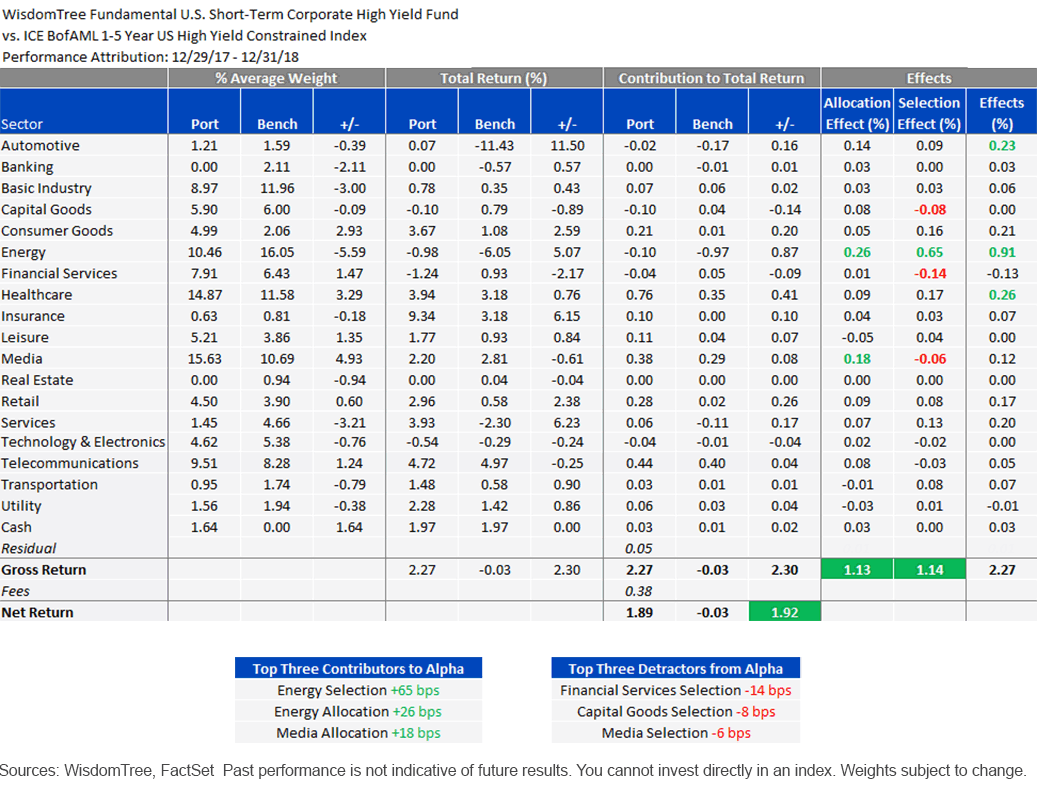
For definitions of terms in the chart, please visit our glossary.
Allocation from the Filtering Process: Sectors with less solvency (free cash flow (FCF)/total debt) tended to be worse off. The index effectively reduced the weight of the worst-performing sectors (Automotive, -11.4%, and Energy, -6.0%) and went overweight in the top-performing sector (Telecom, +5.0%). Overall, the return contribution from allocation effects was 113 bps.
Selection from Being Overweight in Attractive Fundamentals: Cutting bonds with negative fundamentals and over-weighting attractive bonds with lower default probabilities drove a positive selection effect of 114 bps. The largest selection effects came from bonds within the Energy and Health Care sectors.
Conclusion
While 2018 was viewed as the year for “rate hedging” in fixed income, we feel 2019 could be the year of focusing on “credit quality control.”'
Unless otherwise stated, all data is from FactSet, ICE BofA Merrill Lynch as of December 31 2018.
Important Risks Related to this Article
There are risks associated with investing, including possible loss of principal. Fixed income investments are subject to interest rate risk; their value will normally decline as interest rates rise. High-yield or “junk” bonds have lower credit ratings and involve a greater risk to principal. Fixed income investments are also subject to credit risk, the risk that the issuer of a bond will fail to pay interest and principal in a timely manner or that negative perceptions of the issuer’s ability to make such payments will cause the price of that bond to decline. While the Fund attempts to limit credit and counterparty exposure, the value of an investment in the Fund may change quickly and without warning in response to issuer or counterparty defaults and changes in the credit ratings of the Fund’s portfolio investments. Please read the Fund’s prospectus for specific details regarding the Fund’s risk profile.
Categories
About the contributors

Head of Investment and Fixed Income Strategy
Kevin serves as the Head of Investment and Fixed Income Strategy. In this role, he writes macro and fixed income-related content and works closely with the sales, research and marketing teams. In addition, Kevin conducts client-facing webinars and meetings, providing expertise on WisdomTree’s existing and future bond ETFs. Prior to joining WisdomTree, Kevin spent 30 years at Morgan Stanley, where he was Managing Director and Chief Fixed Income Strategist for Wealth Management. He was responsible for tactical and strategic recommendations and created asset allocation models for fixed income securities. He was a contributor to the Morgan Stanley Wealth Management Global Investment Committee, primary author of Morgan Stanley Wealth Management’s monthly and weekly fixed income publications, and collaborated with the firm’s Research and Consulting Group Divisions to build ETF and fund manager asset allocation models. Kevin has an MBA from Pace University’s Lubin Graduate School of Business, and a B.S. in Finance from Fairfield University.
