

Growth Stocks: Where’s the Beef?
Published December 12, 2018

Head of Equity Strategy
This is Part 1 of a two-part blog series on the market’s current expectations for growth and value stocks.
At the risk of making a 34-year-old pop culture reference, growth stock fundamentals remind us of the question first posed by Wendy’s in 1984: “Where’s the beef?”
As was the case back when war was declared on McDonald’s and Burger King, there appears to be a lot of “bun” in growth stocks but not a lot of “meat.”
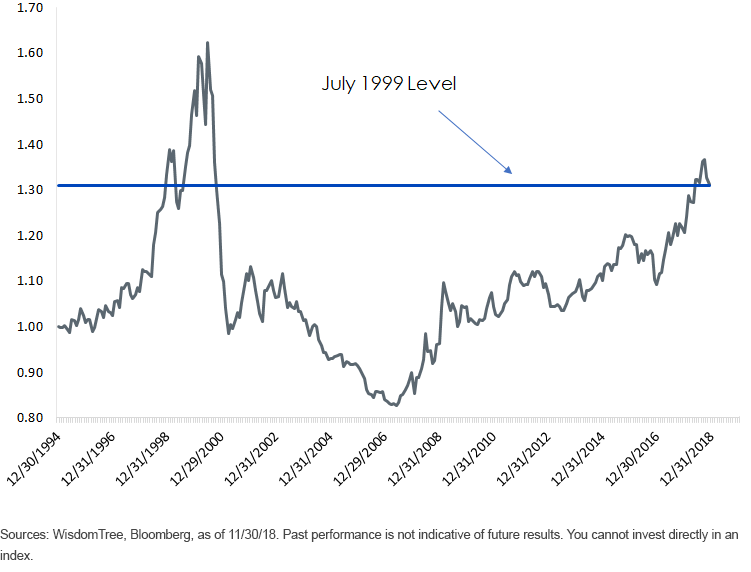
Face it: the magnitude and duration of the multiyear clobbering of value strategies by growth stocks in the current cycle is second only to the legendary 1994–2000 “new economy” years. That epic mania for growth as an investing style began about a year before the 1995 Netscape IPO,1 at which point the tech boom began to rage. That rally took the S&P 500 Growth Index 376% higher (30.1% annualized), trouncing the S&P 500 Value Index’s gain of “only” 183% (19.2% per year).2 When the rug was ripped out from under the market in the 2000–2002 crash, value stocks picked up thousands of basis points of outperformance.
Today, the cumulative gap between the two indexes, which has been stretching out since 2006, is once again in triple digits. From July 31, 2006, through November 30, 2018—more than 12 years—the S&P 500 Growth Index returned 246% (or 10.6% annually), more than doubling the 122% appreciation of the S&P 500 Value Index (6.7% annually).
That’s a difference of 124 percentage points.
Before we begin searching for the beef, consider the striking picture that figure 1 paints. As a reminder, the NASDAQ, about as “growthy” an index as can be constructed, started its crash in March 2000, while the S&P 500 topped later that summer. When they did, the rotation to value stocks was a flood.
Figure 1: S&P 500 Growth Total Return Index Relative to S&P 500 Value
Piggybacking on WisdomTree’s Prior Dividend Growth Work
We received positive feedback on our white paper, “Dividend Growth’s Drivers: Picking Apart Quality,” and this analysis builds on many of those concepts for the debate over growth versus value. In that piece, we looked at our Quality Dividend Growth suite, diving into the interaction of return on equity (ROE) with earnings retention and dividend payout ratios to determine the drivers of shareholder wealth.
The interrelationship between profitability and dividend policy is critical, and these concepts are becoming core parts of second-decade WisdomTree.
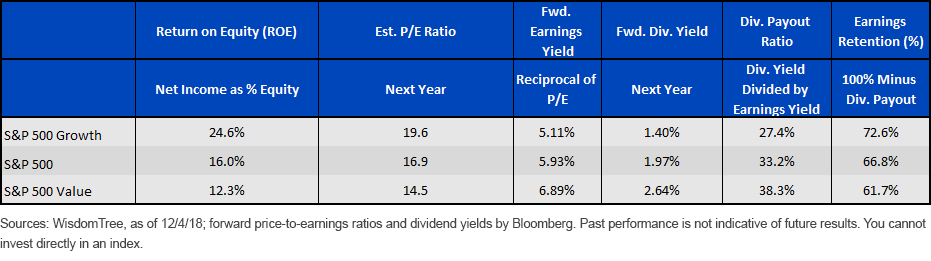
Figure 2 shows profitability and growth metrics for the S&P 500 Growth, S&P 500 and S&P 500 Value Indexes.
Figure 2: S&P 500 Growth, Core and Value Metrics
The Critical Equation
“Dividend Growth’s Drivers: Picking Apart Quality” identified profitability (ROE) as the driver of dividend growth, presenting the critical equation recreated in figure 3.
Figure 3: The Critical Equation

Figure 4 uses the critical equation to calculate “long-term” dividend growth. We added quotation marks to “long-term” because, frankly, looking into the future involves a lot more art than science.
Figure 4: Implied Dividend Growth Estimate
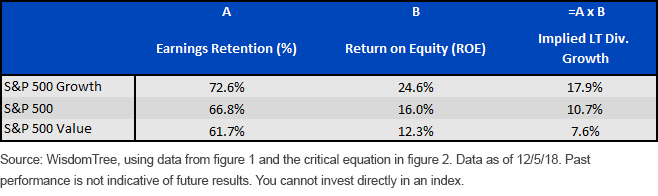
Can the S&P 500 Growth Index achieve long-term dividend growth of 17.9%? And how long is long-term? No one knows. But we can engage the numbers to get a feel for whether we want to pay nearly 20x forward earnings for growth stocks when value stocks are on offer for 15x earnings.
Stay tuned for the second part of this series, where we will consider the possibility of several years of nearly 18% increases in growth stock dividends to see if that even makes sense. Spoiler alert: it doesn’t. Where's the beef? Not in Growth's unsustainable ROE.
1The famed 1995 Netscape IPO is widely regarded as one of the first newsworthy events of the dot-com boom.
2Sources: Bloomberg, WisdomTree, for the period 4/29/1994–3/31/2000
Categories
About the contributor

Head of Equity Strategy
Jeff Weniger, CFA, has been with WisdomTree since 2017 and serves as the Head of Equities. He shapes the firm’s market outlook through a combination of macroeconomic and fundamental analysis. With more than two decades in investment strategy, Jeff is known for his work on market cycles and valuations. Before joining WisdomTree, Jeff was with BMO Private Bank and BMO Global Asset Management for 11 years. At BMO, he sat on the firm’s Asset Allocation Committee and co-managed ETF model portfolios across the U.S. and Canada. In 2013, at age 32, he became the youngest member of BMO’s Global Investment Forum. When he left BMO to come to WisdomTree, his final role was Director, Senior Strategist in the Office of the CIO in 2017.
Jeff is a frequent television guest on networks such as CNBC, Bloomberg, and Schwab, with regular print appearances in The Wall Street Journal, Barron’s and Reuters. He also appears weekly on the Behind the Markets podcast and is a regular on SiriusXM’s The Business Briefing. On X, Jeff has developed one of the larger followings in financial media. He earned a B.S. in Finance from the University of Florida and an MBA from the University of Notre Dame. He has held the CFA charter since 2006.