

Global Impact: Rising Rates around the World
Published August 15, 2013

Chief Investment Officer, Fixed Income and Model Portfolios
Bond investors around the world have had a difficult run the past couple of months. While many market prognosticators have decried the end of the bond market, we believe there is still value in taking a diversified approach to fixed income. Although the recent past has seen yields rise across virtually all fixed income sectors, we do not believe that this period of heightened correlations is set to continue indefinitely. For the past couple of years, beta ran equity markets, and we’re seeing some investors make the same claims about bonds. As globally minded investors, we do not believe that the same factors and fundamentals that drive returns are comparable between the United States and emerging market (EM) countries. For U.S. Treasury investors this year, the 10-Year Note bottomed at 1.63% on a closing basis on May 2, 2013. Just over two months later, the 10-Year was yielding 2.74%!1 Talk of tapering by Fed Chairman Ben Bernanke was interpreted by markets to mean that imminent Fed tightening would occur sooner than anticipated. On the back of this, yields across the emerging markets rose in concert. To many, it seemed as though the cost of capital was increasing around the world. In fact, while Treasury yields rose by over 1.11%, yields in emerging markets actually increased by 1.45%. As the graphs below show, this strong positive relationship has not been the historical norm.
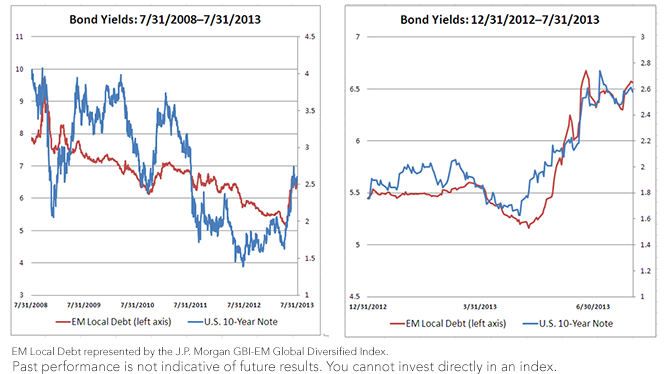
For definitions of terms and indexes in the charts, please visit our Glossary. However, this risk of rising rates needs to be carefully qualified and examined. On a total-return basis, an investment in the 10-Year Treasury Note resulted in a decline of 8.16% during this period2. Due to its lower duration, the larger move in interest rates in emerging markets3 resulted in a loss of just over 5% (5.05%). However, duration has accounted for only a part of the emerging markets story. U.S. dollar strength accounted for additional negative performance for investors in emerging market debt. In fact, losses from currency actually accounted for –6.64%, easily outpacing the decline from higher interest rates4. Interestingly enough, the move in emerging market currencies has been partially attributable to slowing growth in China, yet the Chinese yuan continues to be one of the top-performing emerging market currencies in 2013. However, the question that investors should be asking themselves is, do I believe the U.S. dollar will remain strong indefinitely against cleaner balance sheets and faster-growing economies of emerging markets? While the U.S. economy has recently surprised many economists with stronger earnings data and gross domestic product figures, we do not believe that EM has completely lost its luster in the medium and long term. Total returns for domestic fixed income will come under pressure and experience periods of volatility. Total returns for emerging market fixed income are not immune to global rebalancing. As bond investors, we care principally about generating attractive levels of income per unit of risk. In our opinion, market sentiment for many EM economies continues to heavily discount the emerging market story. China may slow, South Africa may be facing a period of social unrest, and India may continue to be mired in short-term setbacks, but all three of these economies have overwhelmingly positive growth trajectories. We could just as easily highlight the two credit ratings upgrades in the Philippines(and one for Turkey) that now create yields in excess of the U.S. high yield market in a much higher credit-quality portfolio5. Ultimately, emerging markets will undoubtedly continue to be met with challenges and volatility. But should investors continue to believe in their long-term trajectories, some assets may prove to be attractive long-term buying opportunities once market sentiment begins to turn. 1Source: Bloomberg, 2013. 2As represented by the Ryan Labs 10 Year Bond Index, Bloomberg. 3As represented by the J.P. Morgan GBI-EM Global Diversified Index. 4Sources: JPMorgan, Bloomberg, 2013. 5Source: WisdomTree, 7/31/2013.
Important Risks Related to this Article
Diversification does not eliminate the risk of experiencing investment loses. Fixed income investments are subject to interest rate risk; their value will normally decline as interest rates rise. In addition, when interest rates fall, income may decline. Fixed income investments are also subject to credit risk, the risk that the issuer of a bond will fail to pay interest and principal in a timely manner or that negative perceptions of the issuer’s ability to make such payments will cause the price of that bond to decline. Unlike typical exchange-traded funds, there is no index that the Fund attempts to track or replicate. Thus, the ability of the Fund to achieve its objective will depend on the effectiveness of the portfolio manager. Due to the investment strategy of this Fund, it may make higher capital gain distributions than other ETFs. Please read the Fund’s prospectus for specific details regarding the Fund’s risk profile.
Categories
About the contributor

Chief Investment Officer, Fixed Income and Model Portfolios
Rick Harper serves as the Chief Investment Officer, Fixed Income and Model Portfolios at WisdomTree Asset Management, where he oversees the firm’s suite of fixed income and currency exchange-traded funds. He is also a voting member of the WisdomTree Model Portfolio Investment Committee and takes a leading role in the management and oversight of the fixed income model allocations. He plays an active role in risk management and oversight within the firm.
Rick has over 29 years investment experience in strategy and portfolio management positions at prominent investment firms. Prior to joining WisdomTree in 2007, Rick held senior level strategist roles with RBC Dain Rauscher, Bank One Capital Markets, ETF Advisors, and Nuveen Investments. At ETF Advisors, he was the portfolio manager and developer of some of the first fixed income exchange-traded funds. His research has been featured in leading periodicals including the Journal of Portfolio Management and the Journal of Indexes. He graduated from Emory University and earned his MBA at Indiana University.