

Global Fixed Income: Let’s Go to the Videotape
Published June 1, 2016

Head of Investment and Fixed Income Strategy
As we celebrate the unofficial start of summer, fixed income investors may be wondering if there is anything to celebrate yet or whether we should wait on the fireworks. Certainly, fixed income investors were given a “head fake” to start 2016, as the risk-off trade pivoted to more of a risk-on characteristic when winter was transitioning to spring. Since then, headline watching has seemingly become a fixed income pastime, with the Fed taking on a dominant role of late. It should be noted that in June, the Federal Reserve (Fed) will not be alone on this front, as both the European Central Bank (June 2) and the Bank of Japan (June 16) also having policy meetings. So, let’s go to the videotape and see how the global fixed income markets have fared. The interesting twist for the year is that U.S. high yield (HY) and emerging market (EM) local debt have put in the best performances thus far. To provide perspective: as of this writing, HY, as measured by the Barclays U.S. Corporate High Yield Total Return Index Value Unhedged, has produced a positive reading of +7.47%. On the EM side, the total return, as measured by the JP Morgan Government Bond Index – Emerging Markets (GBI-EM) Global Diversified, has come in at +7.70%. This is not the picture investors would have witnessed during the first six weeks of the year. Indeed, on February 11 (2016’s peak risk-off day thus far), HY was posting a negative return of -5.16%, while EM local debt was slightly in the plus column, at +1.2%.
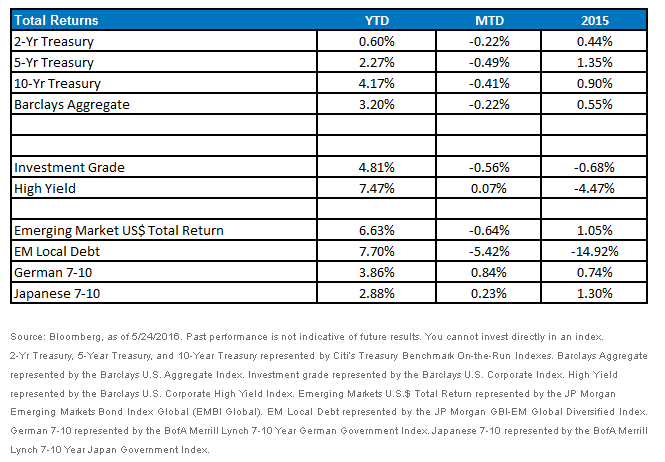
For definitions of Indexes in the chart, visit our glossary. Within the investment-grade (IG) corporate market, a similar pattern has emerged. According to the Barclays U.S. Aggregate Corporate Total Return Value Unhedged Index, the IG sector was producing a positive performance of +4.81% heading into the Memorial Day weekend, a rather noticeable improvement from the +0.74% reading in early February. From the interest-sensitive side, U.S. Treasury market (UST) performance numbers improved more and more, the further out on the yield curve one goes. To illustrate, the UST 2-Year return came in at a rather modest +0.60%, as compared to a more solid showing of +4.17% for the UST 10-Year (utilizing the Citi 2-Year and 10-Year Treasury Benchmark On-the-Run Index). Conclusion Future central bank policy decisions could certainly play an important role for how “the videotape” looks when the calendar reaches the autumnal equinox and beyond. In fact, investors may have already begun to witness some markets pricing in the Fed potentially raising rates at either its June or July policy meetings. The EM local debt space has witnessed a pronounced shortfall, falling -5.42% on a month-to-date basis as of May 24. This decline is mostly a reflection of a stronger dollar, as the EM U.S. dollar (USD) market lost a far smaller -0.64% (JPMorgan Emerging Market Bond Index – Global). It seems to be no coincidence that the recent USD rebound coincided with the recent FOMC minutes and additional Fed rhetoric, which placed a possible June rate hike back on the table.
Important Risks Related to this Article
Fixed income investments are subject to interest rate risk; their value will normally decline as interest rates rise. In addition, when interest rates fall, income may decline. Fixed income investments are also subject to credit risk, the risk that the issuer of a bond will fail to pay interest and principal in a timely manner or that negative perceptions of the issuer’s ability to make such payments will cause the price of that bond to decline.
About the contributor

Head of Investment and Fixed Income Strategy
Kevin serves as the Head of Investment and Fixed Income Strategy. In this role, he writes macro and fixed income-related content and works closely with the sales, research and marketing teams. In addition, Kevin conducts client-facing webinars and meetings, providing expertise on WisdomTree’s existing and future bond ETFs. Prior to joining WisdomTree, Kevin spent 30 years at Morgan Stanley, where he was Managing Director and Chief Fixed Income Strategist for Wealth Management. He was responsible for tactical and strategic recommendations and created asset allocation models for fixed income securities. He was a contributor to the Morgan Stanley Wealth Management Global Investment Committee, primary author of Morgan Stanley Wealth Management’s monthly and weekly fixed income publications, and collaborated with the firm’s Research and Consulting Group Divisions to build ETF and fund manager asset allocation models. Kevin has an MBA from Pace University’s Lubin Graduate School of Business, and a B.S. in Finance from Fairfield University.