

Getting More Defensive in European Portfolios
Published September 13, 2018

Head of Equity Strategy
This is the first of a two-part series on Turkey’s financial crisis and Europe. In this post, we assess European equity risk and potential portfolio solutions. The second part will explore country-level risks to assess WisdomTree ETFs that may help mitigate Turkish contagion.
Withthe Turkish lira against the ropes and emerging markets heavily sold off this year, how can European equity risk be tamed?
We investigated our exchange-traded funds’ (ETFs) exposure to the four banks that own the bulk of Turkish debt. It turns out that each of our Europe-focused ETFs has lower exposure to them than the MSCI EMU (European Monetary Union) Index. While the WisdomTree Europe Hedged Equity Fund (HEDJ), our flagship euro-hedged European equity ETF, has 2.85% in Spain’s BBVA, it doesn’t hold any of the other three: Italy’s UniCredit, the Netherlands’ ING and France’s BNP Paribas. Looking at our other European equity ETFs, many don’t hold any of these banks at all.
For investors who want to maintain European exposure, one path for relative safety leads us to our WisdomTree Germany Hedged Equity Fund (DXGE) because of the relative haven status of that nation, and HEDJ, which covers broad Europe. Both hedge the currency risk to become currency neutral. For investors who want long exposure to the euro, the ETF with zero exposure to the four banks that may best cover the total allocation is the WisdomTree Europe Quality Dividend Growth Fund (EUDG).
The Fragile Five
Thus far, the nations most scrutinized by the market are emerging ones—namely, the so-called BIITS (Brazil, Indonesia, India, Turkey and South Africa). These “Fragile Five” are known for current account deficits, although we argue that India has materially improved on this front in recent years.
But what may be most critical for markets is the effect Turkey’s crisis has on European equities.
Figure 1 shows financial sector weights in WisdomTree’s European equity Indexes that have ETFs that track them. Of particular note is that our German equity Index’s 15% weight in the Financials sector is dominated by insurance companies; perennially troubled Deutsche Bank is barely a half percent of its total, while Commerzbank is not held at all.
Figure 1: Financials Sector Weight, European Equities
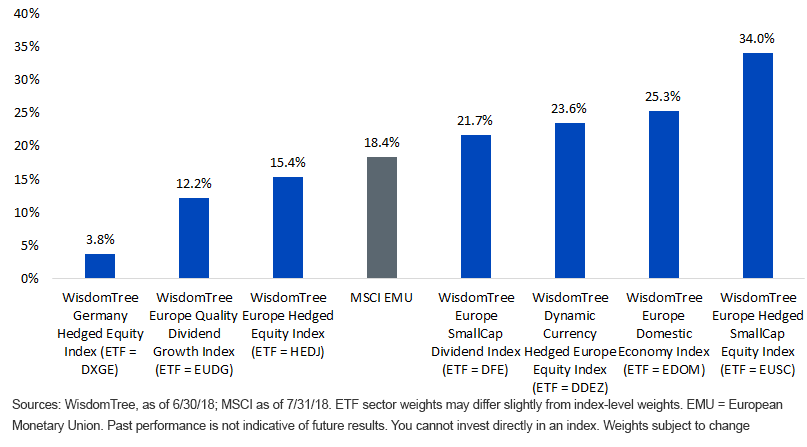
For definitions of indexes in this chart, please visit our glossary.
Figure 2 shows the index weights in the four aforementioned Turkish debt-exposed banks.
Figure 2: Index Weights, Turkey-Exposed European Banks
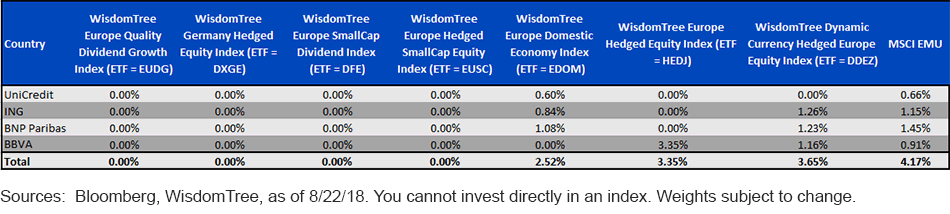
Of the three ETFs that are under-weight in the Financials sector (EUDG, HEDJ and DXGE), they also respectively hold 0%, 3.35% and 0% in the four banks, while MSCI EMU Index’s weighting in them is 4.17%.
A Primer on the Turkish Crisis
This summer, the Turkish lira more than halved. Crisis catalysts are:
- A large current account deficit equal to -6.4% of GDP
- A 2.5% budget deficit-to-GDP ratio
- President Recep Tayyip Erdogan’s elimination of the Turkish central bank’s independence
- Generalized U.S. dollar strength against most currencies
- U.S. sanctions
Erdogan
Although the Turkish president has been around for years, he’s now using hostile relations with the U.S. as his new political tool. Secularists in metro cities such as Istanbul are frightened by his increasingly autocratic ways and conservative interpretations of Islam, fearing that the country is turning its back on the West. Gold and hard currency hoarding is the result.
With the lira already sliding, President Trump sanctioned Turkey, demanding the release of pastor Andrew Brunson, under house arrest on accusations of masterminding the coup attempt that infuriated Erdogan. Trump’s levied penalty is a 50% and 20% rate on steel and aluminum exports, respectively, double the tariff the U.S. administration put on other countries.
Extent of the Debt Problem
According to Credit Suisse and Thomson Reuters Datastream, Turkish non-financial corporations have non-TRY debt equal to more than 35% of GDP, while Turkish financial institutions have another 20% of GDP in hard currency debt. The country ranks first on these metrics.
But we are keen to note that Turkish GDP is only 1% of the global total. Nevertheless, emerging market equities are off by 20% since January, so there is risk of contagion in popular sentiment.
We hypothesize that Mario Draghi, president of the European Central Bank (ECB), may surprise markets by holding interest rates constant next year instead of obliging the consensus, which sees a one-in-three chance of rate hikes. Given our dovish ECB surprise thesis, currency-hedged European ETFs may be more opportune than the ones that might take out that risk (about half of our ETFs hedge and the others don’t).
Some combination of EUDG, DXGE and HEDJ may be an angle for investors aligned with the above thesis.
Important Risks Related to this Article
There are risks associated with investing, including possible loss of principal. Foreign investing involves special risks, such as risk of loss from currency fluctuation or political or economic uncertainty. These Funds focus their investments in Europe, thereby increasing the impact of events and developments associated with the region, which can adversely affect performance. Dividends are not guaranteed, and a company currently paying dividends may cease paying dividends at any time. Investments in currency involve additional special risks, such as credit risk and interest rate fluctuations. As these Funds can have a high concentration in some issuers, the Funds can be adversely impacted by changes affecting those issuers. These Funds invest in the securities included in, or representative of, their Index regardless of their investment merit, and the Funds do not attempt to outperform their Index or take defensive positions in declining markets. Please read each Fund’s prospectus for specific details regarding the Fund’s risk profile.
The Global Industry Classification Standard (“GICS”) was developed by and is the exclusive property and a service mark of MSCI Inc. (“MSCI”) and Standard & Poor’s (“S&P”), a division of The McGraw-Hill Companies, Inc., and is licensed for use by WisdomTree Investments, Inc. Neither MSCI, S&P nor any other party involved in making or compiling the GICS or any GICS classifications makes any express or implied warranties or representations with respect to such standard or classification (or the results to be obtained by the use thereof), and all such parties hereby expressly disclaim all warranties of originality, accuracy, completeness, merchantability and fitness for a particular purpose with respect to any such standard or classification. Without limiting any of the foregoing, in no event shall MSCI, S&P, any of their affiliates or any third party involved in making or compiling the GICS or any GICS classifications have any liability for any direct, indirect, special, punitive, consequential or any other damages (including lost profits), even if notified of the possibility of such damages.
Categories
About the contributor

Head of Equity Strategy
Jeff Weniger, CFA, has been with WisdomTree since 2017 and serves as the Head of Equities. He shapes the firm’s market outlook through a combination of macroeconomic and fundamental analysis. With more than two decades in investment strategy, Jeff is known for his work on market cycles and valuations. Before joining WisdomTree, Jeff was with BMO Private Bank and BMO Global Asset Management for 11 years. At BMO, he sat on the firm’s Asset Allocation Committee and co-managed ETF model portfolios across the U.S. and Canada. In 2013, at age 32, he became the youngest member of BMO’s Global Investment Forum. When he left BMO to come to WisdomTree, his final role was Director, Senior Strategist in the Office of the CIO in 2017.
Jeff is a frequent television guest on networks such as CNBC, Bloomberg, and Schwab, with regular print appearances in The Wall Street Journal, Barron’s and Reuters. He also appears weekly on the Behind the Markets podcast and is a regular on SiriusXM’s The Business Briefing. On X, Jeff has developed one of the larger followings in financial media. He earned a B.S. in Finance from the University of Florida and an MBA from the University of Notre Dame. He has held the CFA charter since 2006.