

Get Your Money’s Worth with Floating Rate Notes
Published August 30, 2018

Director, Portfolio Solutions
Volatility has been a persistent theme throughout 2018, as geopolitical concerns and rising interest rates have weighed heavy on investors’ minds. During times of uncertainty, many market participants have turned to money market funds with the goal of reducing risk and maintaining liquidity while accepting lower amounts of yield and return. However, with the introduction of U.S. government-issued floating rate notes (FRNs), investors now have an opportunity to potentially earn even more on their cash, without having to take on additional credit, liquidity or duration risk.
Market Conditions
As of the end of July, the Federal Open Market Committee (FOMC) has already raised rates twice in 2018, continuing down the path of rate stabilization. Given its transparent indications to have sustained rate hikes for the following quarters, many investors have sought the protection of short maturity or money market funds to aid in their pursuits. While much of the principal invested in these funds may appear to be well suited for such an environment, they may not necessarily be designed to benefit from a rising rate environment.
A common misconception worth exploring is how some view money market funds and their structural intent. Standard money market funds are NOT insured/backed accounts. They are investments, and as such, their is no guarantee against the risk of loss. They do, however, typically provide shareholders with a short-term, high-quality exposure to instruments that typically yield more than standard interest-bearing bank accounts. Additionally, many offer investments that maintain a stable net asset value (NAV). While most money market funds will pay higher levels of income as interest rates rise, they do not necessarily invest in floating rate instruments alone.
FRNs were first issued by the U.S. government in January 2014. These notes provide exceptional liquidity, as the size of the outstanding investable universe nears $317 billion. However, a key attribute that sets these notes apart is that instead of paying a fixed rate of interest like other Treasuries, FRN coupon payments are based on a reference rate (90-day t-bills) plus a spread. Since 90-day bills are auctioned every week, effective duration of FRNs is one week, which allows investors to capture higher rates of income as short-term rates rise. Given that these securities are assumed to be free of default risk, their value is linked to the rate of interest at each weekly auction. Since 90-day t-bills are among the most sensitive to interest rate changes conducted by the FOMC, this provides an opportunity to boost income as the Fed hikes rates.
What’s in Your Money Market Fund?
With more than 1,000 money market funds in existence today, it may be hard to differentiate or make an informed decision between one or another. Typically, they can be broken down into three categories: taxable, tax free and prime. Taxable funds typically invest in short-term money market securities, certificates of deposit and other marketable securities. Tax-free funds, as their name alludes to, invest in short-term money market securities that are often exempt from some federal, state and/or local taxes. Prime funds invest in a wide range of short-term securities, typically eliciting the use of commercial paper and other asset-backed securities. These funds offer higher yields, but also higher risk.
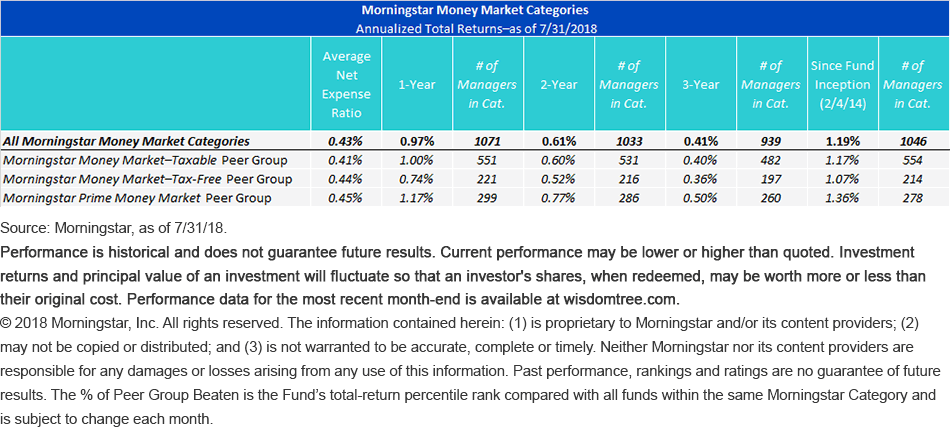
What’s been interesting to see is how FRNs have stacked up against all three. When comparing the WisdomTree Floating Rate Treasury Fund (USFR), which seeks to track the performance of the Bloomberg U.S. Treasury Floating Rate Bond Index, to Morningstar’s three money market peer groups, the Taxable Category, the Tax-Free Category and the Prime Category, USFR has maintained significant levels of outperformance throughout the life of the Fund. In fact, USFR has had annualized returns of 1.43% over the last 1 year, 1.14% over the last 2 years, 0.85% over the last 3 years, and 0.55% since the fund incepted on February 4th, 2014 -- a testament to the FRN’s ability to efficiently participate in rising interest rates. Additionally, when looking at USFR versus the Prime Category, a group that will typically take on additional credit risk to achieve higher yields, USFR has still outperformed since its inception.
Figure 1: Morningstar Money Market Peer Group Performance
For standardized performance of USFR, please click here.
Please visit our glossary for definitions of terms and indexes in the chart.
Additionally, USFR has outperformed without exposing shareholders to excessive levels of volatility. Since inception, USFR has had an annualized standard deviation of 0.21%; 0.20% over the last three years, 0.15% over the last two years and 0.13% over the trailing 12 months. Furthermore, investors get access to FRNs through the ETF wrapper, so they always know what they hold, as opposed to more opaque money market funds. All this at an annualized expense ratio that is 0.28% less than the aggregated category average. At a time where every basis point matters, these fee savings can make a difference in helping drive total return.
We believe that as investors expect more rate hikes from the Fed, or expect volatility to continue for the foreseeable future, it makes sense to allocate short maturity assets in floating rate notes. In our view, FRNs can give investors looking to de-risk the added benefit of higher potential income through participating in rising interest rates while limiting volatility. As Steve Miller so famously recites, now may be the time for you to join Bobbie Sue and “take the money and run.”
Unless otherwise noted, all data as of July 31, 2018. Sources: WisdomTree, Bloomberg, Morningstar, Zephyr StyleADVISOR.
Important Risks Related to this Article
There are risks associated with investing, including possible loss of principal. Securities with floating rates can be less sensitive to interest rate changes than securities with fixed interest rates, but may decline in value. The issuance of floating rate notes by the U.S. Treasury is new and the amount of supply will be limited. Fixed income securities will normally decline in value as interest rates rise. The value of an investment in the Fund may change quickly and without warning in response to issuer or counterparty defaults and changes in the credit ratings of the Fund’s portfolio investments. Due to the investment strategy of this Fund, it may make higher capital gain distributions than other ETFs. Please read the Fund’s prospectus for specific details regarding the Fund’s risk profile.
Categories
About the contributor

Director, Portfolio Solutions
Brendan Loftus joined WisdomTree in 2016 covering our global range of equity, currency, and bond funds along with their corresponding markets. In his present role, he leads the firm’s Portfolio Solutions team, offering specialized guidance and conducting comprehensive analyses of strategies within the context of model portfolios. His passion for investment strategy resonates through his commitment to delivering meticulously personalized investment solutions, thereby empowering our clientele to realize their unique portfolio objectives. Prior to joining WisdomTree, Brendan worked in several wealth-management related roles for Morgan Stanley and Incapital, LLC. Brendan received his B.B.A. with honors in Finance and Economics from Villanova University in 2016.