

Get More Defensive with Your Equity Exposure
Published February 22, 2016

Chief Investment Strategist
It is worth remembering that the S&P 500 Index experienced declines within five of the last seven years, yet it has still managed to end each of those calendar years with positive returns, after adding back dividends. With the rough start for stocks in 2016, both inside and outside the U.S., it’s easy to lose sight of the fact that markets often swoop downward for weeks or months before staging rallies and reclaiming lost ground in the quarters that follow. Whether that occurs in 2016 may well depend on if (and how fast) corporate earnings recover from their current lull—and whether oil prices can stabilize and rise from current levels. On a year-to-date (YTD) basis, the U.S. and developed markets sold off through February 15 by more than 8% and 13%, respectively.1 Undoubtedly, some investors may be viewing 2016 as the year when broad equity markets end the year lower than they began. That means any near-term rallies that do develop are likely to be met by sellers trying to lighten their equity exposure or rotate into more defensive positions. We screened all the WisdomTree equity Funds in search of what has been our most defensive equity Fund thus far in 2016. The answer: the WisdomTree High Dividend Fund (DHS). The Index it tracks, the WisdomTree High Dividend Index, declined just 3.2% through February 15 at a time when the S&P 500 Index had declined by 8.5%. The WisdomTree High Dividend Index is exhibiting three characteristics that investors typically search for in choppy markets: defensive sector exposure, lower beta and a healthy dividend yield. WisdomTree High Dividend Index vs. Russell 1000 Value and S&P 500 Indexes

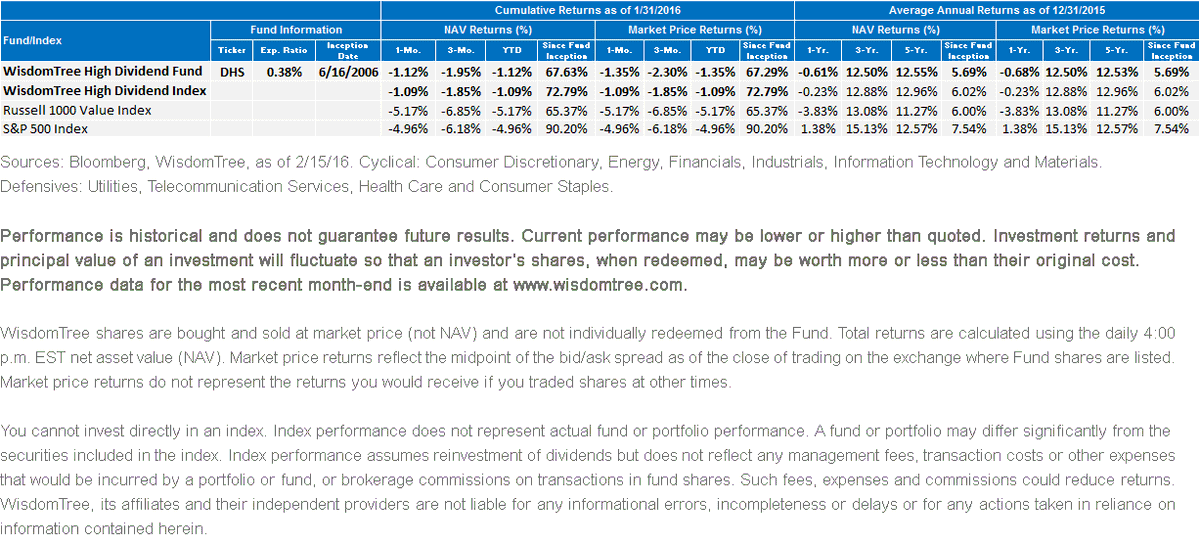
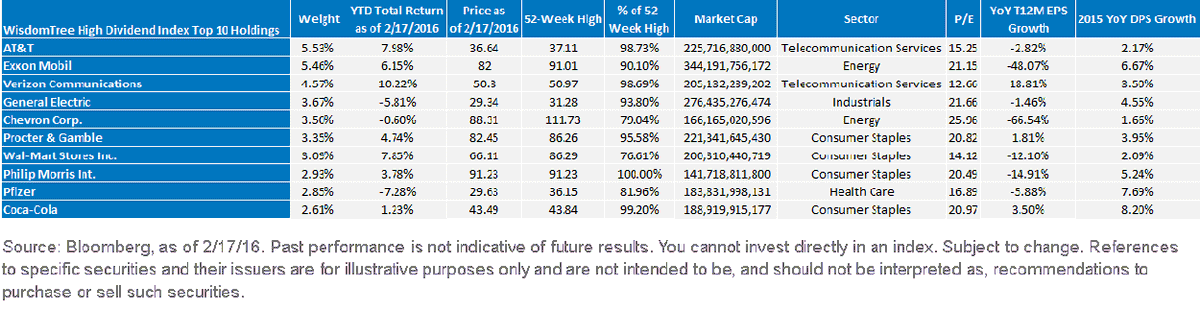
For definitions of terms and indexes in the chart, visit our glossary. Defensive Sector Exposure Driving Year-to-Date Performance By selecting stocks based on high dividend yields and then weighting them based on the dollar value of regular cash dividends paid to shareholders, the WisdomTree High Dividend Index typically exhibits a value tilt. However, by focusing on dividends in the selection and weighting process—unlike some market cap-weighted value indexes—this strategy typically generates a higher starting dividend yield and greater overall exposure to the “defensive sectors” of the market. As of February 2016, the WisdomTree High Dividend Index had a trailing dividend yield of 4.5%, compared to 2.9% for the Russell 1000 Value Index and 2.4% for the S&P 500 Index. In addition, the WisdomTree Index has 47% of its weight in the Consumer Staples, Telecom, Utilities and Health Care sectors, compared to just 32% for the S&P 500. (Index rules, updated in 2012, require that no sector can be more than 25% of the Index’s weight at the annual rebalance, which occurs in December.) So far in 2016 that combination has contributed to the WisdomTree High Dividend Index outperforming the Russell 1000 Value Index by 540 basis points (bps) and the S&P 500 Index by 533 bps in a down market. When we drill down and examine the top 10 holdings of the WisdomTree High Dividend Index, we can see that roughly 38% of the overwhelmingly large-cap Index is concentrated in well-known, mega-cap stocks. In a year when headlines warn that global equity markets are heading into bear territory, seven of the top 10 constituents in the WisdomTree Index actually generated positive returns thus far in 2016. Three of the top 10 names have actually posted new 52-week highs in 2016. And all 10 have been able to increase dividend-per-share payments over the past year, despite, in some cases, headwinds that have caused earnings to contract year over year. Top 10 Holdings in WisdomTree High Dividend Index
For definitions of terms and indexes in the chart, visit our glossary. Beta, Volatility and Risk-Adjusted Returns, 2011–2016 The other appealing aspect of the strategy is that it has the potential to lower overall volatility and beta compared to traditional cap-weighted indexes. Since 2011, the WisdomTree High Dividend Index has had a beta of 0.67 versus the S&P 500. Its standard deviation over that five-year period was 2.5 percentage points less than the S&P 500 and nearly 3 percentage points less than the Russell 1000 Value. This reduction in standard deviation contributed to a higher risk-adjusted return over the period, as measured by its higher Sharpe ratio, a measure of risk-adjusted return. And unlike some of the minimum-volatility indexes that today sport P/E ratios north of 20,2 the WisdomTree High Dividend Index posts a trailing P/E ratio of 17.53, in line with the market multiple of 17.4 times trailing earnings exhibited by the S&P 500. Conclusion Through the first six weeks of 2016, the WisdomTree High Dividend Fund (DHS) has been WisdomTree’s most defensive long-only equity exchange-traded fund in this turbulent market. The stock selection and weighting methodology tilts the portfolio toward higher-dividend-yielding stocks and toward today’s most defensive sectors. That combination has the potential to help investors squeeze more dividend income out of the market, while limiting downside volatility. 1U.S. equity market represented by the S&P 500 Index and developed markets represented by MSCI EAFE Index as of 2/15/16. 2Source: Bloomberg. MSCI USA Minimum Volatility Index exhibited a trailing 12-month P/E of 21 on 2/17/15. 3As of 2/17/16.
Important Risks Related to this Article
Dividends are not guaranteed, and a company currently paying dividends may cease paying dividends at any time.
There are risks associated with investing, including possible loss of principal. Funds focusing their investments on certain sectors may be more vulnerable to any single economic or regulatory development. This may result in greater share price volatility. Please read the Fund’s prospectus for specific details regarding the Fund’s risk profile.
About the contributor
