

Germany Is Having a Moment
Published February 24, 2015

Global Head of Research
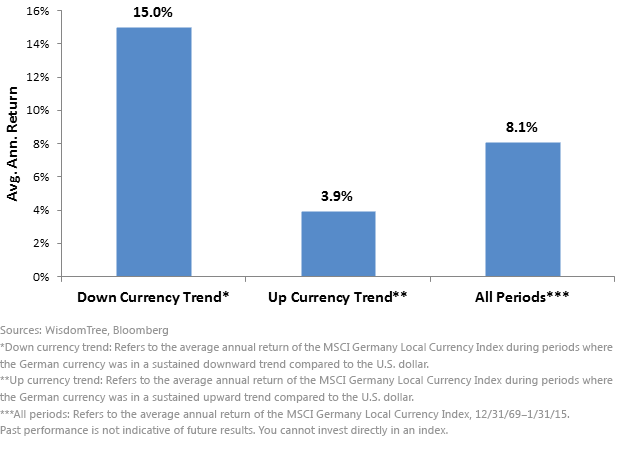
One of the most exciting developments thus far in 2015 has been Mario Draghi’s announcement of an open-ended quantitative easing program at the European Central Bank (ECB) to stimulate economic growth and stem deflationary risk to the eurozone. While it may take time to fully assess the efficacy of this policy, we think that the impact of a weaker euro may be more immediately visible. Where might this be most evident? We’ve got our eyes on Germany. 2015: The Year to Own German Equities? Exports are an important part of Germany’s economy, and as a result, a weaker euro should have a strong impact on the region. In the chart below, we take a historical look at how currency has impacted bottom-line performance in the German equity market. During a period of more than 45 years, investors saw a clear advantage to owning German equities during periods of currency depreciation. While the past can’t guarantee the future, the trend is compelling. MSCI Germany Index in Local Currency (12/31/1969‒1/31/2015)
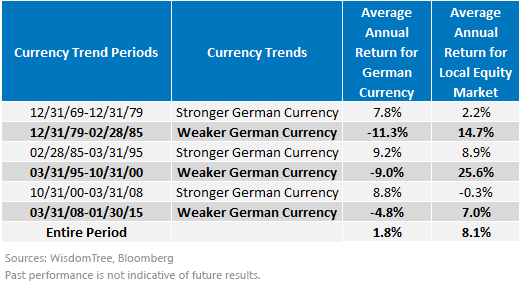
Zooming in on Currency Trend Periods For the period we were able to study, there were six overall currency trends—three characterized by a stronger German currency and three characterized by a weaker one, all measured relative to the U.S. dollar. Two out of the three weaker German currency trends were characterized by double-digit equity market returns.
Fine-Tuning the Focus on German Exporters While the MSCI Germany Index has a long available history, it does not focus solely on German exporters or tilt away from purely domestic revenue generators. However, on May 1, 2013, WisdomTree launched its Germany Hedged Equity Index (German Exporters)—an Index requiring that all constituents generate less than 80% of their revenues from sources in Germany. Only two currency trends in the euro are available for examination from the inception date to February 6, 2015. • Euro Strength, May 1, 2013‒May 6, 2014: This period saw the euro move from about $1.32 to $1.39. German exports were up 19.9%, while the MSCI Germany Index in local currency was up 18.8%. Of course, those measuring the performance of the MSCI Germany Index in U.S. dollars would have benefitted from the appreciation of the euro and been up almost 26% cumulatively over the same period.1 • Euro Weakness, May 6, 2014‒February 6, 2015: This period saw the euro move from about $1.39 to about $1.13—a depreciation of nearly 19%. German exports were up 15.0%, while the MSCI Germany Index in local currency was up 14.9%―thus offering very similar returns. The real key was in not layering on the additional exposure of the euro, which drove down the returns of the MSCI Germany Index in U.S. dollars to -6.4% cumulatively over the same period.2 We encourage investors not to forget about Germany, especially if they believe that Mario Draghi’s program of quantitative easing has the potential to cause a further trend of euro weakness. 1Source: Bloomberg. 2Source: Bloomberg.
Important Risks Related to this Article
Investments in currency involve additional special risks, such as credit risk and interest rate fluctuations. Investments focused in Germany are increasing the impact of events and developments associated with the region, which can adversely affect performance.
About the contributor

Global Head of Research
Christopher Gannatti began at WisdomTree as a Research Analyst in December 2010, working directly with Jeremy Schwartz, CFA®, Director of Research. In January of 2014, he was promoted to Associate Director of Research where he was responsible to lead different groups of analysts and strategists within the broader Research team at WisdomTree. In February of 2018, Christopher was promoted to Head of Research, Europe, where he was based out of WisdomTree’s London office and was responsible for the full WisdomTree research effort within the European market, as well as supporting the UCITs platform globally. In November 2021, Christopher was promoted to Global Head of Research, now responsible for numerous communications on investment strategy globally, particularly in the thematic equity space. Christopher came to WisdomTree from Lord Abbett, where he worked for four and a half years as a Regional Consultant. He received his MBA in Quantitative Finance, Accounting, and Economics from NYU’s Stern School of Business in 2010, and he received his bachelor’s degree from Colgate University in Economics in 2006. Christopher is a holder of the Chartered Financial Analyst Designation.