

From Japan, With Love—Record Buying of Global Securities
Published August 10, 2016

Senior Advisor
Japanese investors have been accelerating their purchases of global securities at an unprecedented pace. The recent publication of July securities transaction data suggests net buying of global securities (equities and bonds) of ¥6.37 trillion1, the biggest one-month outflow on record. In our view, this suggests that domestic monetary policy is actually hitting its target of forcing unprecedented portfolio rebalancing, out of yen and into global assets. However, for now the focus is very much on global bonds, not stocks. Strong Preference for Bonds Japanese investors have shown a strong preference for global bonds over global equities. They bought ¥5.45 trillion global bonds in July—the biggest one-month outflow on record. Japanese investors bought ¥18.7 trillion global bonds in the first seven months of 2016,2 surpassing the 12-month total of ¥11.8 trillion recorded in 2015. In contrast, they bought “only” ¥3.5 trillion of global equities year-to-date,3 which is a run-rate less than one-third of the pace recorded last year; Japan bought ¥13.4 trillion of global equities in 2015, mainly driven by the “global risk-on” rebalancing of the public pension fund, GPIF. When Hedging Costs Rise, the Yen Will Fall The fact that the yen has not weakened despite these massive outflows suggests that overall hedge ratios must have increased. In turn, once the cost of hedging increases with wider interest rate differentials, the yen will likely become vulnerable to weakness when dollar hedges unwind. The growing gap between the yen moving one way and portfolio outflows moving in the opposite direction should be increasing the risk of sharp currency volatility spikes—if and when short-term funding cost differentials begin to move. Global Investors—Record Sell-Out of Japanese Equities Meanwhile, global investors continue to sell out of Japanese equities. They sold ¥224 billion in July and have now been net sellers for seven of the past eight months (April being the only positive month in that period). Over the past 12 months, foreigners sold ¥9.7 trillion in Japanese stocks, which comes to approximately 3.1% of Japan’s current market capitalization (TOPIX). The ¥9.7 trillion equity sell-out marks the highest ever 12-month total outflows on record. In other words, global risk-off has hit Japanese stocks harder than it did during the global financial crisis. In our view, this sell-out is overdone and poised to reverse as soon as it becomes clear that Japanese equities are not just inexpensive but poised for upside and positive earnings momentum into 2017/2018. Bank of Japan Pushes Money into Global Markets
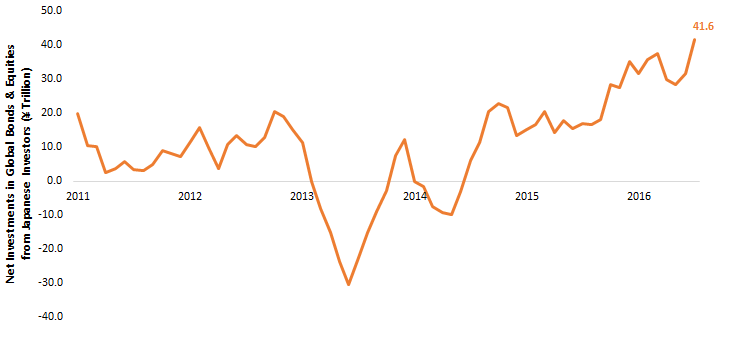
Global Money Has Fled Japan
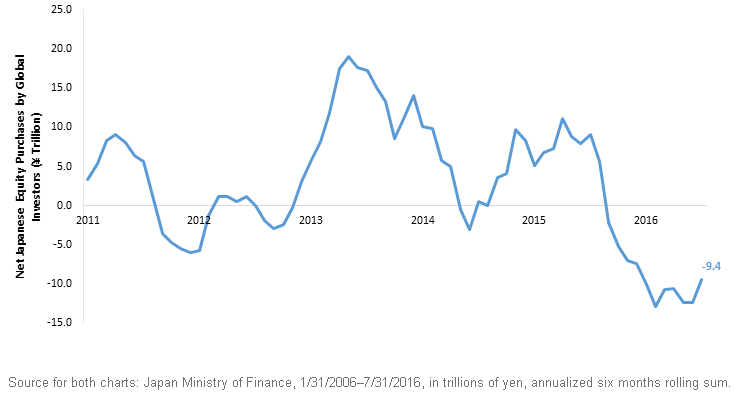
1,2,3Source: Japan Ministry of Finance.
Important Risks Related to this Article
Investments focused in Japan increase the impact of events and developments associated with the region, which can adversely affect performance.
About the contributor
