

Forget Mid Caps Only at Your Peril
Published April 25, 2016

Global Head of Research
It has been almost a decade since we launched our first dividend-focused strategies back in June of 2006. One of the stories that have stood out over this period has been the incredible performance of mid-cap stocks. Mid-Cap Stocks Have Been Strong, Both in Dividends and in Market Capitalization-Weighted Indexes
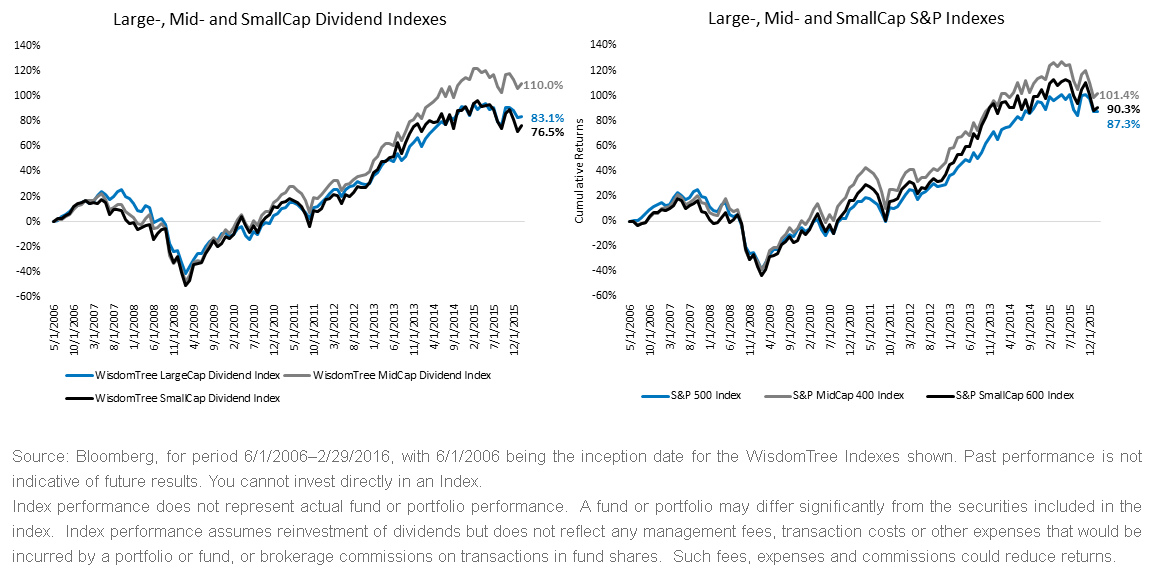
For definitions of indexes in the chart, visit our glossary. The mid-cap stocks’ outperformance poses three important questions, which I will answer below. Question 1: Why Did Mid-Cap Stocks Outperform Large Caps and Small Caps? On the Dividend Side: When comparing the WisdomTree MidCap Dividend Index to the WisdomTree LargeCap Dividend Index, there were only four sectors in the MidCap Index that underperformed their respective counterparts in the LargeCap Index—Information Technology, Energy, Telecommunication Services and Health Care. Financials contributed the most to the relative outperformance, as the big banks were the primary component of the large-cap segment, and they did not do well over this period. While the mid-cap banks were not positive either, they did manage to hold up better than their large-cap counterparts. This allowed insurance companies and real estate companies—whose industry exposure within the large-cap segment was much smaller, to really shine. When comparing the WisdomTree MidCap Dividend Index to the WisdomTree SmallCap Dividend Index, financials become the biggest detractor from relative performance, as the small-cap financials dramatically outperformed their mid-cap counterparts over this period. On the other hand, the Consumer Discretionary sector was the biggest contributor to relative outperformance—with retailing, consumer durables and consumer services contributing strongly to relative outperformance. On the Market Capitalization Side: Comparing the S&P MidCap 400 Index to the S&P 500 Index confirms that the biggest difference over the period was the mid-cap index’ avoidance of the large banks—the same as in the dividend-focused comparison. However, although the Information Technology, Energy and Telecommunication Services (along with Consumer Discretionary) sectors within the S&P MidCap 400 Index also underperformed their respective counterparts within the S&P 500 Index, just like we saw in the dividend-focused comparison, the Health Care sector did not underperform—a notable difference of the market capitalization-focused comparison. The comparison of the S&P MidCap 400 Index against the S&P SmallCap 600 Index showed a very different picture. Unlike the mid-cap and small-cap dividend indexes, financials did not have an average weight of approximately one-third of the entire index here and thus were relatively inconsequential. The Consumer Discretionary sector was the biggest relative contributor to outperformance—similar to the dividend-focused side—but Information Technology was the biggest relative detractor. Question 2: Why Did Mid-Cap Dividend Payers Outperform Mid-Cap Stocks Weighted by Market Capitalization? When comparing the WisdomTree MidCap Dividend Index to the S&P MidCap 400 Index, the first thing that stands out over this period was that only one sector in the dividend-focused Index underperformed its respective counterpart in the market capitalization-weighted index: Health Care. Within Health Care, biotechnology and pharmaceuticals were strong performers, and the fact is, they don’t tend to be early dividend payers in their life cycles, thereby not gaining inclusion in the WisdomTree MidCap Dividend Index. Consumer Discretionary was the sector responsible for the lion’s share of the relative outperformance, and what was interesting is that the average weight to this sector between the two indexes was very similar. Focusing on dividend-paying stocks contributed 11% of the 13% relative performance difference. Question 3: Can the Strong Performance of Mid-Cap Stocks Continue? While this may be the single most important question, it is also the most difficult to answer. We approach it from two distinct standpoints: 1) Valuation: One way to think about valuation is the change in the price-to-dividend ratio—in other words, the reciprocal of the dividend yield. The price level of the index per unit of dividends has decreased approximately 4.6% per year for the S&P MidCap 400 Index, even as the price level for this index increased 75% between June 1, 2006, to February 29, 2016. Also note the price-to-earnings (P/E) ratio, which went from 20.7x to 19.2x over this same period. This tells us that even though prices increased—significantly!—the fundamentals appreciated even faster. 2) Process: If we had to make one distinction between the S&P MidCap 400 Index and the WisdomTree MidCap Dividend Index, it would be the annual Index screening and rebalancing that is employed by WisdomTree and is focused on a measure of relative value—namely dividends. If a part of the dividend-paying mid-cap market appreciates quickly in price—faster than the growth of its dividends—the process of the WisdomTree MidCap Dividend Index will tilt weight away from it and toward areas where dividends have increased faster than prices. While we don’t know if mid-caps will be strongest over the next 10 years, we believe that it’s the focus on the process of mitigating valuation risk that could become more important. Unless otherwise noted, data source is Bloomberg, with period from 6/1/2006 to 2/29/2016.
About the contributor

Global Head of Research
Christopher Gannatti began at WisdomTree as a Research Analyst in December 2010, working directly with Jeremy Schwartz, CFA®, Director of Research. In January of 2014, he was promoted to Associate Director of Research where he was responsible to lead different groups of analysts and strategists within the broader Research team at WisdomTree. In February of 2018, Christopher was promoted to Head of Research, Europe, where he was based out of WisdomTree’s London office and was responsible for the full WisdomTree research effort within the European market, as well as supporting the UCITs platform globally. In November 2021, Christopher was promoted to Global Head of Research, now responsible for numerous communications on investment strategy globally, particularly in the thematic equity space. Christopher came to WisdomTree from Lord Abbett, where he worked for four and a half years as a Regional Consultant. He received his MBA in Quantitative Finance, Accounting, and Economics from NYU’s Stern School of Business in 2010, and he received his bachelor’s degree from Colgate University in Economics in 2006. Christopher is a holder of the Chartered Financial Analyst Designation.