

Fixed Income: Is It Better to Be Early or Late to the “Duration Party”?
Published November 28, 2018

Head of Investment and Fixed Income Strategy
Perhaps the most noteworthy story in the U.S. fixed income arena in 2018 was that the U.S. Treasury (UST) 10-Year yield finally experienced some rather visible upside movement. So, here we are approaching the end of another calendar year, and an overarching question is being posed: Is it better to be early or late to the “duration party”? In other words, will this rising rate trend continue for 2019?
OK, let’s take stock of just what transpired for the UST 10-Year yield thus far this year. As of this writing, the 10-Year has experienced a backup of almost 70 basis points. In the process, a high watermark of 3.24% was registered as recently as a couple of weeks ago, representing the highest level since 2011.
U.S 10-Year Treasury Yield
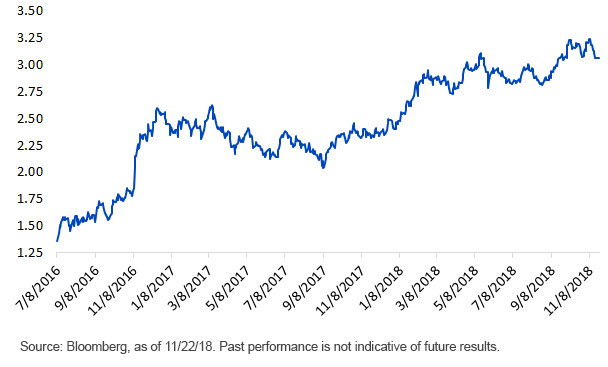
For which side of the “duration trade” should investors prepare their portfolios? Here’s a breakdown of five potential factors for a case of either a higher or lower UST 10-Year yield in 2019. Don’t forget, there could be a third option. The yield stays relatively unchanged in a range-bound pattern.
Case for a Higher UST 10-Year Yield
- Perhaps number one on the list of potential catalysts would be a spike in wage pressures and/or an upside surprise in inflation, where the annualized gain for average hourly earnings hits at least +3.5%.
- In contrast to consensus expectations for a slowdown in U.S. growth in 2019, real GDP actually matches this year’s experience at around +3%, or even exceeds it.
- Based on the two aforementioned factors, the Federal Reserve (Fed) takes on a more aggressive policy-tightening path.
- The ”relative yield advantage trade” on a global scale gets removed due to continued Fed rate hikes (we will be blogging about the cost of hedging in the not-too-distant future).
- “Risk on” becomes a predominant financial market theme as trade uncertainty is removed and the stock market rebounds.
Case for a Lower UST 10-Year Yield
- While a final push to the upside is within the realm of possibility, one could make the case that the lion’s share of retrenchment from the all-time low has already occurred (see figure above).
- U.S. economic growth not only slows in 2019, but real GDP comes in closer to only +2%.
- The recent increase in the year-over-year gain in wages flattens out in the low +3% range.
- A combination of slower U.S. and global growth pushes the Fed to not only pause its rate hikes in 2019, but also potentially puts an earlier than expected end to them altogether.
- Stocks continue to fall and trade uncertainty heats up, especially with China, creating a notable “risk-off” environment.
Conclusion
As you can see, both sides of the debate have merits. However, barring any economic growth/inflation surprises to the upside, I think a case can be made that a good portion of the back-up in the UST 10-Year yield is behind us. That doesn’t mean another round to the upside can’t happen. Indeed, a stronger-than-expected read on wages, for instance, could create such a leg higher, but a 10-year Fibonacci technical analysis points toward 3.45% as a 76.4% retrenchment level, or a level that could be a bit challenging to penetrate. Against this backdrop, and based on prior market experiences, it is usually a better idea to be late to the “duration party” because the risk-reward quotient just doesn’t seem to provide enough of an incentive to be early.
Unless otherwise stated, all data is from Bloomberg as of November 22, 2018.
Categories
About the contributor

Head of Investment and Fixed Income Strategy
Kevin serves as the Head of Investment and Fixed Income Strategy. In this role, he writes macro and fixed income-related content and works closely with the sales, research and marketing teams. In addition, Kevin conducts client-facing webinars and meetings, providing expertise on WisdomTree’s existing and future bond ETFs. Prior to joining WisdomTree, Kevin spent 30 years at Morgan Stanley, where he was Managing Director and Chief Fixed Income Strategist for Wealth Management. He was responsible for tactical and strategic recommendations and created asset allocation models for fixed income securities. He was a contributor to the Morgan Stanley Wealth Management Global Investment Committee, primary author of Morgan Stanley Wealth Management’s monthly and weekly fixed income publications, and collaborated with the firm’s Research and Consulting Group Divisions to build ETF and fund manager asset allocation models. Kevin has an MBA from Pace University’s Lubin Graduate School of Business, and a B.S. in Finance from Fairfield University.