

Fixed Income: “Enhanced” by Performance
Published September 6, 2017

Head of Investment and Fixed Income Strategy
The U.S. interest rate backdrop continues to remain challenging for investors looking for income. The rise in U.S. Treasury (UST) yields following last November’s Election Day, and a bit more recently around the Federal Reserve’s (Fed) first rate hike in 2017, allowed investors to possibly believe that rates may finally be making a more permanent move higher. Or, at the very least, that yield levels had finally bottomed and a new and elevated trading range had been established.
That was then; what about now? I’ve written a number of times about the current U.S. rate backdrop and what may be in store for the remainder of this year and into 2018. The more important question is, how do fixed income investors position their portfolios to try and enhance income without taking on too much credit and/or duration risk?
Index Returns
The traditional approach for fixed income investing has been to follow the market cap-based strategy, where the amount of debt outstanding is the focus for sector weighting. This is the approach utilized by the widely followed Bloomberg Barclays U.S. Aggregate Bond Index (Agg). The major sectors within the Agg are Treasuries, investment-grade (IG) corporates, agency securities and securitized products such as mortgage-backed securities. As the U.S. budget deficit ballooned to record levels in excess of $1 trillion during the 2009–2012 period, Treasury issuance skyrocketed to finance this gaping hole. As a result, the Agg has seen a dramatic shift in its weighting to Treasuries, going from a little over 20% to its current reading of nearly 38%. Consequently, this shift subjects fixed income investors to sacrificing income and heightened rate risk at the same time.
Is there an alternate approach that fixed income investors should consider? The Bloomberg Barclays U.S. Aggregate Enhanced Yield Index (AEY) is a rules-based smart beta approach that seeks to improve upon the counterintuitive features of the market cap-based strategy. By reweighting the sectors of the Agg, the enhanced yield strategy attempts to boost income while still maintaining a familiar risk profile. AEY employs guardrails such as a weight constraint, +/-20% by major sector, and a duration cap of +1 year. This strategy generates over-weights in IG credit and under-weights in Treasuries. It also comes in a “short-term” version for investors who wish to mitigate the potential for higher rates. The guardrails in this case are: weight constraint by major sector +/-30%, duration cap +.5 years.
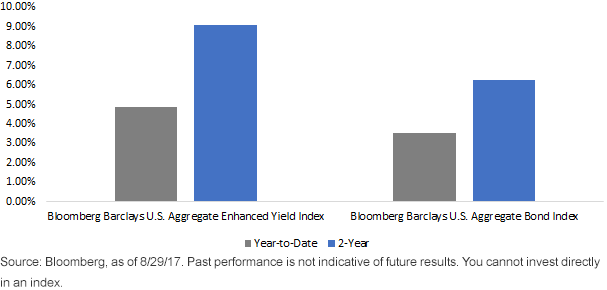
The enhanced yield strategy also has been able to outperform the market cap-based index of late, which both active and passive approaches tend to benchmark themselves against. To provide perspective, over the last two-year period, the AEY registered a total return of +9.09% compared to the benchmark of 6.27%. On a year-to-date basis, the AEY is up almost +4.9% versus roughly +3.5% for the Agg.
How to Put This into Practice
For investors who would like to consider an alternate approach, the WisdomTree Barclays Yield Enhanced U.S. Aggregate Bond Fund (AGGY), which tracks the Bloomberg Barclays U.S. Aggregate Enhanced Yield Index, offers a solution for core fixed income investing.
Unless otherwise noted, data source is Bloomberg, as of August 30,2017.
Important Risks Related to this Article
There are risks associated with investing, including possible loss of principal. Fixed income investments are subject to interest rate risk; their value will normally decline as interest rates rise. Fixed income investments are also subject to credit risk, the risk that the issuer of a bond will fail to pay interest and principal in a timely manner, or that negative perceptions of the issuer’s ability to make such payments will cause the price of that bond to decline. Investing in mortgage- and asset-backed securities involves interest rate, credit, valuation, extension and liquidity risks and the risk that payments on the underlying assets are delayed, prepaid, subordinated or defaulted on. Due to the investment strategy of the Fund, it may make higher capital gain distributions than other ETFs. Please read the Fund’s prospectus for specific details regarding the Fund’s risk profile.
About the contributor

Head of Investment and Fixed Income Strategy
Kevin serves as the Head of Investment and Fixed Income Strategy. In this role, he writes macro and fixed income-related content and works closely with the sales, research and marketing teams. In addition, Kevin conducts client-facing webinars and meetings, providing expertise on WisdomTree’s existing and future bond ETFs. Prior to joining WisdomTree, Kevin spent 30 years at Morgan Stanley, where he was Managing Director and Chief Fixed Income Strategist for Wealth Management. He was responsible for tactical and strategic recommendations and created asset allocation models for fixed income securities. He was a contributor to the Morgan Stanley Wealth Management Global Investment Committee, primary author of Morgan Stanley Wealth Management’s monthly and weekly fixed income publications, and collaborated with the firm’s Research and Consulting Group Divisions to build ETF and fund manager asset allocation models. Kevin has an MBA from Pace University’s Lubin Graduate School of Business, and a B.S. in Finance from Fairfield University.