

Examining the Current Dollar Bull Market against History.
Published January 21, 2017

U.S. Head of Research
In our view, the single most important factor for navigating markets in 2017 will be the value of the U.S. dollar. Monetary policy, corporate earnings, trade policy, capital budgeting decisions and macro stability will all be heavily influenced by the direction of the dollar in global markets. Despite recent grumblings by the incoming administration about dollar strength (specifically against the Chinese yuan), the overwhelming consensus view among strategists is for another year of broad-based appreciation. While we also subscribe to this view, we believe it is important to provide context about current levels relative to history in order to understand where we may be in the cycle. Below, we compare the current1 U.S. dollar2 rally against the two previous periods of broad-based dollar appreciation from the 1980s3 and ’90s4.
Are We There Yet?
In the chart below, we show that the dollar has appreciated by approximately 28% over the last 66 months in real terms.5 Relative to the 1980s, the pace and magnitude of the current appreciation in the dollar is more subdued. However, temporally, it has already outlasted that cycle by nine months. Compared to the period of the mid-1990s, we’re approximately on track. While the pace of appreciation accelerated in mid-2014, when the European Central Bank (ECB) cut rates into negative territory and the Bank of Japan (BOJ) expanded its qualitative and quantitative easing program, we remain somewhat comforted by the fact that very few strategists currently see the dollar as grossly overvalued. In our experience, markets are prone to overshoot to the upside and the downside. As a result, we believe that the dollar cycle could continue for at least another 12–18 months, likely appreciating by approximately 5% in 2017.6
Federal Reserve Real Trade Weighted U.S. Dollar Index: Broad
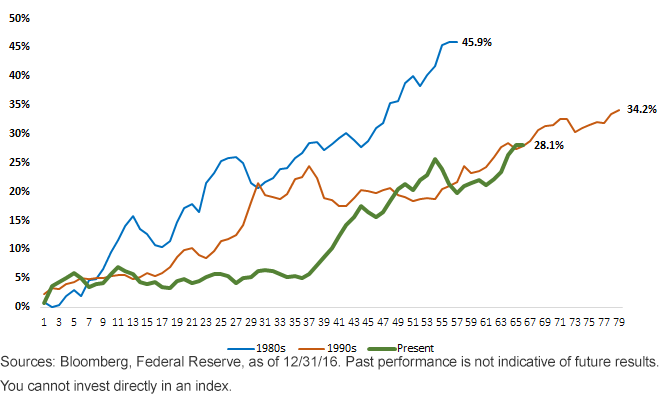
While many investors are currently thinking of how the dollar rally may end, I believe it’s also important to think about how it started. Notably, that the current rally began from the most undervalued point in the dollar’s history.7 While current appreciation trends appear similar, the dollar must potentially move even higher before reaching equilibrium. Additionally, many investors remain skeptical of dollar upside, because the longer this cycle extends, the greater the likelihood the U.S. tips into recession. While we could debate the prospects of recession being delayed due to the results of the U.S. election, the dollar strengthened through two recessions during the 1980s as well as after the 2001 terrorist attacks and ensuing recession in the second cycle. In sum, recessions don’t end dollar bull markets.
Conclusion
In our view, the dollar is likely to appreciate due to Federal Reserve tightening, higher real interest rates in the U.S. attracting assets from abroad, and the TINA principle: Brexit and politics weaken the standing of the euro and the pound for international reserves, while Japan is actively promoting a weaker yen to boost growth and inflation. No other currency can rival the liquidity of the dollar. Ultimately, a strong dollar strengthens the Trump administration’s hand in international trade negotiations, particularly with many emerging market countries. While we remain skeptical of a second Plaza Accord to quickly close global imbalances, a strong dollar remains in America’s interest for 2017.
1Beginning 7/31/11 through 12/31/16.
2As proxied by the Federal Reserve Real Trade Weighted U.S. Dollar Index: Broad.
37/31/80–3/31/85 (57 months).
47/31/1995–2/28/2002 (79 months).
57/31/11–12/31/16.
6Source: WisdomTree.
7Source: Federal Reserve.
Categories
About the contributor

U.S. Head of Research
Bradley Krom joined WisdomTree as a member of the research team in December 2010. He is involved in creating and communicating WisdomTree’s thoughts on global markets, as well as analyzing existing and new fund strategies. Prior to joining WisdomTree, Bradley served as a senior trader on a proprietary trading desk at TransMarket Group. Bradley is a graduate of the Wharton School, University of Pennsylvania.