

European Small Caps from a Capital Markets Perspective
Published January 27, 2014

Capital Markets
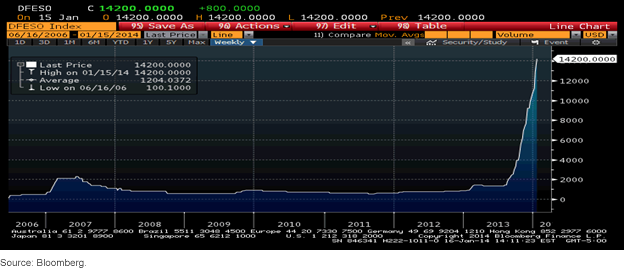
Sitting at the capital markets desk at WisdomTree gives our team a unique perspective on the exchange-traded funds (ETF) industry. Oftentimes we are able to spot emerging trends among particular products and segments of the market due to our interactions with all the market participants in the ETF industry: our clients (end users of our ETFs), the market-making/trading community (liquidity providers) and our portfolio managers. Interacting with these three key groups enables us to understand their perspective while still watching and observing the markets. Over time, we see themes that begin to develop, and as we have seen in the ETF market in the past, once a strong theme takes hold, assets and volumes can increase very quickly. European small caps are a perfect example of one such theme. ETFs can exist in hibernation for years without being noticed by investors. This is usually due to timing and market sentiment. Once the perfect market environment strikes, a fund can go from being barely noticed by investors (i.e., having low volumes and/or low assets) to growing at an incredible pace. A great example is the WisdomTree Europe SmallCap Dividend Fund (DFE). DFE launched in June 2006 with our first suite of WisdomTree ETFs. For seven years, DFE was hardly noticed by investors—but in the middle of 2013, that changed. Here are some interesting statistics1 on DFE: Period: 06/30/06 – 06/30/13 Average Assets under Management (AUM): Approximately $42,000,000 Average Daily Volume: 12,000 shares per day AUM as of June 30, 2013: $57,668,528 Over the course of a few weeks in the summer of 2013, the trading community began to notice more and more buyer interest in DFE. Volumes slowly began to tick up. Small trades were crossing our screens, then bigger trades. Trading volume in DFE was picking up, and an investment trend for European small caps was emerging. The European recovery seemed to be gaining momentum. The market environment was changing, and DFE had the right exposure for investors to take advantage of this emerging trend. DFE’s AUM as of January 21, 2014, is at $892,000,000. Below are two charts that show the increase in shares outstanding in DFE. It is important to note that the market capitalization of an ETF is calculated by taking the market price of the ETF and multiplying it by shares outstanding. Shares Outstanding in DFE between June 16, 2006, and January 21, 2014
Shares Outstanding in DFE between July 1, 2013, and January 21, 2014
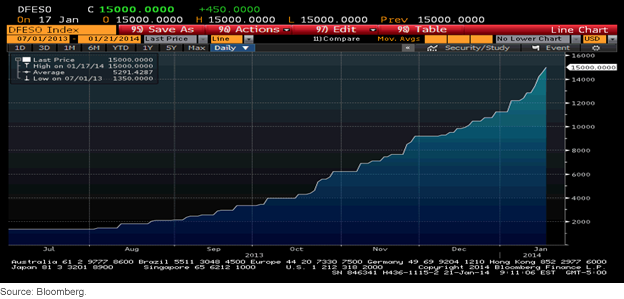
Between July 1, 2013 and January 21, 2014, DFE took in over half a billion dollars in net new inflows. It is important to note that AUM in an ETF can rise and fall based on two factors: inflows/outflows for the fund, and market movement in the underlying securities. How did this happen? In our opinion, the best way to participate in the European recovery is through the small-capitalization segment of the equity market. Here is a recent blog post written by our Director of Research that outlines the European recovery. In addition, DFE remains the only broad European small-cap ETF in the U.S. market today2, and we believe that weighting small caps by fundamental factors is one of the best ways to achieve small-cap exposure. The ETF industry is full of examples like this one, and DFE is another example of how an innovative and passive strategy can provide the right access for investors. 1Source: Bloomberg. 2Source: ETF Database
Important Risks Related to this Article
There are risks associated with investing, including possible loss of principal. Foreign investing involves special risks, such as risk of loss from currency fluctuation or political or economic uncertainty. Funds focusing their investments on certain sectors and/or smaller companies increase their vulnerability to any single economic or regulatory development. This may result in greater share price volatility. Please read the Fund’s prospectus for specific details regarding the Fund’s risk profile. Investments focused in Europe are increasing the impact of events and developments associated with the region, which can adversely affect performance. Past performance is not indicative of future results.
About the contributor
