

Europe: From Great Challenges Come Great Investment Opportunities
Published February 8, 2019

Global Head of Research
Lately it has seemed easy to find reasons to avoid investing in European assets:
- There have been many important dates in the Brexit process. The dates seem to come and go, and no one has any clarity on exactly what will happen.
- Last year, a populist government was formed in Italy—a country that has issued so much debt that actually paying it back seems dubious.
- Various political events—whether elections in Germany or riots in France—have showcased an undercurrent of tension and potential for future instability.
While this list isn’t exhaustive, it hints at factors that affect investors when they initially think about Europe.
Context Point One: Performance
Before my hands hit the keyboard, I know U.S. equities have outperformed European and most global equities for a significant period of time.
However, within European equities, we have seen a divergence between European exporters and the broader market. If investors succumb to thinking about these and other risks, it may lead to less demand for the euro against other currencies, encouraging depreciation. That could encourage further outperformance of these exporters.
For example:
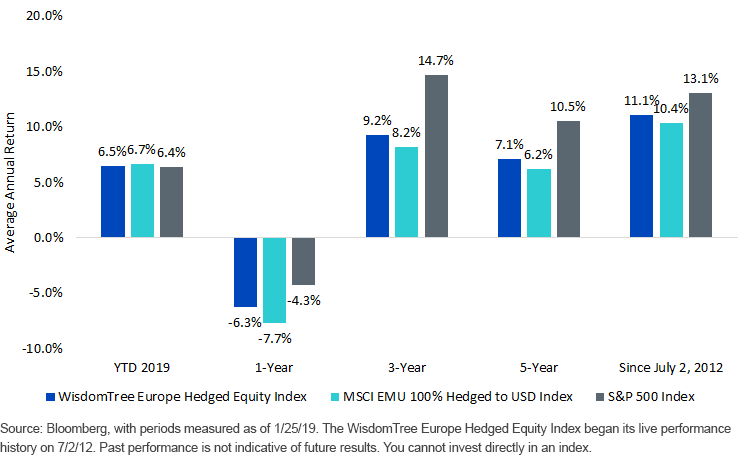
- European equities have started 2019 with outperformance over U.S. equities.
- 2018 was a rough period for risky assets globally, but European exporters outperformed the broad market by more than 1.0%.
- Since the launch of our Europe Hedged Equity strategy in July 2012, we’d bet that many investors wouldn’t realize how close the performance of European exporters was to U.S. equities.
Figure 1: European Exporters Have Outperformed over the Longer Term
Context Point Two: Valuation
Looking at performance alone (and forgetting about things like the U.S. government shutdown), it’s easy to make the case to invest in U.S. equities and harder to make a case to invest in European equities. Of course, this would tend to mean that European equities would be trading at far less expensive valuations than U.S. equities.
Bottom line: The most critical question to consider is whether the discounted valuation of European equities eases concerns over the aforementioned risks.
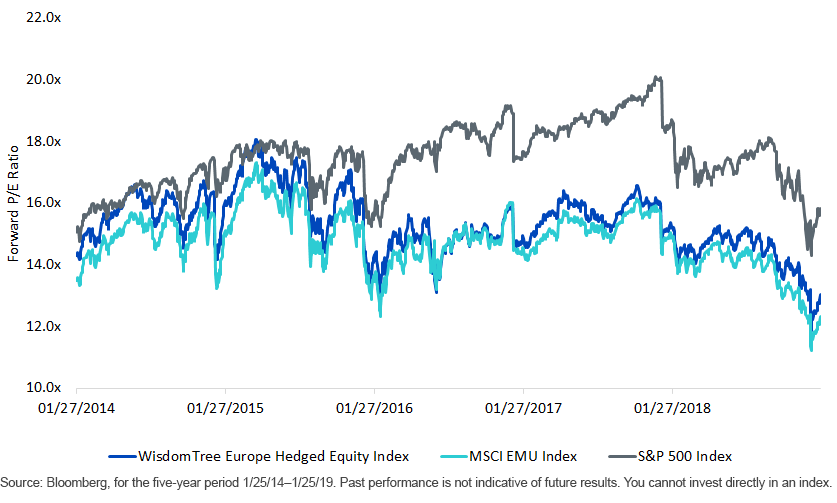
- After the last quarter of 2018, forward P/E ratios of the S&P 500 Index, the WisdomTree Europe Hedged Equity Index and the MSCI EMU Index have all come down. After a bit of recovery in January 2019, we see a range from 12.3x to 15.0x.
- The difference between the forward P/E ratios of the MSCI EMU Index (12.3x) and the WisdomTree Europe Hedged Equity Index (13.0x) comes down to the export tilt, which leads to an under-weight in the Financials and Energy sectors. The Financials sector within Europe is actually a single-digit forward P/E ratio sector as of this writing.
Figure 2: Valuation Gap for European Equities Has Widened Relative to U.S. Equities
Context Point Three: Exporters vs. Domestically Focused Firms
Memories are short. People may not remember the details of what happened in 2017. We can settle for reminding investors that economic data in Europe was strong—and growing—and the euro appreciated by 14% against the U.S. dollar.
The irony: At a time when everyone was demanding European investments and demanding euros, it would actually have been more challenging than at present to make a case for the outperformance of European exporters that are high-quality, global businesses domiciled in Europe.
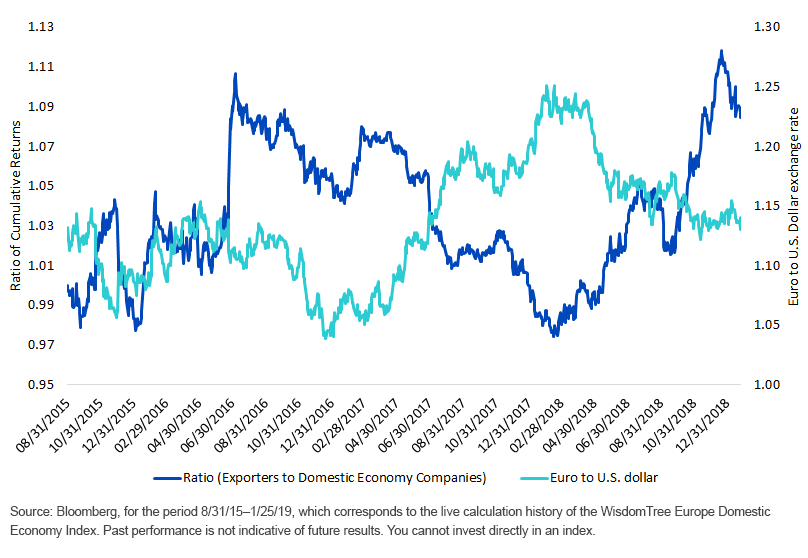
- 2018 was a transition in the euro-to-U.S. dollar exchange rate from the 1.23 to 1.25 range to the 1.13 to 1.15 range, where we remain today.
- We can see from figure 3 that the export-oriented approach delivers outperformance over the domestic company-focused approach to European equities when the euro is trending toward weakness rather than strength. In 2017, a year of euro strength, exporters were up 27.5% and the domestic companies were up 34.8%. In 2018, a year of euro weakness (and, admittedly, risk-off sentiment), exporters were down 16%, whereas the domestically oriented companies were down 24.2%.1
Figure 3: A Weaker Euro Has Catalyzed Exporter Outperformance
Conclusion: From Great Challenge Comes Great Opportunity
It’s easy to find flaws when making the case for European equities over U.S. equities today. There is political risk in the U.S. and in Europe, but economic and earnings growth in the U.S. tends to be enough (at least at present) to paper over some of the risk. In Europe, there is currently nothing that can do that. At the same time, these risks create valuation opportunities. If investors have time horizons extending three, five or seven years into the future, it could make sense to be thinking of Europe from a global allocation perspective.
1Returns represent the WisdomTree Europe Hedged Equity Index and the WisdomTree Europe Domestic Economy Index, measured in US dollars, due to a lack of the WisdomTree Europe Domestic Economy Index calculated in hedged terms.
About the contributor

Global Head of Research
Christopher Gannatti began at WisdomTree as a Research Analyst in December 2010, working directly with Jeremy Schwartz, CFA®, Director of Research. In January of 2014, he was promoted to Associate Director of Research where he was responsible to lead different groups of analysts and strategists within the broader Research team at WisdomTree. In February of 2018, Christopher was promoted to Head of Research, Europe, where he was based out of WisdomTree’s London office and was responsible for the full WisdomTree research effort within the European market, as well as supporting the UCITs platform globally. In November 2021, Christopher was promoted to Global Head of Research, now responsible for numerous communications on investment strategy globally, particularly in the thematic equity space. Christopher came to WisdomTree from Lord Abbett, where he worked for four and a half years as a Regional Consultant. He received his MBA in Quantitative Finance, Accounting, and Economics from NYU’s Stern School of Business in 2010, and he received his bachelor’s degree from Colgate University in Economics in 2006. Christopher is a holder of the Chartered Financial Analyst Designation.