

Emerging Markets Rebound in 2016: More than Just Commodities
Published September 30, 2016

Director, Model Portfolios
After several years of middling to poor performance, emerging markets (EM) have surged in 2016. Broadly looking across global equity asset classes—United States, developed international, emerging markets—thus far investors would see returns of 6.7%, 0.4% and 14.3%, respectively.1 Following a long hiatus, the enticing growth potential offered in emerging markets has started to deliver. A Slow Fed Has Been Great for EM Thus Far Why has EM done well this year? A significant catalyst has been the U.S. Federal Reserve (Fed). At the start of 2016, many expected there could be four incremental hikes to the Federal Funds Rate. To date, there have been zero. As a result: • Emerging Market Currencies Are Rallying: The key example has been the Brazilian real, up approximately 22% YTD.2 Commodity currencies in general within EM— the Russian ruble, Chilean peso, South African rand, etc.—have done well this year. • Commodity Prices Stabilizing: As we ended 2015, it was uncertain just how low the price per barrel of oil could go. Now we have seen stability around $45 to $50. Many emerging markets export commodities, oil in particular, so stability here was quite important. • Energy & Materials Led EM Equities: In the MSCI Emerging Markets Index, those were the two top-performing sectors. Unsurprisingly, those two sectors are the most closely linked to commodity prices and will tend to perform better in an environment in which commodity prices are not in free fall and U.S. dollar strength is not a headwind. One surefire way to improve sentiment in emerging markets is for developed market central banks to provide liquidity. Even if the U.S. raises the Fed Funds Rate by 0.25%, it appears that the European Central Bank (ECB) and the Bank of Japan (BOJ) could be providing substantial liquidity for the foreseeable future. Outperformance without Exposure to Energy and Materials The WisdomTree Emerging Markets Consumer Growth Index, by design, excludes Energy and Materials, the two best-performing sectors in the MSCI Emerging Markets Index this year. Yet, through September 22, 2016, what we’ve seen is that this strategy has managed to outperform the benchmark by 3.84%.3 How WisdomTree EM Consumer Growth Strategy Outperformed without Energy & Materials MSCI EM Sectors - YTD Through 9/15/16
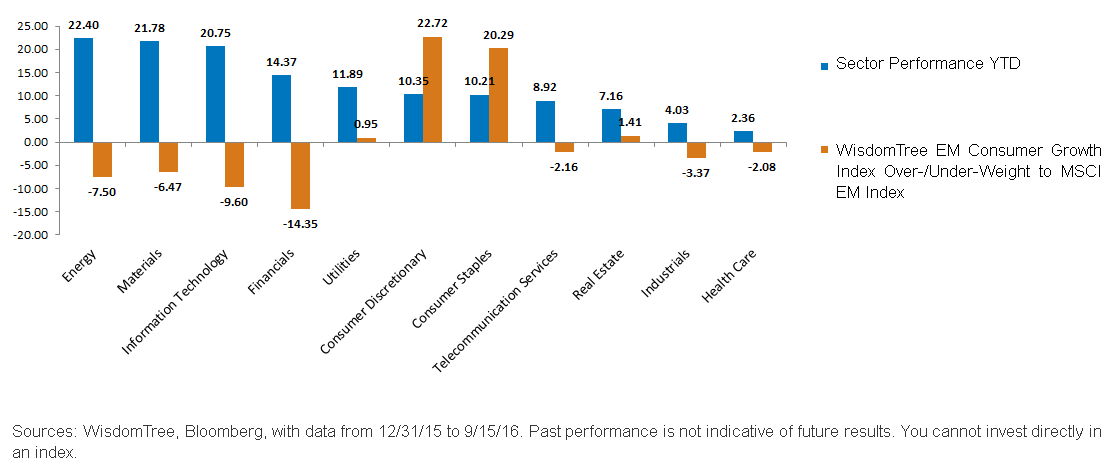
• Under-Weight the Four Top-Performing Sectors: The four top-performing sectors in emerging markets were, in order, Energy, Materials, Information Technology and Financials. Interestingly, these were the sectors that represented the four largest under-weights for the WT Emerging Markets Consumer Growth strategy compared to the MSCI Emerging Markets Index. • Overcoming a Headwind, Thanks to Selection: That the WT Emerging Markets Consumer Growth strategy was able to outperform the MSCI Index despite significant under-weights in the top-performing sectors seems counterintuitive. The bottom line: The individual stocks in the strategy, and the way in which they are weighted, were the driving force behind its outperformance. More specifically, it was also the country and currency exposure in the strategy, particularly within the strategy’s Brazilian holdings. Digging Further into the Advantages of WT Emerging Markets Consumer Growth But over the longer term, there are three primary factors that lead us to believe the advantages could have potential to continue: 1. Close Ties to EM GDP Growth: The plodding pace of global growth has been widely lamented for several years now. Emerging markets are growing at more than twice the rate of developed markets in 2016, and EM gross domestic product (GDP) growth is expected to accelerate into next year. Each constituent in the WT Emerging Markets Consumer Growth strategy must derive at least 60% of its revenue from emerging markets. This domestic focus should help the strategy benefit from a pickup in economic activity while keeping it relatively insulated against a slowdown in developed market growth. 2. Conscious of Valuations: Few investors would argue against the growth of the emerging markets consumer—but consensus often breeds expensiveness, which may help explain why the two consumer sectors in EM often trade at a substantial premium to the market. WisdomTree’s approach also includes sectors that stand to indirectly benefit from the rise of the EM consumer (such as mobile phone providers and health care companies) and that typically trade at less lofty valuations. Further, the strategy’s methodology rewards stocks with less expensive valuations and weights those stocks by their earnings, helping remove the risk of more expensive companies. 3. Size Does Not Imply Quality: Within WisdomTree’s Emerging Markets Consumer Growth Index, companies must prove themselves on both a return on equity (ROE) and a return on assets (ROA) basis over the past three years. This has the impact of screening out many of the larger, less efficient state-owned enterprises, which may not have maximizing shareholder returns as their core mission. Has the Tide Finally Shifted? We believe that the characteristics and design of this strategy position it as a very compelling long-term play on emerging markets economic growth. However, it was born during the 2013 “taper tantrum,” which launched one of the worst environments for emerging markets in recent history. 2016 has been the first time that this Index has been live AND emerging market equities have been in favor. We’re very happy with these initial results but are much more excited about the Index’s future prospects. 1United States: S&P 500 Index. International Developed: MSCI EAFE Index. Emerging Markets: MSCI Emerging Markets Index. Sources: WisdomTree, Bloomberg, 12/31/15–9/15/16. 2Source: Bloomberg. 3Sources: WisdomTree, Bloomberg.
Important Risks Related to this Article
Investments in emerging, offshore or frontier markets are generally less liquid and less efficient than investments in developed markets and are subject to additional risks, such as risks of adverse governmental regulation and intervention or political developments.
About the contributor

Director, Model Portfolios
Joe Tenaglia joined WisdomTree as Asset Allocation Strategist in 2016. He is responsible for building and managing WisdomTree’s CIO-managed and custom model portfolios. In this role he focuses on asset allocation, security selection, and portfolio construction for the firm’s open architecture models, with objectives ranging from strategic to tactical. Joe sits on WisdomTree’s Model Portfolio Investment Committee, which oversees the firm’s ETF models and helps shape and communicate WisdomTree’s thoughts on the markets. Prior to joining WisdomTree, he held roles at Emerging Global Advisors (acquired by Columbia Threadneedle) and BNY Mellon. Joe received his B.S. in Finance and Marketing from Boston College. He is a holder of both the Chartered Financial Analyst designation and Chartered Market Technician designation.