

Emerging Markets Procrastinators
Published April 15, 2019

Head of Equity Strategy
There is a chance that, come this autumn, many fund managers will have zero exposure to the eighth-largest country in the MSCI Emerging Markets Index. It’s one thing to avoid a country because of a bearish thesis; it’s quite another to be caught flat-footed when a “frontier” market gets upgraded to “emerging.”
While our industry has been focused on the inclusion of mainland-listed Chinese A-shares in the MSCI EM Index, there are two frontier markets that MSCI is graduating to emerging market status this year that have been scarcely mentioned.
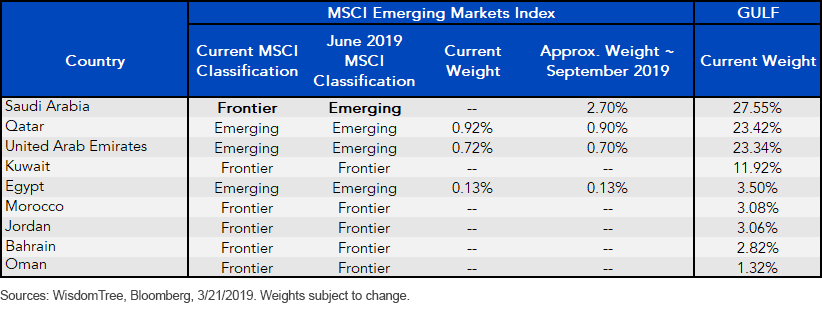
Consider this nugget from the Financial Times in March: a country that I’ll keep under my hat for a few paragraphs will this year be included and comprise about 2.7% of the MSCI EM.1 For comparison, others with similar weights are Mexico (2.7%), Thailand (2.3%), Indonesia (2.2%) and Malaysia (2.2%).
Now digest this, and I mean really digest this bit from the same article:
Emerging market funds have an average exposure of just 0.08 per cent to the country's stocks, according to analysis of 180 funds with $350bn of assets by Copley Fund Research, and more than 90 per cent have no exposure at all.
Hold the phone. MSCI announced this last summer, not yesterday. FTSE Russell and Standard & Poor’s are following suit. Everyone knows the index providers are the big gorillas. What, pray tell, have those 180 managers been doing all day?
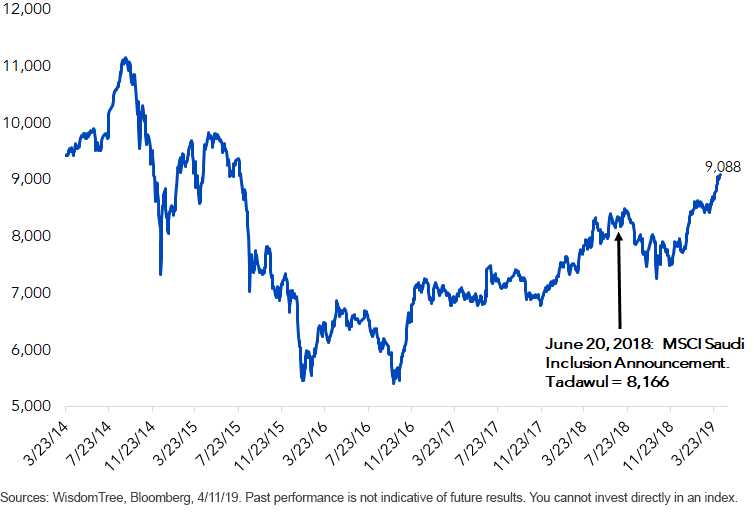
The mystery country is Saudi Arabia (the other graduate is Argentina). Only now is the Tadawul All Share Index of Saudi stocks breaking out. June’s MSCI index inclusion won’t be wished away.
Figure 1: Tadawul All Share Index
Here’s a way in which WisdomTree is unique: we have a pure play ETF for the Middle East. GULF, the WisdomTree Middle East Dividend Fund, has been around for over a decade. It has been our top performer over the last year, and readers of last spring’s GULF: The Global Power Chess Game’s Critical Piece, know my positive structural thesis for the region. Saudi Arabia is currently GULF’s largest component nation, at approximately 28%. June inclusion, complete by September. The procrastinators need to get busy if they want to avoid awkward diligence meetings.
NAVMarket PriceTopBottomDLYMTDQTDYTD3M1Y3Y5Y10YAll Asset ClassAll Sub Asset ClassAs of 4/17/2026
Ticker
Fund
Category
Inception Date
Cumulative
Returns
*The standardized performance of each Fund, can be found by clicking on the Fund’s ticker symbol.Performance is historical and does not guarantee future results. Current performance may be lower or higher than quoted. Investment returns and principal value of an investment will fluctuate so that an investor's shares, when redeemed, may be worth more or less than their original cost. Returns less than one year are not annualized. Performance data for the most recent month-end is available on the respective fund pages.
Figure 2: Weights Comparison
1Steve Johnson and Simeon Kerr, “Landmark for Saudi Stocks as Index Providers Become Kingmakers,” Financial Times, 3/21/19, https://www.ft.com/content/69f5a8ec-4a3a-11e9-bbc9-6917dce3dc62.
Important Risks Related to this Article
There are risks associated with investing, including possible loss of principal. Foreign investing involves special risks, such as risk of loss from currency fluctuation or political or economic uncertainty. This Fund focuses its investments in the Middle East, thereby increasing the impact of events and developments associated with the region which can adversely affect performance. Investments in emerging, offshore or frontier markets such as the Middle East are generally less liquid and less efficient than investments in developed markets and are subject to additional risks, such as risks of adverse governmental regulation and intervention or political developments. As this Fund has a high concentration in some sectors, the Fund can be adversely affected by changes in those sectors. Due to the investment strategy of this Fund it may make higher capital gain distributions than other ETFs. Please read the Fund’s prospectus for specific details regarding the Fund’s risk profile.
Categories
About the contributor

Head of Equity Strategy
Jeff Weniger, CFA, has been with WisdomTree since 2017 and serves as the Head of Equities. He shapes the firm’s market outlook through a combination of macroeconomic and fundamental analysis. With more than two decades in investment strategy, Jeff is known for his work on market cycles and valuations. Before joining WisdomTree, Jeff was with BMO Private Bank and BMO Global Asset Management for 11 years. At BMO, he sat on the firm’s Asset Allocation Committee and co-managed ETF model portfolios across the U.S. and Canada. In 2013, at age 32, he became the youngest member of BMO’s Global Investment Forum. When he left BMO to come to WisdomTree, his final role was Director, Senior Strategist in the Office of the CIO in 2017.
Jeff is a frequent television guest on networks such as CNBC, Bloomberg, and Schwab, with regular print appearances in The Wall Street Journal, Barron’s and Reuters. He also appears weekly on the Behind the Markets podcast and is a regular on SiriusXM’s The Business Briefing. On X, Jeff has developed one of the larger followings in financial media. He earned a B.S. in Finance from the University of Florida and an MBA from the University of Notre Dame. He has held the CFA charter since 2006.