

Emerging Markets Fixed Income & the U.S. Dollar
Published August 3, 2015

U.S. Head of Research
While we remain firm believers in the long-term potential of emerging markets (EM), the past several years have been difficult due to increasing volatility and secular headwinds from a strong U.S. dollar. In a previous post, we sought to introduce a more cost-effective hedge for emerging market investing. In our view, a bullish dollar position against a broad-based basket of developed and emerging market currencies provides a powerful option for managing currency risk in a portfolio of emerging market assets. In the discussion below, we put this concept in practice by combining a bullish dollar strategy1 with an emerging market local debt strategy.2 In our view, emerging markets provide some of the most compelling valuations around the world. Employing a bullish dollar strategy as a hedge for EM currency risk could be a cost-effective way to reduce volatility, particularly in advance of a shift in Federal Reserve (Fed) policy. The "Dirty" Hedge in Practice In 2014, of the 55 major currencies that WisdomTree tracks, none appreciated against the U.S. dollar.3 In our view, during periods of broad-based dollar strength, dirty hedges can be a particularly valuable tool. As we show in the chart below, a 50/50 allocation of a bullish dollar strategy and EM local debt has significantly improved the risk/return profile of emerging market fixed income investing. A Blended Approach to Currency Risk 50% EM Local Debt/ 50% Long-Dollar. (3/31/11-6/30/15)
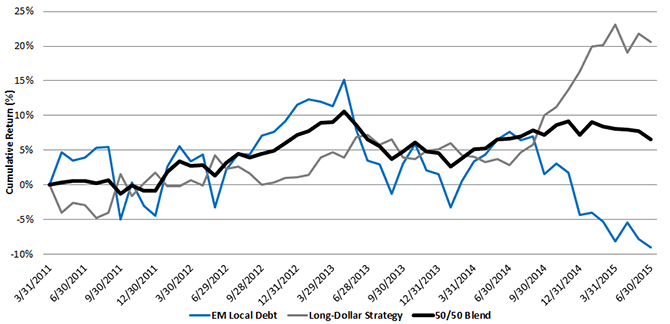
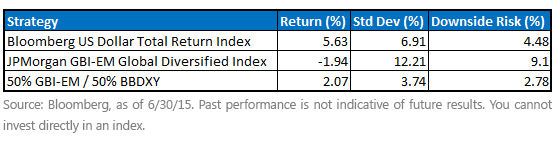
In this blended approach to emerging markets, investors are able to maintain exposure to the emerging market assets while dampening the overall drawdowns and volatility of their investment. As we have seen so far in 2015, emerging markets can experience volatility on the upside as well as the downside.4 By combining legacy EM fixed income positions with a bullish dollar strategy, investors may be able to limit the impact of changes in global monetary policy. While a hedged approach appears prudent, perhaps the most intriguing element of this approach is the total volatility of the blend. Due to the significantly negative correlation (-0.81) of the two assets, investors are able to reduce total volatility of their portfolio by equally weighting these strategies.5 In a similar approach to currency-hedged equities, starting with a 50/50 baseline for currency risk in a portfolio may reduce regret in the current market environment. While we believe that the U.S. dollar will continue to rise, markets inevitably consolidate. During these periods, emerging market assets could perform well. Ultimately, returns for developed and emerging market investments will continue to be impacted by the value of the U.S. dollar. By deploying a bullish dollar strategy as a “dirty” hedge for emerging market bond positions, investors can maintain legacy positions while reducing portfolio volatility and drawdowns. While the timing of a shift in Fed policy remains unknown, a bullish dollar strategy could help emerging market investors reduce risk and preserve returns. 1As represented by the G-20 Liquidity Weighted Currency Composite. 2As represented by the J.P. Morgan GBI-EM Global Diversified Index. 3Source: Bloomberg, as of 12/31/14. 4Source: Bloomberg, as of 6/30/15. 5Source: Bloomberg, as of 6/30/15.
Important Risks Related to this Article
Fixed income investments are subject to interest rate risk; their value will normally decline as interest rates rise. In addition, when interest rates fall, income may decline. Fixed income investments are also subject to credit risk, the risk that the issuer of a bond will fail to pay interest and principal in a timely manner or that negative perceptions of the issuer’s ability to make such payments will cause the price of that bond to decline. Investments in emerging, offshore or frontier markets are generally less liquid and less efficient than investments in developed markets and are subject to additional risks, such as risks of adverse governmental regulation and intervention or political developments.
About the contributor

U.S. Head of Research
Bradley Krom joined WisdomTree as a member of the research team in December 2010. He is involved in creating and communicating WisdomTree’s thoughts on global markets, as well as analyzing existing and new fund strategies. Prior to joining WisdomTree, Bradley served as a senior trader on a proprietary trading desk at TransMarket Group. Bradley is a graduate of the Wharton School, University of Pennsylvania.