

Emerging Markets: Avoiding Demographic Time Bombs
Published May 17, 2017

Head of Equity Strategy
“If all the Chinese in the world were to march four abreast past a given point, they would never finish passing, though they marched forever and ever.” —Ripley’s Believe It or Not, 1910
The International Monetary Fund (IMF) says China’s population will top 1.4 billion sometime in 2019, about four times that of the U.S. But for investment opportunities, what matters is not population levels, but population growth.
In sharp contrast to the graying U.S., many emerging market nations have youthful demographics, but that’s not always the case. For example, Russia’s population has dropped by 5 million since peaking at 148.4 million in 1993. You’ll find a similar trend across the former Eastern bloc. For perspective, the U.S. population grew by 63 million during that time frame.1
Demographic malaise typically happens when there is something structurally deficient inside a political or economic system that causes early deaths, a lack of births and emigration. It happens when young people find little opportunity at “home” and opt to try their luck in foreign cities. It happens when there is some sclerosis, likely stemming from a kleptocratic state, that crushes the confidence that young people need to enthusiastically bring babies into the world.
And it happens when investment prospects are crushed.
Population Growth: An Asset Allocation Metric
Using IMF data for China, South Korea, Taiwan, India, Brazil, South Africa, Russia, Mexico, Indonesia, Malaysia, Thailand and Poland, we assessed a country rotation strategy using a basket of nations that currently make up 89% of the MSCI Emerging Markets Index (MSCI EM).2
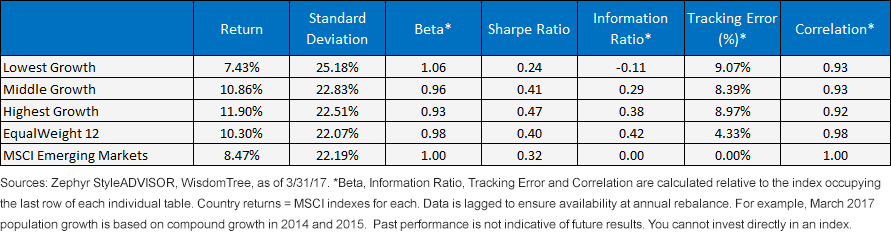
Figure 1 breaks out performance for three equally weighted investment baskets comprising stocks in countries that were ranked #1–4, #5–8 and #9–12 in the 12-nation study, hereafter referred to as the Lowest, Middle and Highest population growth groups.
Figure 1: Population Growth Rotation Study, 2/28/01 –3/31/17
For definitions of terms in the chart, visit our glossary.
In the 15 years that had full calendar year returns, Lowest Growth only outperformed the equally weighted MSCI EM in five of them, while both the Middle and Highest Growth strategies outperformed in nine calendar years. As with the performance data, it appears that the most important consideration is to avoid the demographic time bombs—the Lowest Growth group.
How do the 12 nations rank now, in spring 2017, and is there an exchange-traded fund (ETF) approach in the halls of WisdomTree Research for grabbing this population factor loading? Here are the standings:
Lowest Growth: Poland, Russia, Taiwan, Thailand
Middle Growth: South Korea, China, Brazil, Mexico
Highest Growth: Indonesia, India, Malaysia, South Africa
How can we obtain broad EM exposure while cutting down the Lowest Growth groups?
Action Plan: WisdomTree Emerging Markets Consumer Growth Fund (EMCG)
MSCI EM, a market cap-weighted index, has 19.5% of its exposure in the four Lowest Growth nations. Yet in contrast, we can help reduce that problem by using the WisdomTree Emerging Markets Consumer Growth Fund, which closed the first quarter with just 11.7% of its holdings in Poland, Russia, Taiwan and Thailand. Furthermore, while MSCI EM is stuck below 70% in the eight Middle and Highest Growth countries, EMCG clocks in at roughly 83% in those countries (see figure 2).
Figure 2
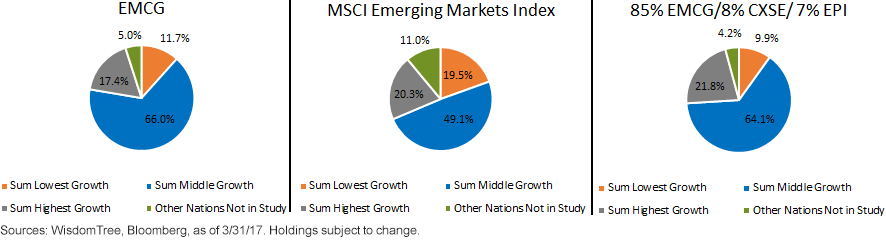
For investors who want to further reduce the Lowest Growth group, figure 2 shows a third possibility: combining EMCG with the WisdomTree India Earnings Fund (EPI) and the WisdomTree China ex-State-Owned Enterprises Fund (CXSE). The new portfolio has less than a tenth of its exposure in the population “dead zone” while still managing to hold China and India in weights that fall between those of MSCI and FTSE EM indexes.
We stopped there, but you get the point. You can go with the multiple ETF mix or keep it simple and stick with EMCG. Either way, “population-proofing” may be something to think about.
1Source: IMF, as of March 2017.
2Using two-year annualized population growth, as of the previous year. All MSCI Emerging Markets Index data sourced from Bloomberg as of 3/31/17.
Important Risks Related to this Article
There are risks associated with investing, including possible loss of principal. Foreign investing involves special risks, such as risk of loss from currency fluctuation or political or economic uncertainty. Funds focusing on a single country, region, sector and/or smaller companies generally experience greater price volatility. Investments in emerging, offshore or frontier markets are generally less liquid and less efficient than investments in developed markets and are subject to additional risks, such as risks of adverse governmental regulation, intervention and political developments. Due to the investment strategy of these Funds they may make higher capital gain distributions than other ETFs.
As these Funds can have a high concentration in some issuers, the Funds can be adversely impacted by changes affecting those issuers. Please read each Fund’s prospectus for specific details regarding each Fund’s risk profile.
Categories
About the contributor

Head of Equity Strategy
Jeff Weniger, CFA, has been with WisdomTree since 2017 and serves as the Head of Equities. He shapes the firm’s market outlook through a combination of macroeconomic and fundamental analysis. With more than two decades in investment strategy, Jeff is known for his work on market cycles and valuations. Before joining WisdomTree, Jeff was with BMO Private Bank and BMO Global Asset Management for 11 years. At BMO, he sat on the firm’s Asset Allocation Committee and co-managed ETF model portfolios across the U.S. and Canada. In 2013, at age 32, he became the youngest member of BMO’s Global Investment Forum. When he left BMO to come to WisdomTree, his final role was Director, Senior Strategist in the Office of the CIO in 2017.
Jeff is a frequent television guest on networks such as CNBC, Bloomberg, and Schwab, with regular print appearances in The Wall Street Journal, Barron’s and Reuters. He also appears weekly on the Behind the Markets podcast and is a regular on SiriusXM’s The Business Briefing. On X, Jeff has developed one of the larger followings in financial media. He earned a B.S. in Finance from the University of Florida and an MBA from the University of Notre Dame. He has held the CFA charter since 2006.