

EM Local Debt: An Updated Framework for Understanding Total Returns
Published August 19, 2016

U.S. Head of Research
Generally speaking, since mid-2011, investing in emerging markets (EM) has generally been a source of frustration and negative performance. While some markets have been able to hold serve, the period was generally marred by a painful combination of U.S. dollar strength, a downshift in global growth and a persistent (and at times rapid) decline in commodity prices. However, performance since February 2016 has shown a marked turnaround in the asset class. In light of this reversal of fortune, we seek to quantify the risk investors are taking in emerging market fixed income. In EM, Yield Is Only a Starting Point By way of review, Bond Math 101 tells us that the best estimator of a fixed income investment’s nominal total return is simply the starting yield. Buy the bond, collect the coupon payments, have your principal returned at maturity. Unfortunately, in the case of fixed income denominated in foreign currencies, yield is only a starting point. For U.S.-based investors, the initial price they pay for the bond, the interceding coupon payments and the ultimate amount repaid at maturity depend on the path of the U.S. dollar’s value against the foreign currency. As a result, assumptions about total returns and the volatility of your investment experience depend heavily on your view of the dollar. From the early 2000s up through the global financial crisis, investing abroad typically meant three positive sources of return: high levels of income, rising asset prices and appreciating foreign currencies. In fact, investors in EM local debt doubled their total returns on a cumulative basis, an astounding 108% against a still respectable 54% by bearing foreign currency risk.1 However, since the start of 2008, the exact opposite has occurred. Owning emerging market local debt unhedged has cost investors nearly 75% in relative performance. With currency having such a dramatic impact on total returns, how can investors possibly know if taking on currency risk will ultimately lead to higher returns? Quantifying EM Currency Risk In my view, one of the primary advantages of owning emerging market fixed income (compared to equities) is that if we make a few key assumptions, we have a fairly good idea about the implicit bets being made in our portfolio. Below, we seek to compare the total returns of investing in a 5-Year U.S. Treasury note vs. investing in a 5-year government bond in an emerging market.
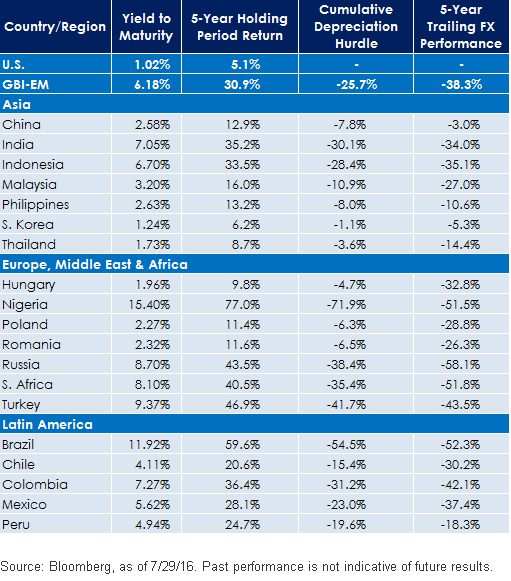
The table above shows that due to higher interest rates in many emerging market countries, foreign currencies would need to depreciate nearly 26% over the next five years for investors to be indifferent between owning a U.S. Treasury bond and EM local debt. While this may appear like an appealing bet, EM currencies have actually declined by over 38% in the past five years, resulting in underperformance of EM local debt compared to Treasuries. In our view, investors would need to experience declines of a similar magnitude in order for performance to rival the previous five years, a period of performance that ranks at the lowest levels of the history of the asset class. In sum, higher-yielding bond markets could provide an additional cushion to help weather declines in foreign currencies against the U.S. dollar. However, a large number of these countries also have meaningful exposure to commodities, which may further complicate the view of their underlying economic strength. While yields in many Asian countries are relatively low compared to other emerging markets, the credit quality of these countries, combined with their comparatively stable currencies, has led to comparatively attractive total returns over the past five years, despite losses in other regions. Ultimately it may be possible for foreign currencies to weaken at a faster pace than the total returns generated from higher interest rates. However, we believe that starting to consider increasing allocations to emerging market debt could yield positive returns for investors focused on the longer-term trend of emerging market growth. While we remain committed to allocations in many emerging markets for the long run, we thought it prudent to re-examine the investment assumptions being made in locally denominated emerging market fixed income. 1Source: J.P. Morgan, 12/31/02–12/31/07.
Important Risks Related to this Article
Investing in emerging markets has been a source of frustration and negative performance since mid-2011. However, performance since February 2016 has shown a marked turnaround.
About the contributor

U.S. Head of Research
Bradley Krom joined WisdomTree as a member of the research team in December 2010. He is involved in creating and communicating WisdomTree’s thoughts on global markets, as well as analyzing existing and new fund strategies. Prior to joining WisdomTree, Bradley served as a senior trader on a proprietary trading desk at TransMarket Group. Bradley is a graduate of the Wharton School, University of Pennsylvania.