


EM Local Debt: A Strong Run with More Room Ahead
Published February 11, 2026

Behnood Noei, CFA
Director, Fixed Income
Key Takeaways
- Emerging market local debt has been one of the strongest fixed income performers, with the J.P. Morgan GBI-EM Global Diversified Composite Index up 21.86% since the start of 2025, supported by a weaker U.S. dollar, attractive carry and improving EM fundamentals that continue to favor allocations today.
- Looking into the first half of 2026, declining EM bond yields, potential further Fed and EM central bank rate cuts, and currency appreciation create a compelling risk-reward setup for EM local debt as growth holds up and inflation trends lower across many countries.
- The WisdomTree Emerging Market Local Debt Fund (ELD) has translated these tailwinds into outperformance through active positioning, particularly its overweight to higher-yielding Latin American issuers such as Brazil, Colombia and Peru, helping it beat the benchmark in 2025 and continue to outperform in 2026.
One of the standout performers in our fixed income lineup so far this year, and over the past twelve months, has been the WisdomTree Emerging Market Local Debt Fund (ELD). The broader emerging market (EM) local debt market has been on a strong run, with the J.P. Morgan GBI-EM Global Diversified Composite Index up 21.86% since the start of 2025. A mix of improving fundamentals across emerging market economies, more supportive central bank policies, and a softer U.S. dollar has helped fuel this rally. In this post, we share our outlook for the sector and take a closer look at how the fund is positioned and how it has performed.
How We Got Here, and Where We Go Next?
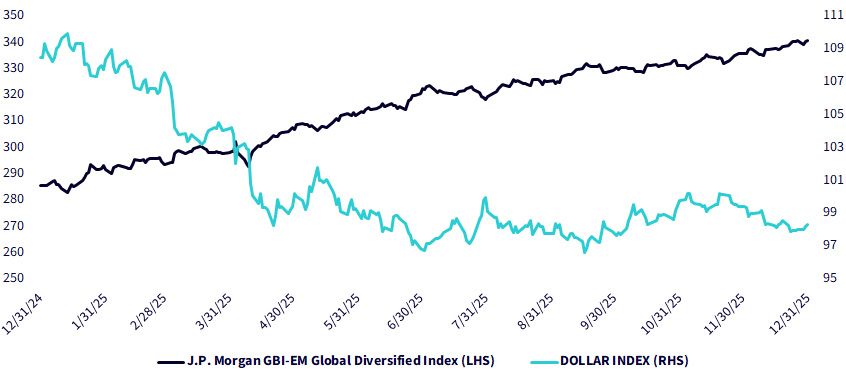
Following a sharp sell-off after the U.S. tariff "Liberation Day" announcement in the first half of 2025, the U.S. dollar remained under pressure for much of the year. Expectations for Federal Reserve rate cuts, which later materialized in the fourth quarter, added to that weakness. A softer dollar, in turn, provided a meaningful tailwind for emerging market currencies, where carry remains attractive and inflation has generally stayed within a stable range across most countries.
Figure 1: Emerging Market Local Debt Has Delivered Strong Returns Amid a Weaker U.S. Dollar
Source: Bloomberg, JPMorgan, as of 12/31/25. You cannot directly invest in an index.
Looking ahead, we expect the strong performance of emerging market local debt to continue through the first half of 2026, supported by both currency appreciation and declining government bond yields. Economic fundamentals across emerging markets remain stable and, in many cases, are improving. Growth has held up, monetary policy credibility remains intact, inflation is trending lower, and external balances are well contained. Risk appetite should stay healthy, helped by additional Federal Reserve rate cuts later in the year. At the same time, we expect further easing from emerging market central banks as policy rates move closer to neutral and the disinflation trend continues.
Several additional factors could support the asset class over the short to medium term. First, emerging market sovereign credit offers the highest exposure to commodities among EM asset classes, including equities, currencies, and corporate credit. We continue to see upside potential in metals such as gold and copper, supported by favorable supply and demand dynamics, even after recent price gains. Second, the recent decline in the U.S. dollar against the Japanese yen is another constructive signal for emerging markets. While it may create some short-term volatility through the unwinding of yen-funded carry trades, the broader takeaway is that a stronger yen tends to weigh on the dollar, which remains a key macro driver for emerging markets overall.
ELD Positioning
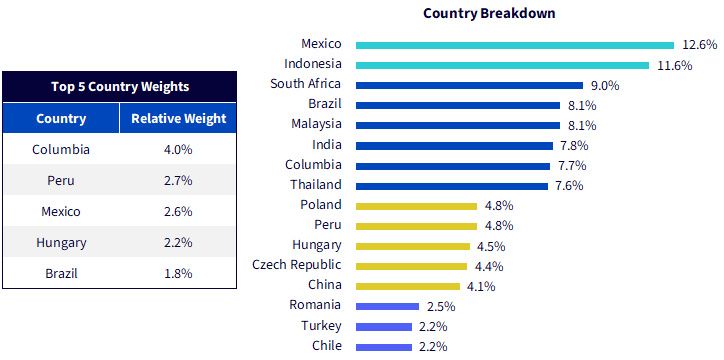
We continue to retain a strategic overweight in Latin America issuers relative to the index and underweights in EMEA and particularly Asian exposures. On average, Latin American issuers offer higher yields with better scores than exposures from the other regions. On an absolute basis, exposure to Latin American and Asian issuers continues to dominate the portfolio.
Figure 2: ELD Portfolio Positioning by Region vs. Benchmark
Source: WisdomTree. Weights as of 12/31/25.
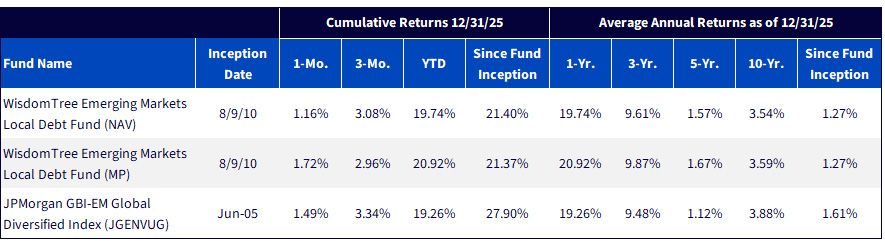
This positioning led the Fund to outperform the index by 49 basis points (bps) after fees and 104bps before fees in 2025. The main contributor to this outperformance was the overweight to Brazil, Columbia, and Peru.
Figure 3: ELD Performance vs. J.P. Morgan GBI-EM Global Diversified Composite Index
Source: WisdomTree, JP Morgan, as of 12/31/25. You cannot directly invest in an index. Past performance is not indicative of future results. Investment return and principal value of an investment will fluctuate so that an investor's shares, when redeemed, may be worth more or less than their original cost. Current performance may be lower or higher than the performance data quoted. For the most recent month-end and standardized performance, click here.
ELD has continued its outperformance in 2026. YTD, the Fund is up by 2.69% in absolute terms and 50bps vs the J.P. Morgan GBI-EM Global Diversified Composite Index.
Conclusion
Emerging market assets, and EM local debt in particular, have delivered an impressive run over the past year. A weaker U.S. dollar, supportive emerging market central banks, and improving country-level fundamentals have all played a role. We believe these conditions are likely to remain in place through 2026, making EM local debt a compelling addition to a diversified fixed income portfolio. That said, as with most asset classes, not all issuers are created equal. Active management is essential to identify opportunities and manage risk, and this is where ELD stands out.
Important Risks Related to this Article
There are risks associated with investing, including possible loss of principal. Foreign investing involves special risks, such as risk of loss from currency fluctuation or political or economic uncertainty. Investments in emerging, offshore or frontier markets are generally less liquid and less efficient than investments in developed markets and are subject to additional risks, such as risks of adverse governmental regulation and intervention or political developments. Derivative investments can be volatile and these investments may be less liquid than other securities, and more sensitive to the effects of varied economic conditions.
Fixed income investments are subject to interest rate risk; their value will normally decline as interest rates rise. In addition, when interest rates fall income may decline. Fixed income investments are also subject to credit risk, the risk that the issuer of a bond will fail to pay interest and principal in a timely manner, or that negative perceptions of the issuer’s ability to make such payments will cause the price of that bond to decline. Due to the investment strategy of this Fund it may make higher capital gain distributions than other ETFs. Please read the Fund’s prospectus for specific details regarding the Fund’s risk profile.
About the contributor

Behnood Noei, CFA
Director, Fixed Income
Behnood Noei serves as Director of Fixed Income at WisdomTree Asset Management, where he develops the firm’s suite of fixed income and currency exchange-traded funds and enhances existing investment processes. Behnood has 11 years investment experience in portfolio management and quantitative research. Prior to joining WisdomTree in 2022, Behnood was a portfolio manager and developer of some of the fixed income ETFs at J.P.Morgan Asset Management, where he was directly responsible for managing more than 7 Fixed Income ETFs and multiple SMAs with more than $13Billion in assets. He graduated from The Ohio State University with Master of Science degree in Finance and is a CFA charter holder.