

EM Dividends: Opportunity from Factor Timing
Published November 11, 2016

Vice President of Strategic Research at Venn by Two Sigma
One hot-button topic that factor investors have recently been exploring is whether various investment factors or investment strategies—such as low-volatility or value investing—can be timed so that the specific investment factor is added when it has the most potential to outperform the market or other factors.
While it’s nearly impossible to predict such market turnarounds, recent discussion has focused on factors that have been out of favor and underperforming over the last three to five years but still have long-term investment merit. In other words, mean reversion of factors would suggest a factor’s returns tend to revert to their average level over longer periods, even if shorter periods can exhibit wide swings.
In some ways, this is a variation of a value-oriented strategy, except that the focus is on applying that value mindset toward factors.
Being curious about which WisdomTree Indexes might show meaningful levels of underperformance relative to the market, we noticed a common asset class among the top culprits: emerging market (EM) dividends.
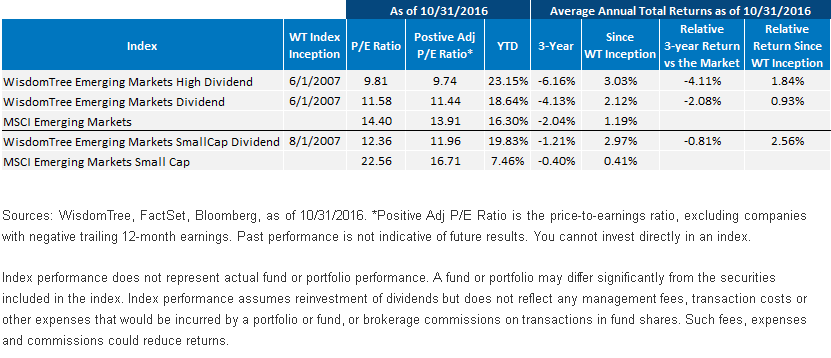
Emerging Markets: Dividend Investing Has Recently Been Out of Favor
While some factor investors have suggested that U.S. high-dividend stocks such as Utilities look expensive after five years of incredibly strong performance, we’d point out that emerging market dividend stocks are on the opposite end of this spectrum.
Three of our broad EM Dividend Indexes—High Dividend, Dividend and SmallCap Dividend—have all exhibited three-year annualized returns that have meaningfully deviated from their historic outperformance relative to their benchmark. These same WisdomTree EM Dividend Indexes have beaten their cap-weighted counterparts going back nine years to the Index live inception dates as well as in our general research prior to their launch. This is evidence that these three-year trends are counter to the observed longer-run merits of their approach.
• For the Emerging Markets Dividend and Emerging Markets SmallCap Dividend Indexes, we observed a spread of over 300 basis points (bps) between their recent three-year underperformance and their average annual outperformance since inception. In the case of the Emerging Markets High Dividend Index, the spread was as large as 596 bps.
• Year-to-date, we have seen some of that momentum reverse in the opposite direction, as all three WisdomTree Indexes have bested their market cap-weighted benchmark, in some cases more than doubling the market’s return.
• It is important to note that the three year annualized returns shown here include any recent outperformance of our EM Dividend Indexes, an indication that if they were to return to more historic outperformance averages, they would still have ground to cover.
We also observed that all three Indexes are trading at a discount relative to the market as measured by their price-to-earnings (P/E) ratios. Interestingly, the WisdomTree Emerging Markets SmallCap Dividend Index, which has more than doubled the MSCI Emerging Markets Small Cap Index’s total return year-to-date, is trading at the largest price-to-earnings discount (45%) relative to its “beta” index, or a 28% discount if we observe the relationship excluding companies with negative trailing 12-month earnings.
Conclusion
Since its launch in January 2001 and through October 2016, the MSCI Emerging Markets Index returned about 9.1% on an annualized basis. Over the last decade, that number shrank to about 3.5%, and over the last three years, the returns have even been negative.
For those who believe in mean reversion of asset classes—and factor investors might want to increasingly consider mean reversion of factor investing strategies—EM dividends as a value investing strategy seem to make a lot of sense.
Important Risks Related to this Article
Investments in emerging, offshore or frontier markets are generally less liquid and less efficient than investments in developed markets and are subject to additional risks, such as risks of adverse governmental regulation and intervention or political developments.
Dividends are not guaranteed, and a company currently paying dividends may cease paying dividends at any time.
Categories
About the contributor
