

ECB QE Favors European Exporters
Published March 17, 2016

Global Head of Research
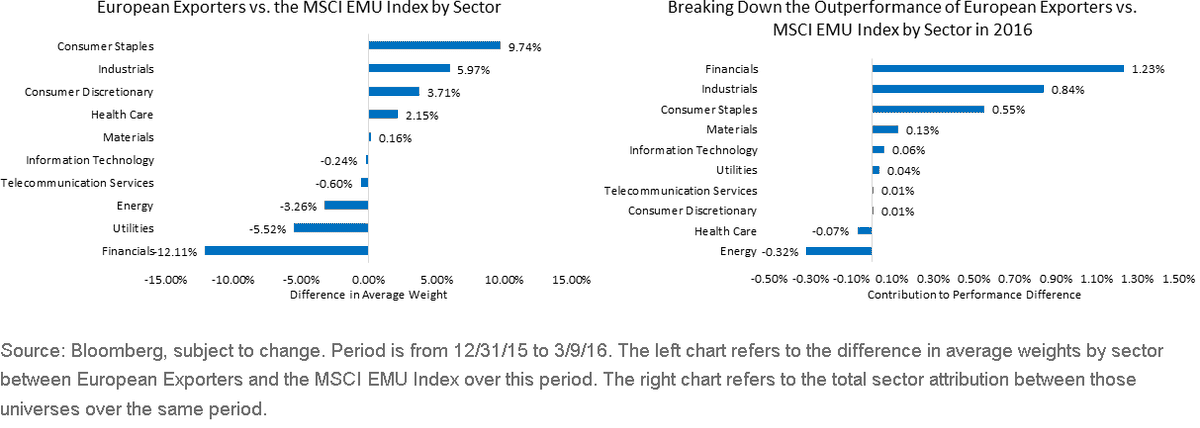
Central bank activity has become one of the most important and influential factors driving markets today. As the U.S. Federal Reserve (Fed) moves toward a policy rate normalization, both the Bank of Japan (BOJ) and the European Central Bank (ECB) are pushing the boundaries with policies that many wouldn’t have considered merely a few years ago. Quantitative Easing (QE) Will Have Important Impacts While it is clear to us that one desired impact of quantitative easing (QE) is rising equity markets, the impact across the different sectors will not be equal. • QE may make it tough for financials: Besides acting as a stimulus to equity markets, other goals of quantitative easing could include an overall lowering of interest rates—on both the long and the short ends of the yield curve. This may not be ideal for the profitability of banks—unless the volume of loans made is enough to counteract the potentially lower profitability per loan. Only time will tell if the velocity of money and aggregate growth in loans will accelerate substantially, whereas we do know that the ECB will be actively exercising its influence to keep interest rates low. • QE may encourage a weaker euro: Let’s face it—currency market behavior does not always cleanly line up with economic rationale. In terms of the exchange rate of the euro measured against the U.S. dollar, it is clear that the monetary policies of the United States and the ECB are moving in different directions. Over the medium to long term, this could serve to encourage a weaker euro compared to the U.S. dollar—making the products and services of European exporters less expensive for U.S. consumers. Over the short term, we have to recognize that currencies can and do exhibit volatility, and they may move in accordance with factors not necessarily related to economic rationale. Bottom Line: The market should not let short-term market volatility—be it in the euro or otherwise—distract it from the unprecedented and extremely aggressive policy prescription that European Central Bank President Mario Draghi announced on March 10, 2016. We are ultimately encouraged by the “whatever it takes” implication and believe that it could ultimately lead to a more positive environment for European equities, even if the road may navigate us through some nearer-term volatility. The Advantage of the Exporter Tilt The WisdomTree Europe Hedged Equity Index (European Exporters) requires eligible constituents to derive at least 50% of their revenues from outside Europe at its annual Index screening. This leads to: • Significant differences in sector exposure compared to the MSCI EMU Index: Most notable is the greater than 12% under-weight to Financials that we have seen thus far in 2016. The large over-weights happen to be in Consumer Staples, Industrials and Consumer Discretionary. Critically, this affords European Exporters the opportunity to outperform if 1) the Financials sector within the eurozone is challenged by the implementation of QE, and 2) Consumer Staples, Industrials and Consumer Discretionary stocks are buoyed by better global growth prospects, a weaker euro exchange rate or some combination. 3) A distinct over-weight to Consumer Staples, a more defensively oriented sector, proves helpful in a volatile market environment. • Outperformance thus far in 2016: As shown in the chart below, even before the March 10 announcement, European Exporters had outperformed the MSCI EMU Index by approximately 2.5% in 2016. The three sectors most responsible for driving this result were 1) Financials, by far the lion’s share, a distinct under-weight to a very challenged sector; 2) Industrials, which were challenged in 2015 but have been performing much better on a relative basis in 2016; and 3) Consumer Staples, a large overweight for European Exporters and an overall defensively oriented sector that may tend to hold up better in volatile market environments. Quantifying the Exporter Advantage
Central Bank Actions Are Here to Stay What we saw on March 10 from the ECB and from the BOJ earlier this year is that global central banks are doing whatever they can to influence markets. It is truly amazing to note that both are employing negative deposit rates. Over time, we will have to see how market dynamics are influenced, and we hope that the fiscal side of the equation can ultimately make its appropriate contribution, taking some of the pressure off monetary policies to carry the full load.
Important Risks Related to this Article
Investments focused in Europe increase the impact of events and developments associated with the region, which can adversely affect performance.
Categories
About the contributor

Global Head of Research
Christopher Gannatti began at WisdomTree as a Research Analyst in December 2010, working directly with Jeremy Schwartz, CFA®, Director of Research. In January of 2014, he was promoted to Associate Director of Research where he was responsible to lead different groups of analysts and strategists within the broader Research team at WisdomTree. In February of 2018, Christopher was promoted to Head of Research, Europe, where he was based out of WisdomTree’s London office and was responsible for the full WisdomTree research effort within the European market, as well as supporting the UCITs platform globally. In November 2021, Christopher was promoted to Global Head of Research, now responsible for numerous communications on investment strategy globally, particularly in the thematic equity space. Christopher came to WisdomTree from Lord Abbett, where he worked for four and a half years as a Regional Consultant. He received his MBA in Quantitative Finance, Accounting, and Economics from NYU’s Stern School of Business in 2010, and he received his bachelor’s degree from Colgate University in Economics in 2006. Christopher is a holder of the Chartered Financial Analyst Designation.