

Do Eurozone Yields Matter Anymore for Treasuries?
Published December 6, 2018

Head of Investment and Fixed Income Strategy

Director, Model Portfolios
Remember when eurozone sovereign debt yields mattered to Treasuries? Back when the U.S. Treasury (UST) 10-year yield was hitting historic lows and any sell-off seemed to be capped, a common justification was that Treasuries still offered a relative yield advantage versus sovereign counterparts such as the 10-year German bund. Interestingly, during this year’s rise in the UST 10-year yield, this argument was conspicuously absent, raising the question: do eurozone yields matter anymore?
Europe’s Role in U.S. Markets
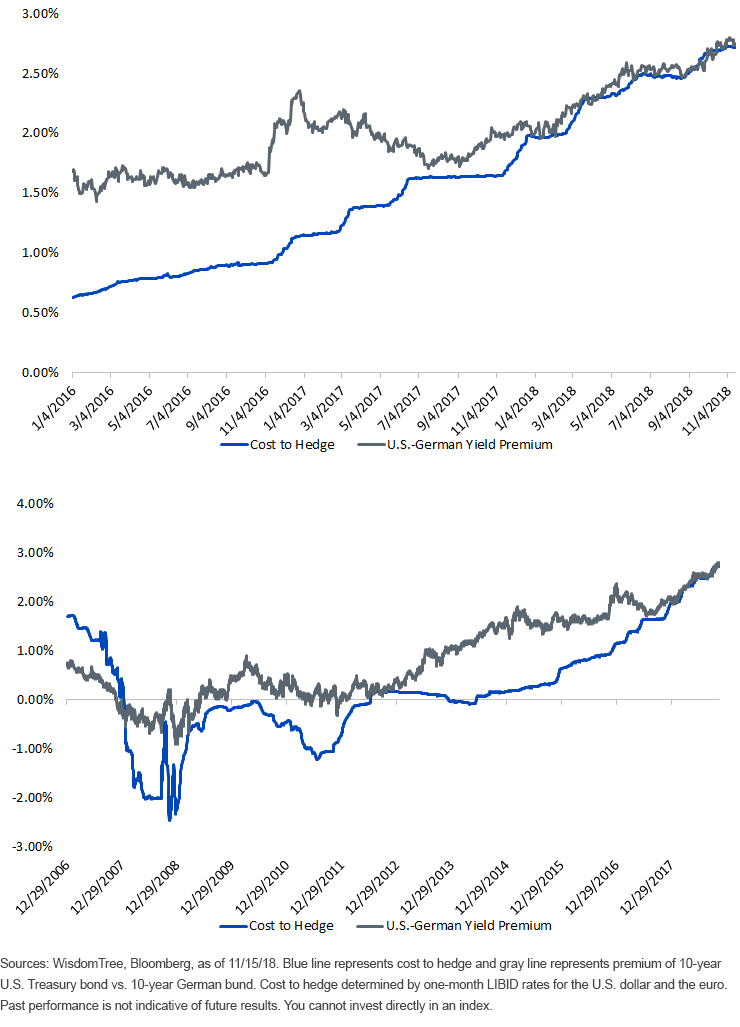
Over the last several years, the European Central Bank’s (ECB) bond purchase program has driven yields lower across Europe, which is clearly evidenced by the divergence between the U.S. and German 10-year yields. Since 2012, this spread has been on a steadily ascending trajectory, reaching an all-time high this year of +280 basis points (bps) in November. However, unlike the past few years’ experiences, this differential did not offer the same degree of support in capping the rise in the UST 10-year yield.
Let’s get some perspective on the whole “yield advantage” aspect of bond trading, as there is more to it than meets the eye. Consider an institutional pension fund or insurance company based in Europe. Thanks to their investment policy statements, many of these investors have required levels of quality investments in their investment portfolios, leaving them with only a handful of options from which to choose throughout the globe. Becuse these investors have gotten barely anything out of bunds, many have gone to U.S. Treasuries for their higher yields.
Of course, there is a hedging cost involved in this cross-Atlantic transaction, which is based on the difference between short-term interest rates in U.S. and Europe (just as U.S. investors are currently paid to hedge euro exposure, the opposite is true for European investors and the dollar). And because the Federal Reserve (Fed) is raising short-term rates at the same time the ECB is locked-in at negative rates, it is becoming more and more expensive for European investors to hedge U.S. dollar exposure when investing in U.S. securities.
Since the Fed started its rate hike cycle at the end of 2015, this increasing hedging cost was something European investors would happily pay, as long as the yield premium of Treasuries over bunds made up for it. That was the case for several years—that is, until earlier this year.
Close, but No Cigar
Ever since the financial crisis, the U.S.-German yield premium has remained above the hedging cost—almost to a suspicious degree, in fact. This year, as the cost and premium have come to a head, the two figures have floated right on top of one another. This post-hedging yield premium came incredibly close to turning negative a few times in the post-crisis era but could never quite sustain a sub-zero level. Like clockwork, every time the hedging cost nudged up, investors backed away from Treasuries or bought bunds until the yield premium paid for itself. We find it hard to imagine this is a coincidence.
U.S.-German Yield Premium vs. Cost to Hedge—Since 2007 and Last Three Years
Where We Go from Here
The ECB has telegraphed a close to its new bond purchase program at the end of the year, but will still buy bonds in order to keep its balance sheet holdings constant. This could keep a ceiling on European yields. It is also our view that the ECB may not raise rates until its current president, Draghi, leaves in October 2019. On the flipside, the Fed is likely to raise rates in December 2018, with the Fed’s latest median projection geared towards three additional hikes in 2019.
These two counteracting monetary forces will continue to drive up the cost of hedging the dollar for European investors. Based on what we’ve observed, with the interest rate differential continuing to widen, we expect the U.S.-German yield premium to follow suit. In the past, that meant either Treasuries sold off, or bunds rallied. Certainly, there are many other dynamics to watch when trying to discern UST rate trends, but the yield advantage landscape has definitely been altered.
Either way, in the lead-up to the Fed meeting, and its aftermath, we have a fascinating few months ahead in bond land.
Categories
About the contributors

Head of Investment and Fixed Income Strategy
Kevin serves as the Head of Investment and Fixed Income Strategy. In this role, he writes macro and fixed income-related content and works closely with the sales, research and marketing teams. In addition, Kevin conducts client-facing webinars and meetings, providing expertise on WisdomTree’s existing and future bond ETFs. Prior to joining WisdomTree, Kevin spent 30 years at Morgan Stanley, where he was Managing Director and Chief Fixed Income Strategist for Wealth Management. He was responsible for tactical and strategic recommendations and created asset allocation models for fixed income securities. He was a contributor to the Morgan Stanley Wealth Management Global Investment Committee, primary author of Morgan Stanley Wealth Management’s monthly and weekly fixed income publications, and collaborated with the firm’s Research and Consulting Group Divisions to build ETF and fund manager asset allocation models. Kevin has an MBA from Pace University’s Lubin Graduate School of Business, and a B.S. in Finance from Fairfield University.

Director, Model Portfolios
Joe Tenaglia joined WisdomTree as Asset Allocation Strategist in 2016. He is responsible for building and managing WisdomTree’s CIO-managed and custom model portfolios. In this role he focuses on asset allocation, security selection, and portfolio construction for the firm’s open architecture models, with objectives ranging from strategic to tactical. Joe sits on WisdomTree’s Model Portfolio Investment Committee, which oversees the firm’s ETF models and helps shape and communicate WisdomTree’s thoughts on the markets. Prior to joining WisdomTree, he held roles at Emerging Global Advisors (acquired by Columbia Threadneedle) and BNY Mellon. Joe received his B.S. in Finance and Marketing from Boston College. He is a holder of both the Chartered Financial Analyst designation and Chartered Market Technician designation.