

Currency Hedging: Re-Examining Costs After 5 Rate Hikes
Published February 5, 2018

U.S. Head of Research
On January 31, the Federal Open Market Committee of the Federal Reserve (Fed) voted to maintain the Federal Funds Rate target of 1.25% to 1.50%. As we transition from the Yellen Fed to the Powell Fed, we thought it could be instructive to re-examine the cost of hedging foreign currencies versus the U.S. dollar. Despite moves to the contrary this year, divergence in monetary policy can have a strong impact on the future direction of exchange rates. In our view, as the U.S. continues to raise interest rates and tighten policy, an investor is paid an increasing amount of embedded income to hedge foreign currencies because of the widening of interest rate differentials between the U.S. and foreign markets.
Rate Outlook
Most forecasters see the Federal Reserve hiking rates three times in 2018. In Europe and Japan, while debates are intensifying about the need to maintain current levels of accommodative policy, many in the market believe that rate hikes will occur at a faster rate than in the United States in 2018. As a result, it seems likely that the Federal Funds Rate may rise to between 2.00% and 2.25%, while rates remain low (read negative) in Europe and Japan. This monetary divergence represents considerable costs at the short end. In the chart below, we highlight the differential between 1 month bank borrowing rates in the U.S. against Europe and Japan.
Carry Increases for Dollar-Based Investors
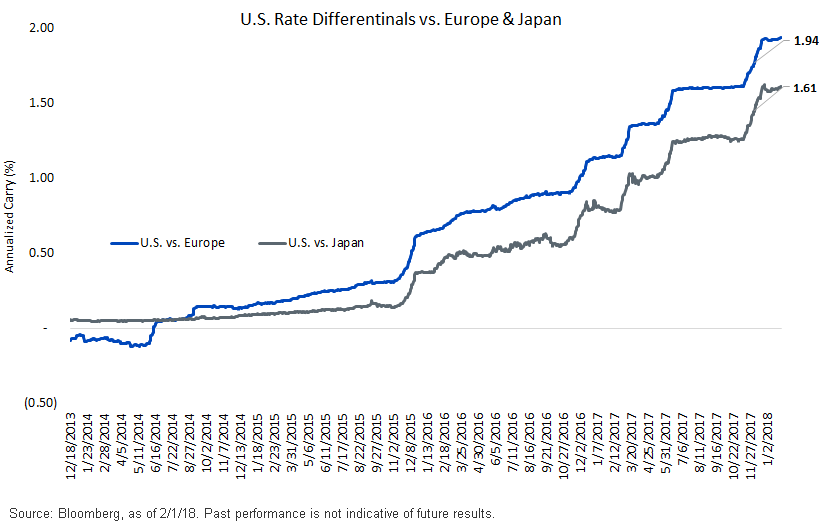
A question we’ve fielded frequently is, what is the cost for an investor to hedge foreign exchange? As this chart shows, the primary driver of the cost of hedging is the relative interest rates in both markets. Since 2014, many investors have actually been able to generate positive carry by hedging euro and yen versus the U.S. dollar—and by increasing amounts. As the Fed continues to raise rates, the amount of interest investors receive for owning dollars increases. Similarly, our research has also shown that as interest rates rise in the U.S. versus foreign markets, the currency tends to appreciate as investors exchange negative-yielding currencies such as euros and yen for higher-yielding U.S. dollars. For strategies like the WisdomTree Europe Hedged Equity Fund (HEDJ) and the WisdomTree Japan Hedged Equity Fund (DXJ), weaker exchange rates often translate into increases in earnings expectations.
Net Portfolio Impact
While the euro and the yen are the most followed currency pairs by U.S. investors, rising short-term rates would have an impact on all currencies. Below, we highlight the cost of hedging for commonly followed equity benchmarks as well as select emerging markets. Given that many EM countries have much higher short-term rates than the U.S., the cost of hedging can at times be significant. However, given that the euro and yen dominate most developed market equity allocations, the carry advantage remains firmly tilted in U.S. investors’ favor.
Estimated Cost of Hedging Inferred through Global Money Market Rates (12/31/2017)
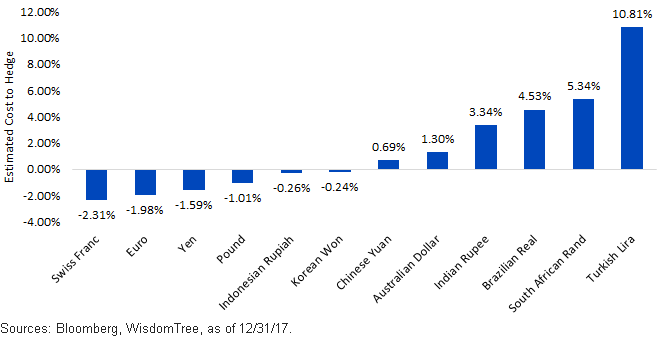
In our view, investors remain far too complacent about the role that currency risk plays in portfolios. Similarly, if investors do not currently have a view on the direction of the U.S. dollar, it may make sense to hedge. This rationale is twofold: Hedged positions generate positive carry and isolate local asset returns. While bearing currency risk has added to returns in 2018, there is no guarantee that this will continue. With rate differentials firmly in U.S. investors’ favor, hedging seems prudent as investors consider changes to their portfolios in 2018.
Important Risks Related to this Article
There are risks associated with investing, including possible loss of principal. Foreign investing involves special risks, such as risk of loss from currency fluctuation or political or economic uncertainty. Investments in currency involve additional special risks, such as credit risk and interest rate fluctuations. The Funds focus their investments in Europe and Japan, thereby increasing the impact of events and developments in Europe and Japan that can adversely affect performance. Derivative investments can be volatile, and these investments may be less liquid than other securities, and more sensitive to the effects of varied economic conditions. As these Funds can have a high concentration in some issuers, the Funds can be adversely impacted by changes affecting those issuers. Due to the investment strategy of each Fund, it may make higher capital gain distributions than other ETFs. Please read the Fund’s prospectus for specific details regarding the Fund’s risk profile.
Categories
About the contributor

U.S. Head of Research
Bradley Krom joined WisdomTree as a member of the research team in December 2010. He is involved in creating and communicating WisdomTree’s thoughts on global markets, as well as analyzing existing and new fund strategies. Prior to joining WisdomTree, Bradley served as a senior trader on a proprietary trading desk at TransMarket Group. Bradley is a graduate of the Wharton School, University of Pennsylvania.